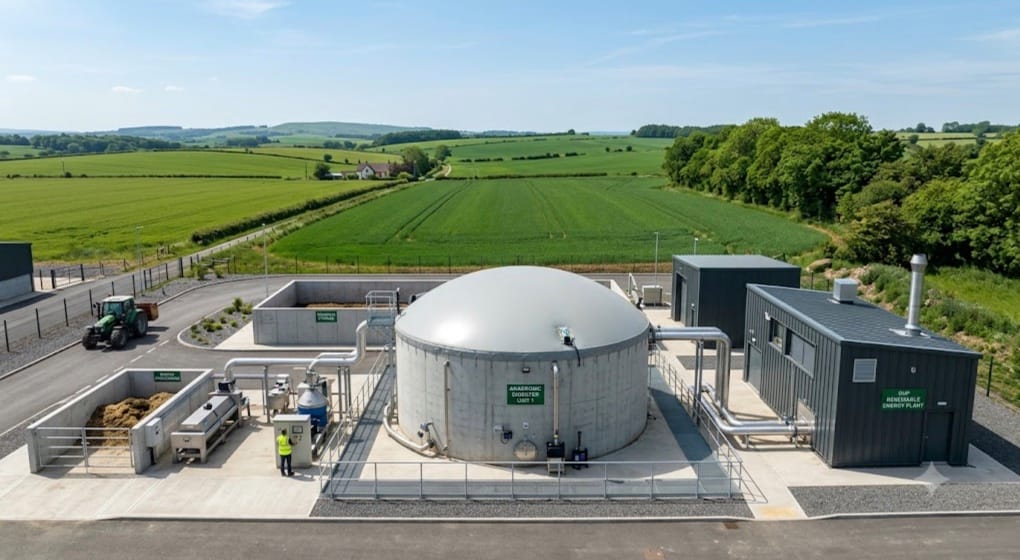
Biogas systems convert dairy manure and other suitable organic material into renewable energy through anaerobic digestion. A complete dairy system usually includes manure collection, pretreatment, a digester, gas handling, energy equipment, digestate storage, and nutrient management.
For beginners, the process is easier to understand as one material flow:
Collect → Pretreat → Digest → Capture gas → Use energy → Manage digestate
A digester is therefore not a standalone waste machine. Its performance depends on the manure entering it and on how the farm uses the gas and digestate afterward.
The U.S. EPA’s AgSTAR program reported that manure-based anaerobic digestion projects in the United States produced energy equivalent to about 3.29 million MWh of electricity in 2023.
Quick Answer: How Does a Dairy Biogas System Work?
| Stage | Main Equipment | Main Purpose |
|---|---|---|
| Manure collection | Scraper, pump, flush | Move manure from barns |
| Pretreatment | Screen, sand removal, separator | Control unwanted material |
| Digestion | Anaerobic digester | Produce biogas + digestate |
| Gas treatment | Moisture/H₂S removal | Prepare gas for use |
| Energy conversion | CHP, boiler, RNG upgrading | Produce electricity, heat or fuel |
| Digestate separation | Separator | Divide liquid and solids |
| Storage | Tank, lagoon | Hold nutrients before use |
| Land application | Tanker/injection equipment | Return nutrients to crops |
The main lesson is simple: successful biogas systems begin with good dairy manure management, not with choosing the digester.
1. How Should Dairy Manure Be Collected Before Anaerobic Digestion?
Anaerobic digestion works best when the farm can supply a predictable manure stream.
EPA AgSTAR notes that digestion is particularly suited to farms that regularly collect liquid, slurry, or semi-solid manure at a common point, preferably every day or every other day. Bedding, stones, sand, and other materials can influence digester suitability and pretreatment requirements.
EPA AgSTAR – Is Anaerobic Digestion Right for Your Farm?
Common Dairy Manure Collection Methods
| Collection Method | Typical Manure | Automation | General Digester Fit* |
|---|---|---|---|
| Tractor scraping | Slurry/semi-solid | Low | Good |
| Automatic scraper | Slurry | High | Very good |
| Flush system | Diluted liquid | High | System-dependent |
| Vacuum collection | Liquid/slurry | Medium | Good |
| Slatted floor/pit | Liquid/slurry | High | Good |
| Deep bedding removal | High solids | Low | More pretreatment |
*General planning comparison. Actual compatibility depends on manure solids, bedding, water addition, climate, and digester technology.
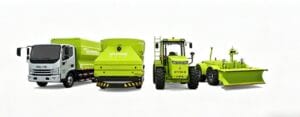
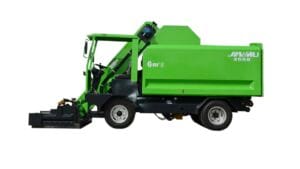
An automatic scraper can be particularly useful where frequent manure removal is needed. Instead of waiting for a tractor to make several large cleaning rounds, manure can be collected at scheduled intervals.
For digestion, that consistency can simplify material handling.
Why Bedding and Sand Matter
Bedding cannot be ignored when planning a digester.
Sand is especially important because it can settle inside pits and tanks, increase wear on pumps, occupy storage volume, and complicate material handling.
Penn State’s research dairy provides a useful real-world example. Its manure and sand are scraped twice daily before passing through sand-separation equipment as part of the manure-management process.
Penn State Extension – Penn State Digester
This does not mean every sand-bedded dairy needs the same equipment. It shows why bedding should be considered before the digester is selected.
Think of the system as:
Barn → Collection → Sand/debris control → Digester
When Is a Manure Separator Needed?
A manure separator divides the manure stream into liquid and solid fractions. Depending on the project, separation may occur before or after digestion.
| Farm Condition | Why Separation May Help |
|---|---|
| High coarse-solid content | Improves downstream handling |
| Recoverable fiber | Creates a separate solids stream |
| Pumping difficulties | Reduces troublesome solids |
| Digestate treatment | Separates liquid and solid outputs |
| Bedding recovery plan | May provide reusable material* |
*Recovered material requires appropriate treatment, hygiene management, and compliance with local requirements before reuse.
A separator does not make manure nutrients disappear. It mainly changes how solids, liquids, and nutrients move through the system.
The objective of pretreatment is simple:
Deliver a predictable manure stream while controlling materials that could interfere with the digester.
2. How Do Biogas Systems Turn Dairy Manure Into Energy?
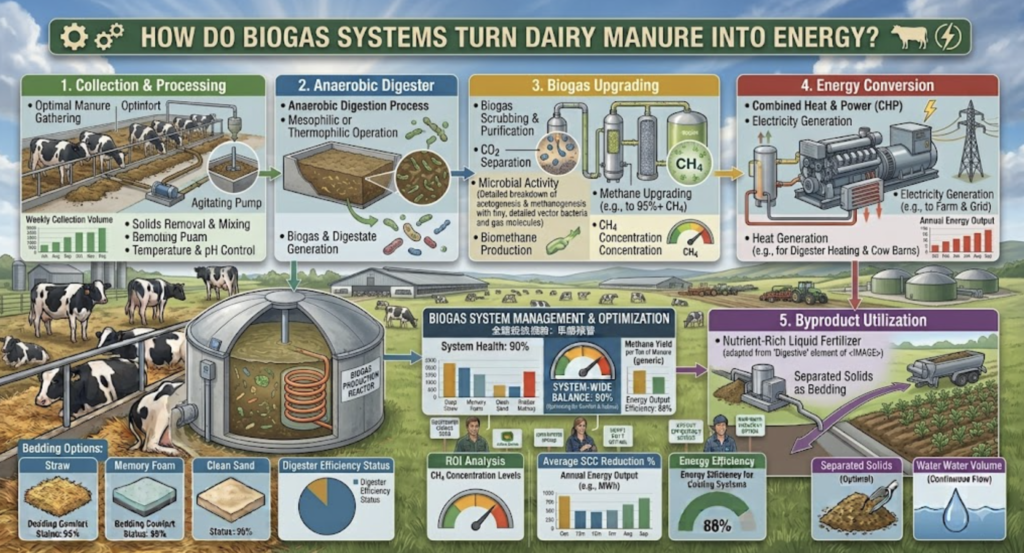
Inside an anaerobic digester, microorganisms break down biodegradable organic material without oxygen. The process produces biogas, which contains energy-rich methane, and digestate, which retains much of the manure’s nutrient content.
The basic process is:
Manure → Anaerobic digester → Biogas + Digestate
The gas then needs to be collected and prepared for its intended use.
Main Types of Dairy Digesters
| Digester Type | Typical Feedstock | Main Characteristic | Main Consideration |
|---|---|---|---|
| Covered lagoon | Dilute manure | Covered storage/digestion | Climate and manure dilution |
| Plug-flow | Thicker manure | Material moves through reactor | Consistent solids |
| Complete mix | Pumpable slurry | Heated, mixed reactor | More mechanical equipment |
| Advanced/custom | Variable | Project-specific | Greater complexity |
There is no single “best” digester.
Selection depends on manure volume, solids content, bedding, climate, temperature, water addition, organic loading, co-digestion plans, and the farm’s ability to operate the equipment.
What Can Dairy Biogas Be Used For?
Raw biogas may require moisture removal, hydrogen sulfide control, and other treatment before use.
The final route generally looks like this:
Biogas → Boiler → Heat
Biogas → CHP → Electricity + Heat
Biogas → Upgrading → Renewable Natural Gas (RNG)
| Energy Route | Product | Possible Farm Use |
|---|---|---|
| Boiler | Heat | Hot/process water |
| CHP | Electricity + heat | Farm electricity + thermal energy |
| Generator | Electricity | Farm/grid |
| Gas upgrading | RNG | Pipeline/transport fuel |
| Direct gas use | Thermal energy | Suitable heating processes |
EPA AgSTAR identifies electricity, thermal energy, and upgraded renewable natural gas among the potential uses of captured biogas.
EPA AgSTAR – Market Opportunities
How Much Energy Can a Dairy Digester Produce?
There is no reliable universal kWh-per-cow number.
Manure collection, cow diet, co-digestion, digester technology, methane yield, generator efficiency, parasitic energy use, and uptime all influence production.
EPA’s Livestock Anaerobic Digester Database illustrates how different real projects can be.
| EPA Project Example | Dairy Animals | Reported Biogas | Reported Electricity |
|---|---|---|---|
| AA Dairy, New York | 520 | 42,868 ft³/day | 613,000 kWh/year |
| ABEC Bidart-Old River, California | 15,500 | 600,000 ft³/day | 16.206 million kWh/year |
EPA – Livestock Anaerobic Digester Database
These are project examples, not production benchmarks.
For early planning, electricity can be estimated in one line:
Annual electricity = Generator capacity × Operating hours × Load factor
Example:
250 kW × 8,000 hr/year × 90% = 1,800,000 kWh/year
This is an illustrative calculation only. Actual electricity production depends on available biogas, methane concentration, engine efficiency, downtime, and the electricity consumed by the digester itself.
3. What Happens to Manure After Anaerobic Digestion?
Anaerobic digestion does not make manure disappear.
Part of the biodegradable organic material is converted into biogas, while digestate remains.
That digestate still contains water, solids, nitrogen, phosphorus, potassium, and other nutrients that need to be managed.
What Is Digestate?
Digestate is the material remaining after anaerobic digestion.
Depending on the farm’s system, it can be stored as a combined material or passed through separation equipment.
| Output | Main Characteristic | Potential Management Route |
|---|---|---|
| Biogas | Methane-rich gas | Energy |
| Solid digestate | Higher solids | Bedding*, compost, soil use |
| Liquid digestate | Pumpable, nutrient-containing | Storage + crop application |
*Reuse as bedding depends on treatment, hygiene, farm practices, and applicable requirements.
Solid vs. Liquid Digestate
A manure separator may be used after digestion when the farm wants to divide digestate into two easier-to-manage streams.
The solid fraction can potentially be handled separately, while the liquid fraction remains pumpable for storage and nutrient application.
The appropriate arrangement depends on the complete manure system rather than the separator alone.
Nutrient Management After Digestion
This is one of the most important points for beginners:
Digestion produces energy, but nutrient management remains necessary.
USDA’s Economic Research Service notes that manure applied according to crop nutrient needs can substitute for some commercial fertilizer while supplying nutrients to agricultural land.
The complete flow is therefore:
Barn → Collection → Digestion → Separation → Storage → Crop application
Storage capacity, nutrient testing, application timing, available land, transport distance, runoff risk, and local environmental requirements should all be considered.
A digester changes manure characteristics. It does not remove the farm’s responsibility for nutrients.
4. Are Biogas Systems Profitable for Dairy Farms?
Biogas systems can contribute to dairy farm profitability, but there is no universal payback period.
Returns depend on capital cost, financing, manure availability, plant uptime, electricity or RNG prices, incentives, maintenance, labor, co-digestion opportunities, and other revenue.
Where Does Biogas Revenue Come From?
| Value Source | Potential Value |
|---|---|
| Electricity | Farm use or grid sale |
| Heat | Reduced purchased heating energy |
| RNG | Pipeline or transport-fuel market |
| Avoided energy purchases | Lower utility/fuel cost |
| Tipping fees | Eligible co-digestion feedstocks |
| Recovered solids | Bedding or other use |
| Renewable/environmental credits | Market-dependent |
| Nutrient value | Potential fertilizer substitution |
The economic mix varies by location.
One dairy may focus on CHP electricity while another project may depend primarily on RNG sales. A third may benefit from co-digestion or avoided bedding and energy expenses.
How to Calculate Biogas ROI
A useful first calculation is:
Annual net benefit = Energy value + Other revenue + Avoided costs − Annual operating costs
Then:
Simple payback = Net installed investment ÷ Annual net benefit
Consider a hypothetical project:
| Item | Planning Example |
|---|---|
| Net installed investment | $2,000,000 |
| Energy value | +$180,000/year |
| Other revenue | +$120,000/year |
| Avoided costs | +$50,000/year |
| Operating & maintenance | −$140,000/year |
| Annual net benefit | $210,000/year |
| Simple payback | 9.52 years |
Calculation:
$180,000 + $120,000 + $50,000 − $140,000 = $210,000/year
$2,000,000 ÷ $210,000 = 9.52 years
This is an illustrative financial example, not an industry benchmark.
A real feasibility study should also consider financing costs, taxes, depreciation, equipment replacement, inflation, energy-price changes, incentives, and expected project life.
What Can Make a Project Unprofitable?
Five factors deserve particular attention:
- Low plant uptime — revenue falls when the digester, gas equipment, or generator frequently stops.
- Expensive gas treatment — cleaning and upgrading can become a major operating cost.
- Inconsistent manure supply — poor feedstock control can hurt process stability.
- Weak energy/offtake pricing — producing gas has limited value without a good use or buyer.
- Underestimated maintenance — pumps, mixers, engines, separators, controls, and gas equipment all require service.
For dairy farm profitability, the question is not simply:
“How much biogas can we produce?”
A better question is:
“What is each unit of usable energy worth after the cost of producing it?”
5. How Do You Know If a Biogas System Fits Your Dairy?
Start with the farm, not the equipment brochure.
A technically impressive digester can still be a poor investment if manure collection is unsuitable, digestate has nowhere to go, or the farm has no valuable energy market.
10-Question Biogas Readiness Checklist
| Question | Why It Matters |
|---|---|
| How much manure is collected daily? | Determines feedstock supply |
| What is its solids content? | Helps select technology |
| What bedding is used? | Determines pretreatment needs |
| Is manure collected centrally? | Reduces handling complexity |
| Is separation required? | Controls sand/solids |
| How will biogas be used? | Defines energy equipment |
| What is the energy/offtake price? | Drives revenue |
| How will digestate be managed? | Determines nutrient plan |
| Who will operate/service it? | Affects reliability |
| What happens during shutdown? | Farm still produces manure |
The last question is particularly important.
Even when a digester stops, cows continue producing manure. The dairy manure management system therefore needs emergency or bypass capacity.
Five Common Biogas Project Mistakes
- Choosing the digester before studying manure flow — design the technology around the actual manure stream.
- Ignoring sand and bedding — solve pretreatment issues before construction.
- Treating biogas as free energy — pumps, gas cleaning, engines, controls, and maintenance consume energy and money.
- Forgetting digestate — nutrients still require storage and responsible use.
- Building without an energy buyer or use — confirm electricity, heat, or RNG value before calculating ROI.
Frequently Asked Questions
What is a dairy farm biogas system?
A dairy biogas system uses anaerobic digestion to convert biodegradable material in manure into biogas and digestate. The gas can be used for heat, electricity, or upgraded to RNG.
Does a biogas digester eliminate manure?
No. Digestate remains after digestion and still requires storage, separation, nutrient management, or land application.
How many cows are needed for a biogas system?
There is no universal minimum herd size. Feasibility depends on manure volume, collection method, digester technology, co-digestion opportunities, energy value, incentives, financing, and operating costs.
Does every dairy digester need a manure separator?
No. A manure separator is used when solids handling, bedding, sand, pumping, storage, or digestate-management requirements make separation useful.
Are biogas systems profitable?
They can be, but profitability is project-specific. A farm should calculate installed cost, financing, uptime, operating expenses, energy revenue, incentives, and other potential income before investing.
Engineering, Safety and Environmental Note
The energy outputs, equipment arrangements, financial examples, and comparisons in this guide are planning references rather than universal engineering specifications.
Final projects require site-specific evaluation of manure quantity and solids, bedding, digester loading, gas production, gas treatment, storage, electrical or pipeline connections, nutrient management, fire and gas safety, environmental permitting, and local regulations.
Qualified engineering, environmental, utility, and safety professionals should be involved before construction or major investment.
Conclusion
Successful biogas systems start with reliable manure management rather than the digester itself. A farm needs consistent collection, suitable pretreatment, a realistic energy market, and a practical plan for digestate and nutrients.
An automatic scraper can support consistent collection, while a manure separator may help control solids or sand depending on the project. The digester can then convert part of the manure’s organic material into useful renewable energy.
The decision path is:
Manure supply → Pretreatment → Digester → Energy market → Digestate plan → ROI
When those pieces work together, dairy manure management can support renewable energy, dairy farm profitability, and more resource-efficient future dairy farming.
Recommended Resources
- Dairy Farm Machine – Dairy Farm Equipment
- EPA AgSTAR
- EPA – Anaerobic Digestion on Dairy Farms
- EPA – Livestock Anaerobic Digester Database
- USDA ERS – Manure Management
- Penn State Extension – Dairy
- International Dairy Federation (IDF)
- FAO – Dairy Production and Products
- National Dairy FARM Program
- Journal of Dairy Science
- Progressive Dairy
- Dairy Herd Management