A feeding system is only as efficient as its full route from ingredient storage to the bunk. A self propelled TMR mixer can combine several jobs in one machine, while a trailed setup can make better use of a tractor and loader already on the farm. Neither is automatically the better purchase. Compare the complete cycle, the supporting assets, and the delays that actually occur on your site—not just the mixer itself. This guide focuses on that workflow decision; for the underlying machine and ration process, see this TMR mixer.
Self Propelled TMR Mixer or Trailed Mixer: The Short Answer
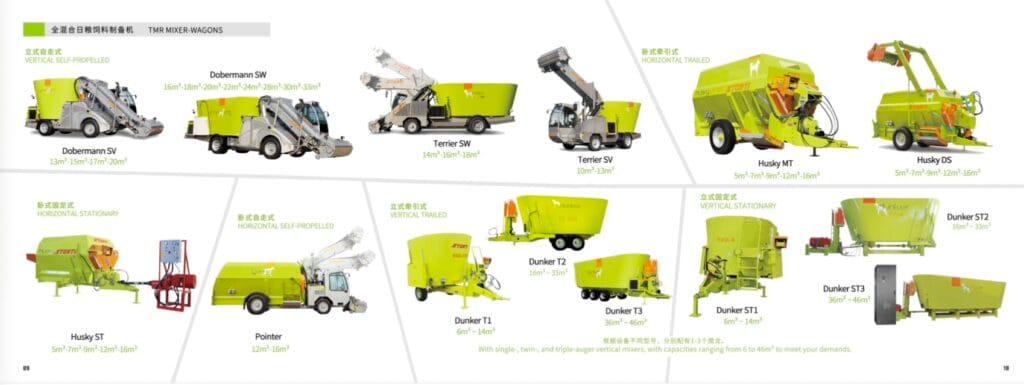
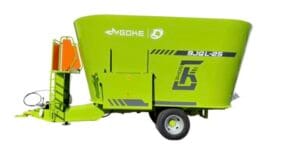
A self-propelled TMR mixer carries its own propulsion system; a conventional trailed mixer is powered and moved by a tractor. That mobility label alone does not say what loading, chopping, mixing, or discharge equipment is fitted. In particular, self-propelled does not automatically mean self-loading; check the installed loading system on the quoted machine. EN 703:2021 treats these functions separately. Regler et al. tested tractors with trailed mixers and a simulated electric-motor operating pattern, so it cannot establish a complete-system energy or cost winner.
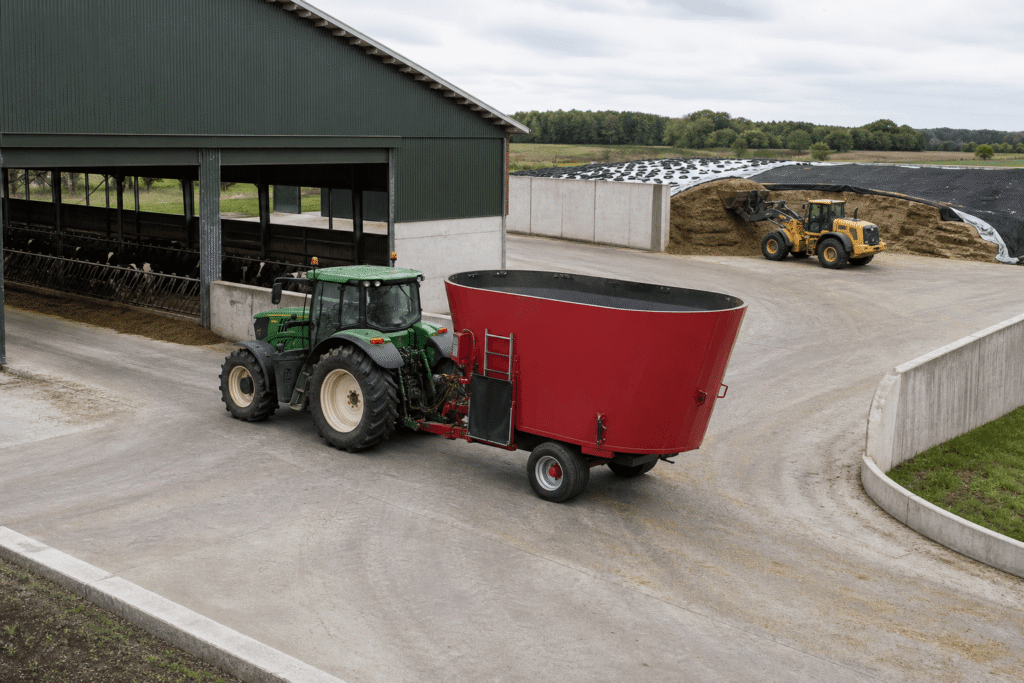
The useful TMR mixer comparison is therefore a system comparison. An integrated unit can load or extract ingredients, mix, travel, and discharge in one machine. A trailed system commonly pairs a tractor and mixer wagon with a loader, although stationary loading changes that sequence. Moallem and Lifshitz The better fit depends on daily batches, ingredient layout, tractor conflicts, route access, service support, and what happens if one asset stops.
How the Two Feeding Workflows Differ
Self-Propelled Workflow: Load, Mix, Travel, and Feed
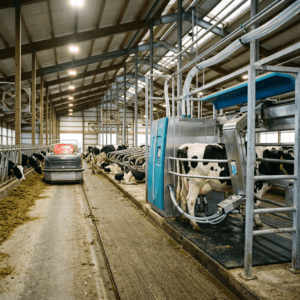
When a self-propelled TMR mixer has integrated loading, one batch can move from forage face or ingredient store to loading, weighing, mixing, travel, and bunk discharge without a transfer to another machine. That integration may simplify handoffs, but it is not evidence of a fixed labor saving: storage position, number of ration groups, travel distance, cleaning, and delays still set the day’s work. Cornell PRO-DAIRY
Trailed Workflow: Coordinate Mixer, Tractor, and Loading Method
With a trailed feed mixer, a tractor supplies motion and PTO power while a loader, telehandler, or stationary system supplies ingredients. The sequence can require a machine change or a second operator, but it can also let the farm reassign the tractor or loader outside feeding. Record the actual loading method before judging either route.
| Batch step | Integrated self-propelled package | Trailed package | Supporting-machine question |
|---|---|---|---|
| Load/extract | May be onboard | Loader or stationary system commonly used | Is loading included and available? |
| Mix/weigh | On the mixer | On the mixer, tractor PTO drives it | Are scales and controls maintained? |
| Travel | Machine drives itself | Tractor pulls mixer wagon | Does another task need the tractor? |
| Discharge | Machine discharges at bunk | Mixer wagon discharges at bunk | Does clearance suit the feed alley? |
| Operator transfer | May remain in one cab | May coordinate tractor and loader | How many handoffs occur per batch? |
The table identifies movements rather than a winner. Time each step across representative feeding days, including waits and cleanup. A self-propelled unit can reduce transfers when its installed functions match the route; a trailed mixer can be equally direct where loading is fixed and the tractor is free.
Side-by-Side Comparison for Daily Dairy Work
Labor, Movements, and Feeding Schedule
Instead of accepting a claimed saving, build a time log for a representative day: batches, minutes for every step, labor hours, waiting, and conflicts with other work. Repeat it on days with several ration groups. Independent examples show that labor is shaped by layout and operating practice, not propulsion alone. Cornell PRO-DAIRY
Building Access, Traction, and Travel Routes
Walk each proposed route with a tape and site plan: narrow passages, doors, overhead clearance, turns, slopes, surface condition, discharge clearance, and travel between feed center and barns. Teagasc offers a useful measurement mindset, not universal dimensions. Confirm candidate limits and local road rules; EN 703 does not itself establish travelling stability, traction, braking, or road suitability. EN 703:2021
Maintenance, Downtime, and Feed-Quality Controls
For a trailed feed mixer, assess tractor PTO, hydraulics, loaded weight, ballast, braking, terrain, and both manuals—not tractor horsepower in isolation. Iowa State University Extension For either design, downtime means the whole chain: tractor/loader/mixer availability versus propulsion, mixer, and installed loader availability. Ask each supplier who responds, what parts are stocked, and what backup can feed cattle that day.
| Criterion | Self-propelled system | Trailed system |
|---|---|---|
| System assets | Dedicated drive and mixer; may include loader | Tractor, mixer wagon, plus loading method |
| Workflow steps | Can consolidate functions | Can separate loading and feeding work |
| Operator transfers | Potentially fewer | May require coordination or a second machine |
| Site fit | Check dimensions, traction, and route | Check tractor-plus-wagon geometry and route |
| Travel | Self-driven between tasks | Tractor provides travel |
| Tractor dependence | Not for propulsion | Central dependency |
| Maintenance concentration | More functions in one asset | Service divided across assets |
| Downtime/backup | Need dedicated contingency plan | Fleet may provide flexibility, if compatible |
| Quality controls | Scales, load order, time, wear matter | Same controls matter |
| Best-fit pattern | High use with verified integrated workflow | Existing compatible fleet or flexible use |
This matrix is a due-diligence list, not a scorecard. A self propelled TMR mixer still needs the same ration controls: ingredient weights, dry matter, particle size, loading order, mixing time, scale condition, wear, and operator practice. Penn State Extension One 216-cow comparison found some preparation advantages for its tested self-propelled loading system, but it cannot settle every farm’s purchase. Moallem and Lifshitz Avoid copying a fill level from another mixer: a 21 m³ study tested 40%, 70%, and 100% loading levels for one wagon and ration. Costa et al.
Keep guards fitted, stop and isolate before clearing or servicing, exclude people from moving equipment, and manage PTO, conveyors, moving vehicle, and fall hazards as the manual and local rules require. UK HSE
Compare Total Cost with Your Own Farm Data
Build an Annual Whole-System Cost
Do not compare invoice price alone. Machinery-cost guidance separates ownership from repairs, fuel, lubrication, labor, and other operating costs; apply those categories to every asset used in the feeding chain. Mississippi State University Extension Allocate the tractor and loader fairly when they serve several jobs. That broader inventory is part of planning dairy farm equipment, not an extra cost to ignore.
Normalize Cost and Workload
Use farm records and quotes in local currency. First calculate batches/day = ceiling(total as-fed kg/day ÷ verified usable kg/batch). Then log daily process minutes = Σ(loading + mixing + travel + discharge + setup/cleaning + delays). Annual system cost is ownership + supporting-machine allocation + labor + fuel/energy + maintenance + other recurring + downtime allowance; divide it by annual tonnes as-fed delivered for cost per tonne. Usable batch must respect payload, the manual, ration bulk density, and uniformity checks.
| Input | Self-propelled | Trailed | Evidence class |
|---|---|---|---|
| Ownership/finance per year | Enter farm value | Enter farm value | Dealer quote / farm record |
| Supporting-machine allocation | Enter value | Enter value | Farm record / assumption |
| Labor hours and rate | Enter value | Enter value | Farm record |
| Fuel L/t or energy kWh/t | Enter measured value | Enter measured value | Farm record |
| Repairs, service, insurance | Enter value | Enter value | Farm record / estimate |
| Downtime and backup allowance | Enter value | Enter value | Assumption |
| Annual tonnes as-fed delivered | Enter value | Enter value | Farm record |
The worksheet deliberately has no market prices. For a self propelled TMR mixer, measure liters per tonne or kWh per tonne across loading, mixing, travel, and discharge; a cyclic-mixing study does not prove an energy winner for the whole feeding system. Regler et al. Keep the downtime allowance visible so a low operating figure does not hide an unplanned feeding risk.
Which System Fits Your Farm?
Operating Patterns That May Favor Each System
A self propelled TMR mixer may suit a farm where verified onboard loading and travel remove repeated coordination, feeding demand justifies a dedicated machine, and the route fits its actual limits. A trailed feed mixer may suit a farm with a compatible tractor and loader, useful fleet backup, and lower dedicated utilization. These are hypotheses to test with the time log and annual-cost worksheet, not rules based on herd size alone. Put the actual self propelled TMR mixer configuration—not the category name—on the quote checklist.
What to Verify Before Requesting Quotes
For every dairy feeding machine under consideration, make each supplier’s quote answer the same questions: installed loading functions; usable payload; PTO/hydraulic match or engine system; batches and ration groups; measured route and turning space; service access; wear parts; response time; backup; and local road and safety requirements. A structured TMR mixer selection process helps keep those comparisons consistent. If the longer-term plan changes the feeding route entirely, also compare an automatic feeding system; it is an alternative workflow, not proof that either mixer design is obsolete.
Frequently Asked Questions
Can a Self-Propelled Unit Replace Both the Loader and Tractor?
Only if the quoted unit includes the required loading system and can perform every ingredient and site task safely. Verify the package rather than the mobility label.
Is a Self Propelled TMR Mixer Always Cheaper for a Large Dairy?
No. Compare annual whole-system cost, annual tonnes delivered, labor, energy, service, and downtime. There is no supported universal size threshold.
Does Propulsion Type Determine Ration Consistency?
No. Weighing, loading sequence, batch size, mixing time, wear, and operator consistency govern the delivered ration. Validate the actual process at the bunk.
What Records Should Be Collected Before Comparing Quotes?
Collect batches, minutes per step, labor hours, tonnes delivered, fuel or energy, repairs, delays, tractor/loader conflicts, and feeding deviations.
Recommend Resources
- Dairy Farm machine
- International Dairy Federation (IDF)
- Food and Agriculture Organization (FAO) – Dairy Production
- National Dairy FARM Program
- Journal of Dairy Science (JDS)
- Progressive Dairy
- Dairy Herd Management