Healthy dairy cows need a balanced diet just as people do. A human cannot stay healthy by eating only rice or only meat every day. Likewise, a dairy cow cannot produce high-quality milk by eating only grass or corn. Every ingredient has a different job, and when they are combined correctly in a TMR (Total Mixed Ration), cows receive complete and balanced cow nutrition for better health, productivity, and longevity.
Modern dairy farming focuses on providing the right balance of energy, protein, fiber, minerals, vitamins, and feed additives. Selecting high-quality feed ingredients not only increases milk production but also improves feed efficiency and reduces feeding costs.
Best Dairy Cow Feed Ingredients
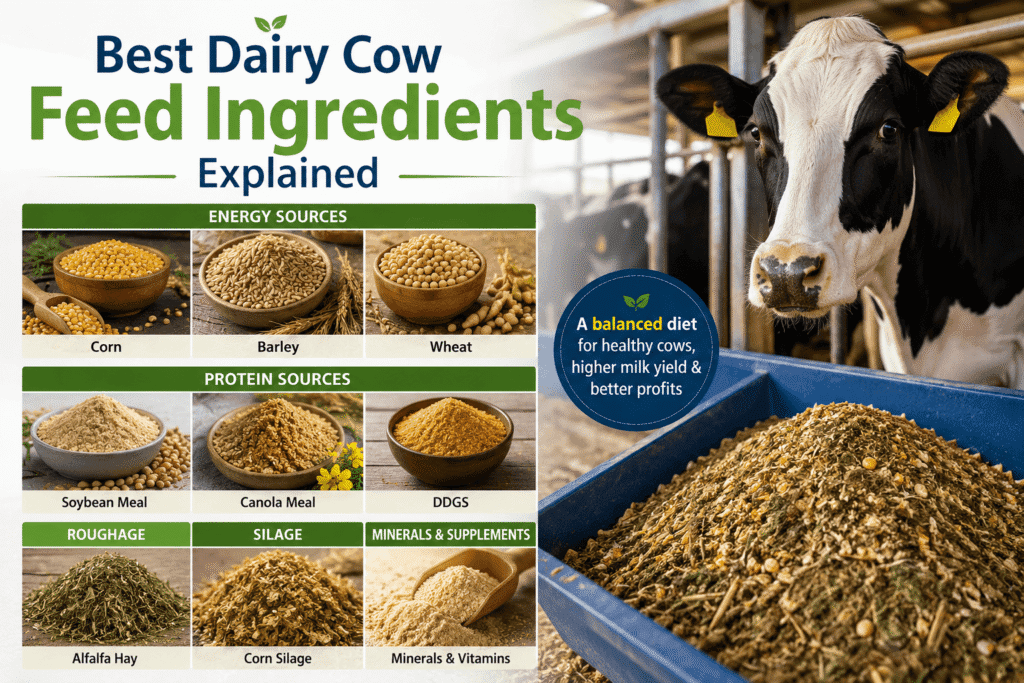
| Feed Category | Feed Ingredient | Main Nutrients | Primary Function | Major Producing Countries |
|---|---|---|---|---|
| Forage | Corn Silage | Energy, Fiber | Main forage and energy source | USA, China, Brazil, Argentina |
| Forage | Alfalfa Hay | Protein, Calcium, Fiber | Premium forage for high-producing cows | USA, Canada, Spain, Australia |
| Forage | Grass Hay | Fiber | Supports rumen health and chewing activity | Worldwide |
| Energy Feed | Corn Grain | Starch, Energy | Supplies energy for milk production | USA, Brazil, China, Ukraine |
| Protein Feed | Soybean Meal | High Protein | Primary protein source for dairy diets | Brazil, USA, Argentina |
| Protein Feed | Canola Meal | Protein | Cost-effective alternative protein source | Canada, Australia |
| Protein Feed | Cottonseed | Fat, Fiber, Protein | Increases dietary energy and milk fat | USA, India, China |
| Protein Feed | DDGS | Protein, Energy, Fiber | Provides economical protein and energy | USA, China, Brazil |
| Supplement | Molasses | Sugar | Improves feed taste and reduces sorting | Brazil, India, Thailand |
| Supplement | Minerals & Vitamins | Essential Nutrients | Support immunity, fertility, and bone health | Produced worldwide |
| Feed Additives | Yeast, Probiotics, Enzymes, Buffers | Specialized Nutrients | Improve digestion, rumen stability, and feed efficiency | USA, Europe, China, Japan |
Understanding Each Feed Category
A successful dairy ration is built by combining different categories of feed rather than relying on a single ingredient.
Forage
Forage is the foundation of every TMR. Corn silage, alfalfa hay, and grass hay provide the fiber that keeps the rumen healthy while supplying part of the cow’s daily energy and protein needs. Good-quality forage also encourages chewing, increases saliva production, and supports efficient digestion.
Energy Feed
Energy feeds mainly supply carbohydrates that fuel milk production. Corn grain is the most widely used energy source because it provides highly digestible starch. Adequate energy intake helps dairy cows maintain body condition and produce higher milk yields.
Protein Feed
Protein feeds provide amino acids that support muscle maintenance, milk protein synthesis, growth, and reproduction. Soybean meal remains the industry standard, while canola meal, cottonseed, and DDGS are commonly used to balance nutrition and reduce feed costs.
Supplements
Supplements include molasses, minerals, and vitamins. Molasses improves the taste of feed and helps hold ingredients together inside the TMR, reducing feed sorting. Minerals and vitamins are essential for strong bones, fertility, immune function, and overall cow nutrition.
Feed Additives
Modern feed additives are designed to improve rumen performance and nutrient utilization. Common products include yeast cultures, probiotics, enzymes, buffers, rumen-protected amino acids, and rumen-protected fats. Although they are used in relatively small amounts, they can significantly improve feed efficiency, milk production, and herd health when used correctly.
Dairy Cows and Humans Need Balanced Diets
Think of a dairy cow like a professional athlete. An athlete cannot stay healthy or perform well by eating only bread or only chicken. They need carbohydrates for energy, protein for muscle growth, healthy fats, vitamins, and minerals to recover after training.
A dairy cow works in much the same way. Producing milk every day requires a balanced supply of nutrients. A well-formulated TMR is like a complete, nutritious meal for humans, containing grains, vegetables, protein, fruit, and essential nutrients. Each ingredient contributes something different, and together they create complete cow nutrition that supports milk production, reproductive performance, disease resistance, and long-term health.
Recommended Dairy Cow Feed Recipe (TMR Formula)
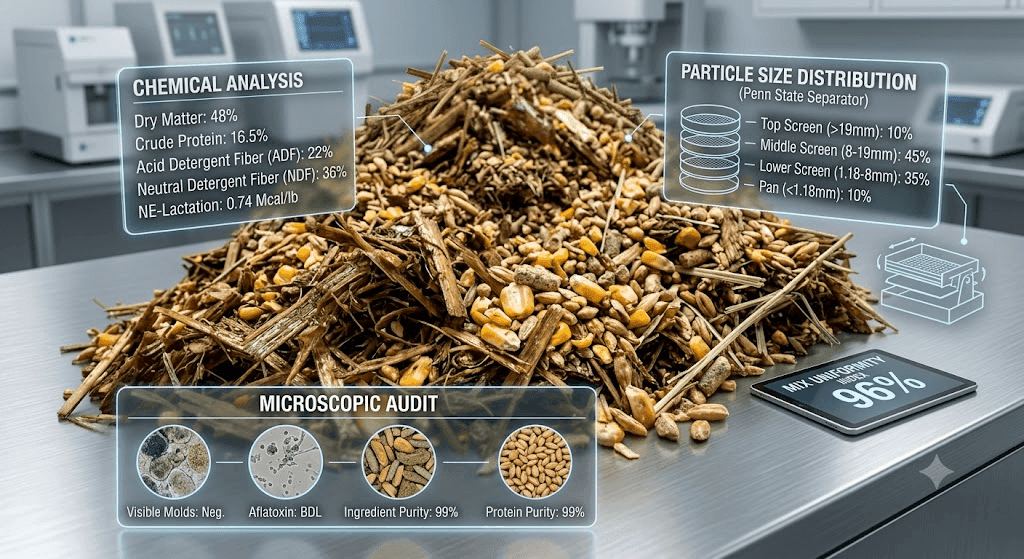
A successful dairy farm does not use one fixed feed recipe for every cow. The ration should be adjusted according to production level, lactation stage, and available feed resources. However, the following TMR formula is a common reference range for high-producing dairy cows.
| Feed Ingredient Category | Recommended Percentage of Dry Matter (%) | Typical Amount per Cow per Day (Fresh Weight) | Main Purpose |
|---|---|---|---|
| Corn Silage | 35–50% | 20–30 kg | Provides energy, fiber, and supports rumen fermentation |
| Alfalfa Hay / Grass Hay | 10–25% | 3–8 kg | Supplies effective fiber and protein |
| Corn Grain | 15–25% | 4–8 kg | Provides starch and energy for milk production |
| Soybean Meal / Protein Sources | 8–15% | 2–5 kg | Supports milk protein synthesis and body maintenance |
| Cottonseed / DDGS | 5–10% | 1–3 kg | Adds protein, fiber, and energy |
| Minerals & Vitamins | 1–3% | 100–300 g | Supports immunity, fertility, and bone health |
| Feed Additives | 0.1–1% | 20–150 g | Improves digestion, rumen stability, and feed efficiency |
Practical Feeding Experience
Based on commercial dairy farm practices, a high-producing Holstein cow producing approximately 25–40 kg of milk per day usually consumes around 20–25 kg of dry matter intake (DMI) daily.
A typical ration may contain:
- 45% forage (corn silage + alfalfa hay)
- 50% concentrate (corn grain + soybean meal + other energy and protein sources)
- 5% supplements (minerals, vitamins, and feed additives)
This balance helps maintain healthy rumen function while providing enough energy for high milk production.
Just like humans need different diets depending on their lifestyle, dairy cows also require different feeding strategies. A professional athlete needs more calories and protein than an office worker, and a high-producing dairy cow requires more energy and nutrients than a dry cow or replacement heifer.
Example Daily TMR Recipe for a Lactating Dairy Cow
| Ingredient | Amount (kg/cow/day, fresh weight) |
|---|---|
| Corn Silage | 25 kg |
| Alfalfa Hay | 5 kg |
| Corn Grain | 6 kg |
| Soybean Meal | 3 kg |
| DDGS | 2 kg |
| Cottonseed | 2 kg |
| Mineral & Vitamin Premix | 0.15 kg |
| Feed Additives | 0.05 kg |
| Total Feed Intake | Approximately 43 kg fresh feed/day |
This type of ration can support good milk production when combined with proper herd management, clean drinking water, comfortable housing, and regular monitoring.
Key Points for Feed Recipe Adjustment
- High milk-producing cows need more energy and protein.
- Early lactation cows usually require higher nutrient density.
- Low-quality forage requires additional concentrate supplementation.
- Feed costs should always be considered when adjusting the ration.
- Regular TMR analysis helps maintain consistent cow nutrition.
The best dairy feeding program is not the most expensive formula, but the one that achieves the best balance between milk production, cow health, and feed cost efficiency.
Manual Feed Mixing vs TMR Mixer: Which Method Produces Better Results?
After selecting the right feed ingredients and creating a balanced recipe, the next challenge for dairy farmers is how to prepare and deliver the feed efficiently.
Traditionally, many small dairy farms prepared feed manually. Workers measured ingredients, chopped forage, mixed materials with simple tools, and distributed feed by hand. While this method can work for small herds, it becomes difficult to maintain accuracy and consistency as farm size increases.
Modern dairy farms use TMR mixers to automatically combine forage, grains, protein sources, minerals, vitamins, and feed additives into one uniform ration. This technology improves feeding accuracy, reduces labor requirements, and helps maintain consistent cow nutrition.
Comparison: Manual Feeding vs TMR Mixer Feeding
| Comparison Item | Manual Feed Mixing | TMR Mixer Feeding |
|---|---|---|
| Mixing Accuracy | Depends heavily on worker experience | High accuracy through weighing and automatic mixing |
| Feed Uniformity | Ingredients may separate easily | Creates a consistent TMR mixture |
| Labor Requirement | Requires many workers and more physical effort | Reduces labor and improves efficiency |
| Feeding Time | Several hours depending on herd size | Faster preparation and delivery |
| Feed Waste | Higher risk of sorting and leftover feed | Reduces feed sorting and waste |
| Nutrient Balance | Difficult to maintain every batch | Each bite contains balanced nutrients |
| Feed Cost Control | More difficult to measure consumption | Better control through accurate feeding |
| Suitable Farm Size | Small farms with limited cows | Medium and large dairy farms |
| Milk Production Stability | More variation due to feeding inconsistency | More stable production performance |
Why TMR Mixer Produces Better Feeding Results
1. More Accurate Nutrient Distribution
In manual feeding systems, ingredients are often mixed unevenly. For example, some cows may eat more corn grain while others consume more forage. This creates differences in energy and protein intake.
A TMR mixer combines all ingredients evenly, ensuring every bite contains the correct ratio of fiber, energy, protein, minerals, vitamins, and feed additives.
This is similar to human nutrition. If a person eats only the meat from a meal and ignores vegetables and carbohydrates, the diet becomes unbalanced. Dairy cows also need every nutrient component in the correct proportion.
2. Reduced Feed Sorting
Cows are naturally selective animals. When feed is not properly mixed, stronger cows may choose high-energy ingredients while weaker cows may consume more low-quality fiber.
A properly prepared TMR reduces ingredient separation and encourages all cows to consume a balanced ration.
Benefits include:
- More stable rumen fermentation
- Better feed utilization
- Lower risk of digestive problems
- Improved herd performance
3. Lower Labor Cost
Manual feed preparation requires workers for:
- Cutting forage
- Measuring ingredients
- Carrying feed
- Mixing materials
- Distributing feed
As herd size increases, labor becomes one of the largest operating costs.
A TMR mixer can complete these tasks much faster. One operator can prepare feed for hundreds or thousands of cows, significantly improving farm efficiency.
4. Better Feed Cost Management
Feed is usually the largest expense on a dairy farm. Small mistakes in feed measurement can create significant economic losses.
With a TMR mixer:
- Ingredients are accurately weighed
- Feed waste is reduced
- Overfeeding is avoided
- Feed consumption can be monitored
This helps farmers achieve better milk production with lower feed cost.
Example: Farm Result Comparison
| Item | Manual Mixing | TMR Mixer |
|---|---|---|
| Herd Size | 100 cows | 1,000 cows |
| Daily Feeding Labor | Several workers | 1–2 operators |
| Feed Mixing Quality | Variable | Consistent |
| Feed Sorting | Higher | Lower |
| Daily Feed Management | Difficult to track | Easier to monitor |
| Production Stability | More variation | More consistent |
Practical Farm Experience
Many dairy farms that switch from manual feeding to a TMR mixer experience improvements in daily management. The biggest changes are not only higher milk production but also more consistent cow performance.
A dairy cow is similar to a professional athlete. An athlete cannot achieve stable performance if meals are different every day. Dairy cows also require a consistent nutritional program to maintain high milk production.
A properly mixed TMR provides cows with the same balanced “meal” every day, supporting healthier digestion, better reproduction, improved milk quality, and longer productive life.
Conclusion
Manual feed preparation may be suitable for small farms, but it becomes inefficient as dairy operations expand. A TMR mixer provides better mixing accuracy, lower labor requirements, reduced feed waste, and more consistent cow nutrition.
For modern dairy farming, investing in TMR technology is not only an equipment upgrade but also an important step toward improving productivity, reducing operating costs, and building a more profitable dairy business.
Frequently Asked Questions (FAQ)
1. What is the difference between manual feed mixing and a TMR mixer?
Manual feed mixing requires workers to measure, prepare, and mix ingredients by hand or with simple tools. The final ration quality depends heavily on worker experience and accuracy.
A TMR mixer automatically weighs and combines forage, grains, protein sources, minerals, vitamins, and feed additives into a uniform ration. It provides more consistent cow nutrition, reduces feed sorting, and improves feeding efficiency.
2. Does a TMR mixer increase milk production?
A TMR mixer does not directly increase milk production by itself, but it helps cows receive a more balanced diet every day.
Better mixing consistency can improve:
- Feed intake
- Rumen stability
- Nutrient absorption
- Milk production stability
- Feed conversion efficiency
When combined with good herd management, a properly prepared TMR can help dairy cows achieve higher and more consistent milk yields.
3. Is a TMR mixer worth the investment for a dairy farm?
For small farms with only a few cows, manual feeding may still be practical. However, as herd size increases, a TMR mixer can significantly reduce labor costs, minimize feed waste, and improve feeding accuracy.
A TMR mixer is especially valuable for farms with:
- More than 100 dairy cows
- High-producing Holstein cows
- Expensive feed ingredients
- Limited labor availability
- Goals to improve farm automation
The investment should be evaluated based on labor savings, feed cost reduction, improved production stability, and long-term farm efficiency.