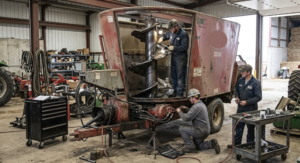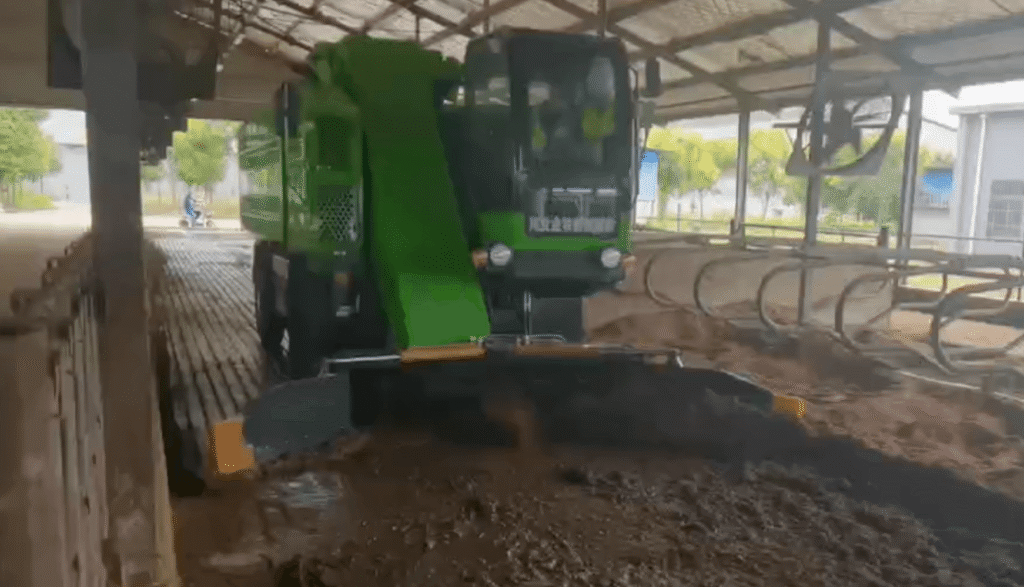
Manure collection machines help dairy farms remove manure from alleys and move it toward channels, pits, storage, or treatment systems. The main options are tractor scrapers, automatic cable or chain scrapers, robotic manure scrapers, flush systems, and slatted-floor systems.
Compare manure collection and cleaning machines for dairy farms, including automatic scrapers, manure robots, flush systems, labor savings, ROI, and selection tips.
For beginners, the equipment choices can look confusing because manure does not behave the same on every farm. Sand bedding, straw, sawdust, liquid manure, slurry, alley width, floor slope, and herd size can all change which machine works best.
The easiest way to start is with four questions:
Where is the manure produced? How wet is it? How often should it be removed? Where does it go next?
Quick Answer: Main Dairy Manure Cleaning Systems
| System | Main Job | Labor Need | Best Fit |
|---|---|---|---|
| Tractor/skid-steer scraper | Push manure from alleys | High | Small or flexible farms |
| Automatic cable/chain scraper | Clean fixed alleys automatically | Low | Straight freestall alleys |
| Robotic manure scraper | Autonomous alley cleaning | Low | Modern or retrofit barns |
| Flush system | Move manure with water | Low–Medium | Liquid-manure facilities |
| Slatted-floor system | Let manure fall below floor | Low | Purpose-built barns |
| Vacuum/tanker unit | Collect and transport slurry | Medium | Yards and flexible routes |
Beginner takeaway: the most important difference is how manure moves. Scrapers push it, robots move it automatically, flush systems use water, and slatted floors allow it to drop into a collection area below.
1. Why Manure Collection Matters in Dairy Barns
A dirty alley is more than a visual problem.
Wet manure can make walking surfaces slippery, soil legs and udders, increase moisture around hooves, and create additional cleaning work for employees.
Penn State Extension notes that repeated scraping and vehicle traffic can wear concrete floor grooves over time. When grooves become polished or shallow, traction can decrease and resurfacing may be required.
University of Minnesota Extension also highlights the value of automatic manure removal in robotic-milking barns because it can reduce cow disturbance while helping keep alleys and cows cleaner.
What a Good Manure System Should Accomplish
| Goal | Why It Matters |
|---|---|
| Remove manure frequently | Keeps walking surfaces cleaner |
| Maintain floor traction | Helps reduce slipping |
| Reduce cow disturbance | Supports normal movement |
| Lower repetitive labor | Reduces driving time |
| Match bedding type | Prevents unnecessary wear or blockage |
| Move manure reliably | Avoids backups in channels or pits |
| Match future treatment | Supports separation, storage, digestion, or composting |
For beginners, think of manure collection as the first stage of a larger system:
Cow alley → cleaning machine → transfer channel → pit/separator → storage → land application or treatment
If one stage is undersized, the whole process can become a bottleneck.
2. Types of Manure Collection and Cleaning Machines
Different machines solve different problems. The best choice depends on manure consistency, bedding material, alley geometry, labor availability, and the downstream manure system.
Tractor and Skid-Steer Scrapers
A tractor, skid steer, or loader with a scraper blade is still one of the simplest options.
The operator drives along the alley and pushes manure toward a cross-channel or reception pit.
The main advantage is flexibility. The same machine can often be used for bedding, loading, snow removal, and other farm jobs.
The main disadvantage is labor.
A Penn State Extension study of robotic-milking dairies reported that 7 farms used automatic manure scrapers continuously throughout the day, while 2 farms used skid loaders to remove manure twice daily. Stall cleaning ranged from 1–4 times/day, with most farms cleaning stalls twice daily.
That comparison shows what automation changes: more frequent cleaning becomes possible without assigning a driver to every cycle.
Automatic Cable and Chain Scrapers
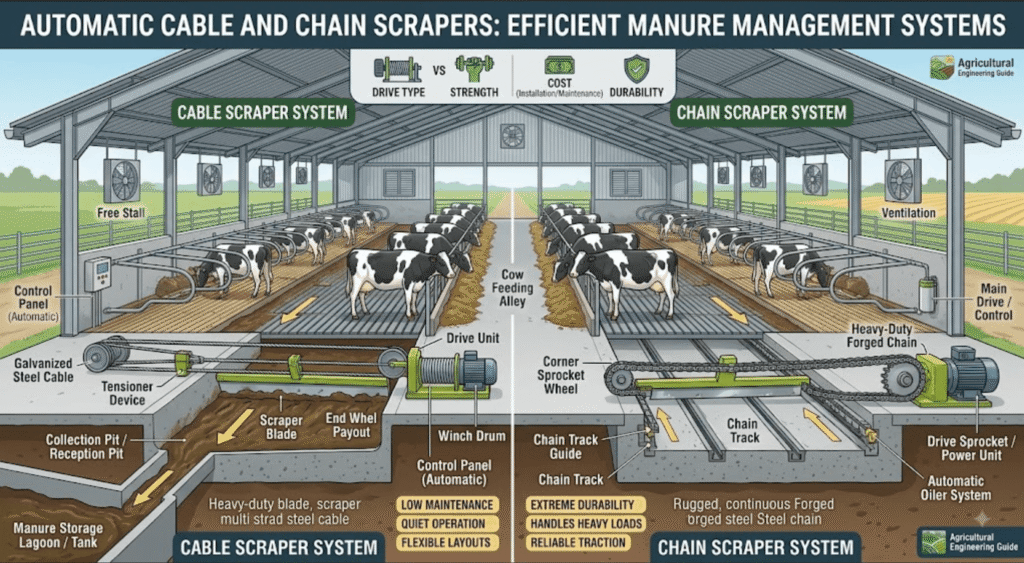
Fixed automatic scrapers use a blade pulled by a cable, chain, hydraulic drive, or similar system.
| Feature | Automatic Scraper |
|---|---|
| Driver required per cycle | No |
| Route | Fixed |
| Typical barn | Freestall |
| Operation | Programmed cycles |
| Main advantage | Low repetitive labor |
| Main limitation | Fixed alley geometry |
| Bedding compatibility | Must be confirmed |
These systems are strongest where alleys are straight and predictable.
Because the scraper follows a fixed route, gate positions, crossovers, floor slope, discharge channels, and scraper parking positions should be planned before installation.
Robotic Manure Scrapers
A robotic manure scraper performs a similar job but moves autonomously.
Instead of following a fixed cable, it navigates programmed routes and usually returns to a charging point.
Penn State described a dairy that installed an automated alley scraper during a robotic-milking transition to keep alleys clean while reducing disruption to cows.
Robots can be attractive when:
- fixed cables are difficult to install;
- several routes need cleaning;
- cow traffic must remain flexible;
- night cleaning is useful;
- repetitive tractor movement is undesirable.
They still require suitable floors, accessible charging points, safe routes, and enough clearance around gates and corners.
Flush Systems and Slatted Floors
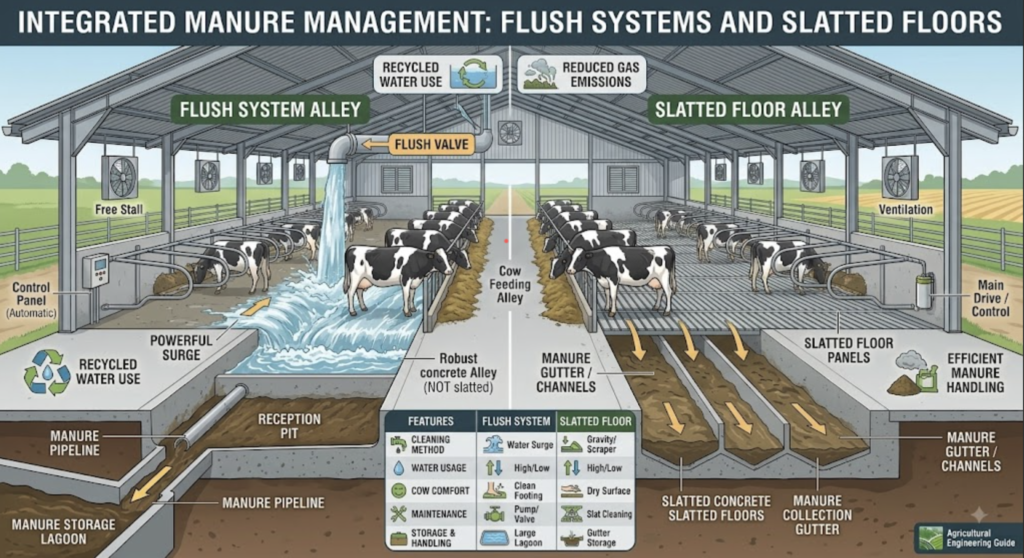
Flush systems use water or recycled liquid to move manure from the alley.
The main advantage is low mechanical traffic in the cow area.
The tradeoff is more liquid volume.
A flush system can increase the amount of material that pumps, separators, pits, and storage must handle.
Slatted floors take a different approach. Manure falls through openings into a pit or transfer area below.
They can reduce surface scraping, but they require purpose-built flooring and below-floor infrastructure. For this reason, slatted systems are easier to include in new construction than retrofit into an existing solid-floor barn.
3. Which Manure Cleaning System Fits Your Dairy Farm?
There is no single “best” machine.
The right choice depends on the farm’s layout, manure type, bedding, labor cost, and future plans.
Machine Selection Comparison
| Farm Condition | Tractor/Loader | Auto Scraper | Robot Scraper | Flush | Slatted Floor |
|---|---|---|---|---|---|
| Small existing barn | ✓✓✓ | ✓✓ | ✓ | ✓ | — |
| Straight freestall alleys | ✓✓ | ✓✓✓ | ✓✓✓ | ✓✓ | ✓ |
| Complex retrofit routes | ✓✓ | ✓ | ✓✓✓ | ✓ | — |
| New large freestall | ✓✓ | ✓✓✓ | ✓✓✓ | ✓✓✓ | ✓✓ |
| Low-labor priority | ✓ | ✓✓✓ | ✓✓✓ | ✓✓✓ | ✓✓✓ |
| Flexible route needed | ✓✓✓ | ✓ | ✓✓✓ | — | — |
| Sand bedding | ✓✓✓ | System-dependent | System-dependent | More difficult | Project-dependent |
| Water restrictions | ✓✓✓ | ✓✓✓ | ✓✓✓ | — | ✓✓ |
Rating: ✓ = possible, ✓✓ = suitable, ✓✓✓ = strong fit.
This table is a planning guide, not a universal technical rule.
Sand bedding is a good example. It can provide excellent stall comfort, but sand is abrasive. It can increase wear in scrapers, settle in channels, and complicate pumps and separators.
So the scraper should not be chosen separately from the bedding and downstream system.
Barn Layout Comes First
Before comparing machines, record:
| Measurement | Why It Matters |
|---|---|
| Alley length | Determines scraper travel |
| Alley width | Determines blade or robot size |
| Floor slope | Affects manure movement |
| Crossovers | Can interrupt fixed scraper routes |
| Gates | Affect automation |
| Bedding type | Changes manure consistency |
| Discharge point | Determines travel direction |
| Collection channel | Must accept manure flow |
| Charging/service area | Needed for robots |
Imagine one barn with four straight 70-meter alleys. A fixed automatic scraper may work very well.
Another barn may have short irregular alleys, crossovers, gates, and robotic-milking traffic. A mobile robot may provide more flexibility.
This is why herd size alone is not enough for selecting manure collection equipment.
How Often Should Dairy Alleys Be Cleaned?
There is no single cleaning frequency for every dairy.
In the Penn State robotic-dairy observations:
- 7 farms used automatic scrapers continuously;
- 2 farms used skid loaders 2 times/day;
- stall cleaning ranged from 1–4 times/day;
- most farms cleaned stalls 2 times/day.
The practical lesson is not that every farm needs continuous scraping.
It is that automatic equipment makes frequent cleaning possible without increasing driving labor.
4. Manure Collection Costs, Labor Savings & ROI
Before comparing purchase prices, calculate what the farm currently spends on cleaning.
Manual Cleaning Labor Example
Assume a 500-cow dairy uses a skid steer for 3 cleaning rounds/day, each round takes 35 minutes, and labor costs $22/hour.
Daily labor = 3 rounds × 35 min ÷ 60 = 1.75 hr/day
Annual labor = 1.75 hr/day × 365 = 638.75 hr/year
Annual labor cost = 638.75 hr × $22/hr = $14,052.50/year
| Item | Planning Example |
|---|---|
| Cleaning cycles | 3/day |
| Time/cycle | 35 min |
| Daily labor | 1.75 hr |
| Annual labor | 638.75 hr |
| Labor cost | $22/hr |
| Annual direct labor | $14,052.50 |
Planning example — not an industry-average cost.
For beginners, the table means the farm spends almost 639 labor hours per year on this one task before fuel, repairs, tires, and machine depreciation are added.
Automatic Scraper ROI Example
Use:
Annual Net Saving = Labor Saving + Vehicle Saving − Automation Operating Cost
Assume:
- installed cost = $60,000
- labor saving = $12,000/year
- vehicle saving = $5,000/year
- operating and maintenance cost = $3,000/year
Annual net saving = $12,000 + $5,000 − $3,000 = $14,000/year
Simple payback = $60,000 ÷ $14,000 = 4.29 years
| ROI Item | Planning Example |
|---|---|
| Installed investment | $60,000 |
| Labor saving | +$12,000/year |
| Vehicle saving | +$5,000/year |
| Operating/maintenance | −$3,000/year |
| Net annual saving | $14,000/year |
| Simple payback | 4.29 years |
These figures are examples only.
Actual ROI should use the farm’s quotation, wage rate, electricity price, vehicle operating cost, financing, expected machine life, and service contract.
Do Not Forget Downstream Capacity
Removing manure faster does not help if the next stage cannot handle the flow.
Think of the chain:
scraper → cross-channel → pump → separator → storage
If the scraper sends manure faster than the cross-channel can move it, material backs up.
If a flush system adds a large amount of water, storage volume increases.
If the separator is undersized, the reception pit may fill too quickly.
That is why manure collection equipment should be selected together with the entire manure-handling system.
The environmental side also matters. The U.S. EPA identifies manure as a significant source of nitrogen and phosphorus that can reach surface or groundwater if poorly managed.
For farms using anaerobic digestion, EPA AgSTAR explains that digesters can capture methane from manure and convert it into usable biogas.
The cleaning machine is therefore only the front end of a larger nutrient-management process.
5. How to Choose and Maintain a Manure Cleaning Machine
A good buying decision starts with the barn, not the brochure.
5-Step Selection Checklist
Step 1: Identify the Manure Type
Confirm whether the system mainly handles:
- scraped slurry;
- liquid manure;
- sand-laden manure;
- straw or sawdust bedding;
- bedded-pack manure.
Different materials move differently and create different wear patterns.
Step 2: Measure the Route
Measure the actual usable alley, not only the construction drawing.
Confirm alley length, width, slope, crossovers, gates, scraper parking position, discharge point, and charging/service locations.
Step 3: Check Cow Interaction
Equipment shares the barn with cows.
University of Minnesota Extension notes that automatic manure removal can reduce cow disruption in robotic-milking barns.
Slow, predictable movement is generally easier for cows to adapt to than irregular tractor traffic.
Step 4: Inspect Floor Traction
Automatic cleaning does not remove the need for floor maintenance.
Penn State Extension warns that repeated scraping can wear floor grooves and reduce traction over time.
Inspect for:
- polished concrete;
- shallow grooves;
- broken edges;
- water pooling;
- slippery intersections;
- scraper damage.
A clean floor that becomes slippery is not a successful result.
Step 5: Plan Maintenance Before Purchase
| Machine Type | Main Service Areas |
|---|---|
| Tractor scraper | Blade, tires, hydraulics |
| Cable scraper | Cable, pulleys, drive |
| Chain scraper | Chain, sprockets, wear points |
| Hydraulic scraper | Cylinders, hoses |
| Robot scraper | Wheels, battery, sensors, blade |
| Flush system | Valves, pumps, nozzles |
| Vacuum unit | Pump, hose, tank seals |
Maintenance access should be easy and safe.
A drive unit installed where manure continuously covers it or a robot charger placed in cow traffic can turn a small design problem into a daily inconvenience.
Common Buying Mistakes
| Mistake | Better Approach |
|---|---|
| Choosing only by herd size | Design around alley and manure type |
| Ignoring bedding | Confirm sand/straw compatibility |
| Automating a poor floor | Fix traction and drainage first |
| Comparing purchase price only | Calculate total ownership cost |
| Ignoring storage capacity | Size the whole manure flow chain |
Frequently Asked Questions
What is the best manure collection machine for a dairy farm?
There is no single best machine. Straight freestall alleys often suit automatic scrapers, complex retrofit barns may benefit from robotic cleaners, and smaller farms may prefer tractor or skid-steer scraping.
How often should manure alleys be cleaned?
The correct frequency depends on stocking density, manure loading, floor condition, barn design, and equipment. Penn State observed robotic dairies using continuous automatic scraping, while some skid-loader farms cleaned twice daily.
Are robotic manure scrapers worth it?
They can be useful where repetitive labor is costly or tractor traffic disrupts cow movement. ROI should include labor, vehicle costs, maintenance, electricity, service, and installed price.
Can automatic scrapers handle sand bedding?
Some systems can, but sand increases abrasion and can affect scrapers, channels, pumps, separators, and storage. Confirm that the entire manure system is designed for sand.
Is more frequent cleaning always better?
Not automatically. Frequent cleaning should still be balanced with floor traction, cow disturbance, machine wear, bedding compatibility, and downstream capacity.
Engineering Note
Machine capacity, scraper dimensions, alley geometry, floor slope, manure consistency, bedding type, collection-channel capacity, pump sizing, storage volume, and local environmental requirements should be checked for the individual dairy before final equipment selection.
Conclusion
The best manure collection system is not necessarily the most automated one.
It is the system that matches:
manure type + bedding + barn layout + labor cost + storage + future treatment
Small farms may continue to get good value from tractors or skid steers because those machines already perform several other jobs.
Straight freestall barns often suit fixed automatic scrapers because alley cleaning becomes much less dependent on labor availability.
Robotic cleaners add route flexibility and can be useful in barns where reducing tractor traffic around cows is important.
Flush and slatted-floor systems can reduce mechanical scraping, but they require the downstream manure infrastructure to be designed around them.
Before buying, measure the alleys, calculate current labor, check floor condition, identify bedding type, and confirm where the manure goes after cleaning.
A well-designed manure collection system should make the barn cleaner without simply moving the bottleneck from the alley to the storage pit.
Recommended Resources
- Dairy Farm Machine
- Penn State Extension – Dairy Cattle
- University of Minnesota Extension – Dairy
- University of Wisconsin–Madison Dairy Extension
- U.S. EPA AgSTAR
- International Dairy Federation (IDF)
- FAO – Dairy Production and Products
- National Dairy FARM Program
- Journal of Dairy Science
- Progressive Dairy
- Dairy Herd Management