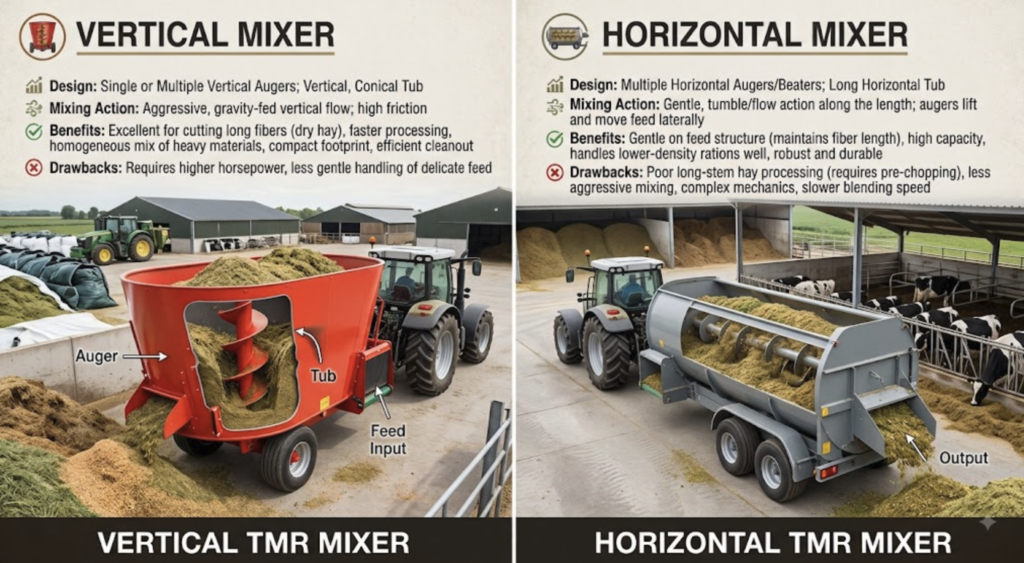
A vertical vs. horizontal TMR mixer comparison should start with the ration—not the machine. Vertical mixers generally use one or more upright augers, while horizontal mixers use horizontal augers, reels, paddles, or combinations of these components. Neither design is automatically better; the right choice depends on forage type, batch size, feeding groups, available power, barn access, and measured mixing performance.
For beginners, the buying logic is simple:
Ration → Batch size → Mixer type → Power → Barn fit → Mixing test → Cost
A properly managed total mixed ration combines forage, grain, protein feeds, minerals, vitamins, and additives into one feed mixture. University of Minnesota Extension notes that TMR feeding can improve feeding accuracy and reduce the ability of cows to sort individual ingredients. (University of Minnesota Extension)
University of Minnesota Extension – Feeding Total Mixed Rations
Quick Answer: Vertical vs. Horizontal TMR Mixer
| Buyer Question | Vertical Mixer | Horizontal Mixer |
|---|---|---|
| Produces complete TMR | Yes | Yes |
| Main mixing axis | Vertical | Horizontal |
| Main mixing components | Vertical auger(s) | Auger/reel/paddle |
| Handles dry forage | Yes* | Yes* |
| Electronic weighing available | Yes | Yes |
| Mobile models available | Yes | Yes |
| Stationary models available | Yes | Yes |
| Can prepare PMR | Yes | Yes |
| Automated feeding integration | Possible | Possible |
| One design always mixes better | No | No |
*Actual performance depends on the specific machine, forage length, knives, loading sequence, ration density, and manufacturer specifications.
The key lesson is that vertical or horizontal describes the mixing mechanism, not the final ration quality.
1. How Do Vertical and Horizontal TMR Mixers Work?
A vertical and horizontal mixer perform the same basic job: combine measured feed ingredients into a uniform ration. The difference is how material moves inside the mixing chamber.
How a Vertical TMR Mixer Works
A typical vertical mixer contains one or more upright augers. As they rotate, feed is lifted and circulated through the chamber. Knives or other cutting components may also process long forage.
The basic process is:
Load → Lift/cut → Circulate → Mix → Discharge
Vertical machines are available in:
- single-auger designs;
- twin-auger designs;
- multi-auger designs;
- mobile versions;
- stationary versions.
University of Minnesota Extension recommends a different ingredient-loading order for vertical mixers than for conventional auger mixers. For vertical mixers with one or two center augers, it suggests loading dry or long forage first, followed by grains, concentrates, and then ensiled forage. (University of Minnesota Extension)
That alone shows why the TMR mixer guide should consider both machine design and operating procedure.
How a Horizontal TMR Mixer Works
Horizontal mixers move material mainly along a horizontal axis using augers, reels, paddles, or combinations of these components.
The basic process is:
Load → Move laterally → Circulate → Blend → Discharge
“Horizontal mixer” is a broad category. A reel mixer and a multi-auger horizontal mixer can behave differently with the same ingredients.
Core Mechanical Comparison
| Feature | Vertical | Horizontal |
|---|---|---|
| Main mixing axis | Vertical | Horizontal |
| Main element | Auger | Auger/reel/paddle |
| Cutting action | Model-dependent | Model-dependent |
| Scale system | Common | Common |
| Mobile configuration | Available | Available |
| Stationary configuration | Available | Available |
| Mixing time | Ration/model-dependent | Ration/model-dependent |
| Ideal application | Depends on ration | Depends on ration |
University of Minnesota Extension states that final mixing time varies with mixer type, mixer load, tractor size, and machine condition. It gives approximately 5 minutes after the final ingredient as a general reference, while noting that vertical mixers often require only 3–5 minutes of final mixing. (University of Minnesota Extension)
That is a useful starting point, but the actual manufacturer’s instructions should take priority.
2. Which Mixer Produces the Better TMR?
Neither design guarantees better TMR. Mixing quality should be judged by particle distribution, ingredient accuracy, loading order, mixing time, discharge uniformity, and cow sorting behavior.
This is one of the most important points in any vertical vs. horizontal TMR mixer comparison.
Particle Size and Mixing Consistency
University of Minnesota Extension recommends checking TMR particle size approximately every 2–4 weeks and calibrating mixer scales every 3 months. (University of Minnesota Extension)
Its TMR particle-size guidance is:
| Separator Level | Target |
|---|---|
| Top screen | 3–8% |
| Middle screen | 30–50% |
| Lower screen | 30–50% |
| Bottom pan | <20% |
University of Minnesota Extension – TMR Particle Size Guidance
UMN also recommends checking scales at approximately one-third, two-thirds, and full mixer capacity, using known weights of about 25–45 kg as a practical calibration method. (University of Minnesota Extension)
For beginners, this table means something important:
A good mixer is one that repeatedly produces the target ration—not one that simply looks more powerful.
Loading Order and Mixing Time
Even a well-designed mixer can perform poorly if ingredients are loaded inconsistently.
Monitor:
| Check | Why It Matters |
|---|---|
| Ingredient weights | Controls ration accuracy |
| Forage dry matter | Changes as-fed loading amounts |
| Loading sequence | Affects mixing behavior |
| Mixing time | Too little causes poor mixing |
| Overmixing | Can reduce particle length |
| Scale accuracy | Affects every ingredient |
| Discharge pattern | Shows uniformity |
| Feed refusal | May indicate sorting |
UMN recommends testing ensiled forage and wet-feed dry matter roughly once or twice per week, because changes in moisture can change the amount that should be loaded on an as-fed basis. (University of Minnesota Extension)
Use a 3-Point Discharge Test
A practical way to compare mixer performance is to collect samples at different stages of unloading:
Sample 1 = ~25% discharge → Sample 2 = ~50% → Sample 3 = ~75%
Compare the three samples for:
- particle distribution;
- visible ingredient differences;
- moisture where practical;
- laboratory nutrient composition where justified.
This is a practical evaluation method, not a universal laboratory standard.
The important question is:
Does the ration remain reasonably consistent from the beginning to the end of discharge?
UMN notes that long particles and excessive material on the top screen can increase opportunities for sorting. (University of Minnesota Extension)
This type of testing is more useful than assuming that vertical automatically means better forage handling or horizontal automatically means better mixing.
3. How Do You Calculate the Right TMR Mixer Capacity?
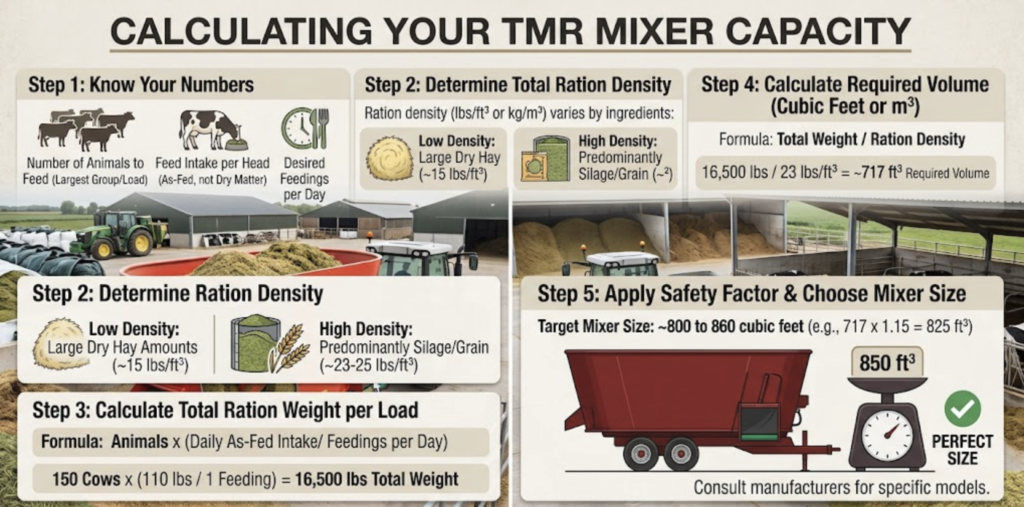
TMR mixer capacity should be calculated from the farm’s feeding program, not cow numbers alone.
You need:
- cows per group;
- as-fed intake;
- number of feedings;
- number of batches;
- actual ration bulk density;
- minimum and maximum batch size.
Calculate Daily Feed and Batch Weight
Consider an illustrative 500-cow dairy.
Assume 50 kg as-fed/cow/day for this planning example.
Daily feed = 500 cows × 50 kg/cow/day = 25,000 kg/day
If feeding twice per day:
Feed/cycle = 25,000 kg ÷ 2 = 12,500 kg/cycle
If each feeding cycle requires two equal batches:
Batch weight = 12,500 kg ÷ 2 = 6,250 kg/batch
The 50 kg/cow/day value is illustrative, not a universal dairy intake recommendation. Actual as-fed intake depends on dry matter intake, ration moisture, production, cow size, group, and nutrition program.
Convert Weight to Mixer Volume
Use:
Required mixer volume = Batch weight ÷ Measured TMR bulk density
If the farm’s measured ration density were 350 kg/m³ for this example:
Required volume = 6,250 kg ÷ 350 kg/m³ = 17.86 m³
Again, 350 kg/m³ is only an illustrative planning input.
Do not use one universal internet density for every TMR. Forage type, chop length, ration moisture, ingredients, and compaction all affect bulk density.
Rated Volume vs. Working Capacity
A mixer advertised as 20 m³ does not automatically mean you should plan on exactly 20 m³ for every batch.
Check:
| Specification | Why It Matters |
|---|---|
| Rated tub volume | Physical mixer size |
| Recommended working range | Normal operating volume |
| Maximum loaded weight | Protects frame/axles |
| Minimum effective batch | Important for small groups |
| Forage expansion | Affects usable space |
| PTO/electrical power | Determines drive requirement |
| Loading height | Must match loader |
| Discharge height | Must fit feeding area |
The smallest group deserves just as much attention as the largest.
For example, an oversized mixer may handle the main lactating group efficiently but perform poorly when preparing a small dry-cow or transition-cow batch.
Capacity Planning Checklist
| Farm Question | What It Determines |
|---|---|
| Largest group | Maximum batch |
| Smallest group | Minimum batch |
| Feedings/day | Batch frequency |
| As-fed intake | Feed weight |
| Ration density | Required volume |
| Forage length | Mixer processing needs |
| Tractor PTO | Drive capability |
| Loader height | Loading compatibility |
| Feed alley | Physical access |
| Expansion plan | Future reserve |
This calculation framework is one of the most important parts of a TMR mixer buying guide.
4. How Do TMR Mixers Fit Modern Automated Feeding Systems?
A modern dairy may use anything from a conventional tractor-pulled mixer to a central feeding kitchen connected to automatic distribution equipment.
The main mixer requirements—accurate weighing, correct batch size, consistent mixing, and reliable operation—remain the same.
PMR and an Automatic Milking System
An automatic milking system often changes the feeding strategy.
Penn State Extension describes robotic-milking herds using a partial mixed ration (PMR) formulated for a certain level of milk production, with remaining concentrate delivered individually through a computerized feeding system or milking robot. (Penn State Extension)
Penn State Extension – Component Feeding Systems
That means the mixer still has an important role.
The PMR needs to be consistent enough that the concentrate delivered through the automatic milking system complements rather than compensates for an unpredictable bunk ration.
Penn State also emphasizes that an AMS is a coordinated system that influences housing, feeding, and overall herd management. (Penn State Extension)
Automatic Feeding System Integration
Feeding technology can be considered in stages:
| Feeding Setup | Mixing | Transport | Distribution |
|---|---|---|---|
| Conventional | Mobile mixer | Tractor | Operator |
| Semi-automated | Mobile/stationary | Mechanized | Mixed |
| Automatic feeding system | Stationary/automated | Automated | Automated |
| Centralized system | Central mixer | Automated | Multiple groups |
As automation increases, consider:
- automatic ingredient weighing;
- recipe storage;
- computerized controls;
- multiple ration programs;
- automatic loading;
- stationary mixer compatibility;
- data connectivity;
- cleaning access.
Neither vertical nor horizontal technology is automatically better for an automatic feeding system. Compatibility depends on the complete feeding architecture.
Central Feeding Kitchen
A central feeding kitchen changes the buyer’s question from:
Which mixer wagon should we buy?
to:
Which mixing technology fits our storage, weighing, conveying, batching, and distribution system?
A simplified workflow is:
Ingredient storage → Weighing → Mixer → Automated transport → Distribution
Both vertical and horizontal stationary mixers may be suitable depending on the ration, required batch sizes, control system, and equipment supplier.
5. Vertical vs. Horizontal TMR Mixer: Which Should You Buy?
Choose vertical or horizontal only after confirming ration structure, batch range, power requirement, building fit, and measured mixing performance.
That is a stronger buying rule than choosing by herd size alone.
Final Buyer Comparison
| Buyer Requirement | Vertical | Horizontal |
|---|---|---|
| Complete TMR | Yes | Yes |
| PMR preparation | Yes | Yes |
| Electronic scales | Yes | Yes |
| Long forage | Model-dependent | Model-dependent |
| Small batch performance | Model-dependent | Model-dependent |
| Mobile version | Yes | Yes |
| Stationary version | Yes | Yes |
| Automatic feeding | Possible | Possible |
| Central kitchen | Possible | Possible |
| PTO/power requirement | Check model | Check model |
| Wear-part cost | Check supplier | Check supplier |
| Local service | Verify | Verify |
| Universally better | No | No |
The table intentionally avoids saying “vertical is for large farms” or “horizontal is for small farms.” Modern manufacturers offer both types in different sizes and configurations.
Compare Total Cost of Ownership
Do not compare purchase price alone.
Total ownership cost = Purchase price + Fuel/electricity + Labor + Maintenance + Wear parts + Downtime − Resale value
Also consider financing, insurance, taxes, and local service costs where applicable.
| Cost Factor | What to Compare |
|---|---|
| Initial purchase | Same specification/options |
| Power | PTO hp or electric load |
| Knives | Number + replacement price |
| Auger/reel/paddle | Expected wear |
| Gearbox | Service/parts |
| Load cells | Calibration/replacement |
| Tires/axles | Mobile mixer cost |
| Labor | Loading + mixing + delivery |
| Service | Technician availability |
| Downtime | Backup feeding method |
Avoid generic online price comparisons unless the machines have the same capacity, weighing system, discharge arrangement, options, warranty, freight, and installation scope.
10 Questions Before Buying
- What forage types and lengths will we mix?
- What is our largest batch?
- What is our smallest batch?
- How many feeding groups are required?
- How many batches are mixed each day?
- What tractor PTO or electrical power is available?
- Can the mixer fit the loading area and feed alley?
- How are scales calibrated?
- Are knives, augers, bearings, gearboxes, and load cells available locally?
- Will the farm eventually use an automatic feeding system, central feeding kitchen, or automatic milking system?
Test the Mixer With Your Own Ration
One of the strongest pre-purchase checks is a real feed test.
Ask the supplier to demonstrate the machine with a ration close to your actual formulation and at a realistic batch size.
| Test | What to Measure |
|---|---|
| Loading | Ingredient accuracy |
| Mixing | Required time |
| Particle size | Excessive processing |
| Discharge | Beginning/middle/end consistency |
| Residual feed | Material left inside |
| Scale | Weight accuracy |
| Power | Actual requirement |
| Loading access | Loader compatibility |
| Cleaning | Time and access |
| Service | Wear-part accessibility |
Use:
Load → Mix → Sample at 25%, 50%, 75% discharge → Compare → Inspect residual feed
This creates a much more useful decision than relying on a brochure.
Frequently Asked Questions
Is a vertical TMR mixer better than a horizontal mixer?
No design is universally better. The correct choice depends on forage, batch size, mixing performance, available power, barn layout, maintenance, and total cost.
Which TMR mixer is better for long forage?
Many vertical mixers are designed to process dry or long forage, and UMN specifically gives a loading sequence beginning with dry or long forage for vertical mixers. However, actual forage capability is model-specific and should be verified with the manufacturer. (University of Minnesota Extension)
How do you calculate TMR mixer capacity?
Daily feed = Cows × As-fed intake
Batch weight = Daily feed ÷ Feedings/day ÷ Batches/feed cycle
Mixer volume = Batch weight ÷ Measured TMR bulk density
Then confirm the manufacturer’s recommended working range and maximum loaded weight.
Can a TMR mixer work with an automatic milking system?
Yes. Robotic-milking dairies may use PMR at the feed bunk while additional concentrate is delivered through the automatic milking system. (Penn State Extension)
Can vertical and horizontal mixers be automated?
Potentially yes. Both can be available in stationary configurations, but integration with weighing, controls, loading equipment, conveyors, feeding robots, and the overall automatic feeding system must be confirmed for the specific project.
Conclusion
A vertical vs. horizontal TMR mixer decision should begin with the ration and end with measured performance.
Vertical mixers may be attractive when their auger and forage-processing characteristics match the farm’s ration. Horizontal mixers may be preferable when their auger, reel, or paddle design better matches the required ingredients and feeding workflow.
The practical buying sequence is:
Ration → Batch size → Capacity → Mixing test → Power → Barn fit → Maintenance → Total cost → Automation
Use actual feed requirements to determine TMR mixer capacity, verify manufacturer specifications, and test the machine with your own ration whenever possible.
For farms planning an automatic milking system, automatic feeding system, or central feeding kitchen, also evaluate future digital and stationary-system compatibility before buying.
The better mixer is not the one with the more impressive brochure. It is the machine that repeatedly delivers the ration your cows are supposed to eat.
Recommended Resources
- University of Minnesota Extension – Feeding Total Mixed Rations
- Penn State Extension – Total Mixed Rations for Dairy Cows
- Penn State Extension – Component Feeding Systems
- Penn State Extension – Automatic Milking Systems
- Penn State Extension – Dairy Nutrition and Feeding
- UW–Madison Dairy Extension
- International Dairy Federation
- FAO – Dairy Production and Products
- National Dairy FARM Program
- Journal of Dairy Science
- Dairy Farm Equipment – AIG Machinery