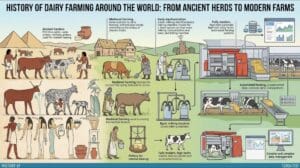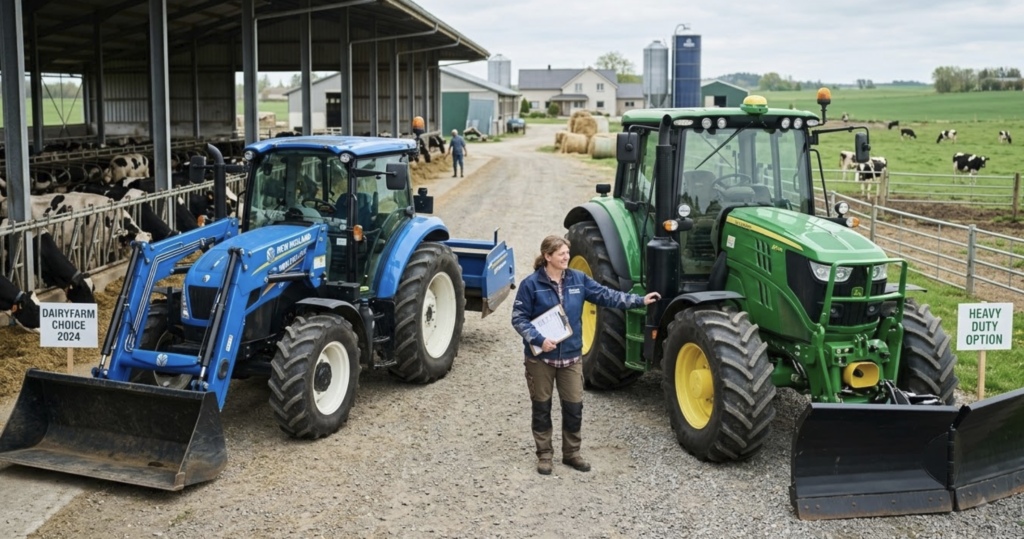
Dairy farm tractors should be selected around the work they must perform, not simply by horsepower. On a dairy, one tractor may load silage, power a TMR mixer, scrape manure, move bedding, tow trailers, and support daily feeding. The best tractor is the one that matches the farm’s actual implements, barn layout, workload, and long-term operating cost.
Learn how to choose dairy farm tractors by horsepower, PTO, hydraulics, loader capacity, transmission, barn fit, TMR requirements, cost per hour, and future automation.
For beginners, tractor brochures can make the buying process feel more complicated than it needs to be. Engine horsepower gets most of the attention, but it is only one part of the decision.
A practical buyer should work through the machine in this order:
job → implement requirement → PTO → hydraulics → loader → transmission → physical fit → operating cost
Quick Buyer Rule
If the tractor mainly powers a mixer, prioritize PTO horsepower, PTO speed, drawbar capacity, and reliability. If it mainly loads feed, prioritize hydraulic performance, loader capacity, visibility, transmission, and maneuverability. For a multipurpose tractor, balance both and make sure it physically fits the barn.
Dairy Tractor Buying Checklist at a Glance
| Buying Factor | What to Confirm | Why It Matters |
|---|---|---|
| Engine power | hp or kW | Overall tractor capability |
| PTO power | hp/kW at PTO | Drives mixer and PTO implements |
| PTO speed | 540 / 540E / 1,000 rpm | Must match the implement |
| Hydraulic flow | L/min or gal/min | Controls loaders and hydraulic tools |
| Loader capacity | kg or lb | Determines safe material handling |
| Lift height | m or ft | Must clear mixer or wagon |
| Transmission | Manual, shuttle, powershift, CVT/IVT | Affects repetitive work |
| Drawbar/hitch | Load rating | Must match trailers and mixers |
| Tractor dimensions | Width, height, wheelbase | Determines barn access |
| Turning ability | Radius and steering geometry | Important in tight yards |
| Tires and ballast | Type and configuration | Affect traction and stability |
| Dealer/service | Parts + response time | Reduces downtime |
Beginner takeaway: do not start by asking, “How much horsepower can I afford?” Start by asking, “What is the hardest job this tractor must perform every day?”
1. What Jobs Do Dairy Farm Tractors Need to Perform?
A tractor used for a job 365 days per year should influence the buying decision more than an implement used only a few days each season.
Typical dairy farm operations include loading silage, powering a TMR mixer, hauling feed, moving bedding, scraping manure, handling bales, towing trailers, loading manure, and general yard work.
Rank Jobs by Frequency and Importance
| Work Type | Typical Examples | Buying Priority |
|---|---|---|
| Daily critical | TMR mixing, feed loading | Highest |
| Daily support | Bedding, manure scraping | High |
| Frequent transport | Feed or manure hauling | High |
| Seasonal | Forage work, snow removal | Medium |
| Occasional | Utility trailers, maintenance | Lower |
For beginners, the reason for this ranking is simple.
If the tractor used for feeding fails, cows still need to be fed that day. If a tractor used for occasional snow removal fails in July, the urgency is very different.
Match the Tractor to the Job
| Dairy Job | Power Demand | PTO Importance | Hydraulic Importance | Maneuverability |
|---|---|---|---|---|
| TMR mixing | Medium–High | Very High | Medium | Medium |
| Feed loading | Medium | Low | Very High | High |
| Manure scraping | Low–Medium | Low | Medium | Very High |
| Bedding | Medium | Low–Medium | High | High |
| Bale handling | Medium | Low | High | High |
| Manure hauling | High | Low | Medium | Medium |
| Forage work | High | High | High | Medium |
| General utility | Low–Medium | Medium | Medium | High |
A feeding tractor and a loader tractor may therefore need different strengths.
For a mixer tractor, PTO performance may dominate the decision. For a loader tractor, hydraulic flow, loader geometry, transmission, visibility, stability, and turning ability may matter more.
Should One Tractor Do Everything?
Small dairies often need one versatile tractor. Medium and large operations can reduce risk by splitting jobs.
| Farm Situation | Practical Strategy |
|---|---|
| Small dairy | One versatile primary tractor + backup plan |
| Medium dairy | Feeding tractor + utility/loader tractor |
| Large dairy | Dedicated feeding, loading, and field units |
| Highly automated dairy | Fewer repetitive tractor jobs; tractors remain for loading, transport, and backup |
These are planning approaches, not fixed herd-size standards.
Backup capacity deserves special attention. Feeding cannot simply stop because one tractor is waiting for a repair.
2. How Much Horsepower, PTO and Hydraulic Capacity Do You Need?
The most common beginner mistake is comparing engine horsepower alone.
For dairy applications, you should separate:
engine power → PTO power → hydraulic capacity
Engine Horsepower vs. PTO Horsepower
Engine horsepower describes the engine’s total rated output.
PTO horsepower describes the power available to a PTO-driven implement.
They are not the same number.
For example, John Deere currently lists the 5050E at approximately 38 PTO hp (28.3 kW), while the much larger 8R 310 is rated at approximately 257 PTO hp (191 kW). These examples show how widely tractor capability can vary between models.
When matching a TMR mixer or other PTO-powered feeding equipment, use the implement manufacturer’s PTO requirement rather than the tractor’s model number.
Match the Implement to the Tractor
| Implement Requirement | Tractor Specification to Check |
|---|---|
| 90 PTO hp mixer | Rated PTO horsepower |
| 540 rpm mixer | 540 PTO capability |
| Hydraulic conveyor/door | Hydraulic flow + remotes |
| Large silage bucket | Loader lift capacity |
| High-sided mixer | Loader lift height |
| Heavy mixer wagon | Drawbar rating + tractor weight |
| Hilly feeding route | Brakes + traction + power reserve |
This is the basic logic behind good tractor selection.
Simple PTO Planning Example
Suppose a mixer requires 90 PTO hp.
If the farm uses an illustrative 15% reserve:
Planning PTO = 90 hp × 1.15 = 103.5 hp
The 15% figure is a planning example, not an engineering standard. Actual reserve depends on ration density, terrain, start-up load, mixer design, and manufacturer guidance.
The correct sequence is:
Implement requirement → tractor PTO specification → operating reserve → real-world verification
PTO Speed Must Match
Common agricultural PTO speeds include:
- 540 rpm
- 540E
- 1,000 rpm
Many modern tractors offer more than one mode. Economy PTO allows some suitable lighter-load implements to operate at the required PTO speed while the engine runs slower.
However, PTO mode should always match the tractor and implement manufacturer’s instructions.
Hydraulics Matter Just as Much for Loader Work
Before buying a loader tractor, confirm:
| Hydraulic Check | Why It Matters |
|---|---|
| Pump flow | Controls loader cycle speed |
| Hydraulic pressure | Affects available force |
| Number of remotes | Determines implement compatibility |
| Loader lift capacity | Must handle attachment + material |
| Loader lift height | Must clear mixer or wagon |
| Hydraulic couplers | Must match implements |
| Oil capacity | Important with large hydraulic tools |
A tractor can have enough engine horsepower and still feel slow or unsuitable if hydraulic performance is poor.
That is why the most powerful tractor is not always the best loader tractor.
3. Which Tractor Size and Configuration Fits Your Dairy Farm?
Herd size is useful for initial planning, but workload and layout are better indicators.
Two 500-cow dairies can require very different machines. One may purchase most forage and only load and feed cows. Another may grow forage, harvest it, load it, mix it, and transport it with the same tractor fleet.
Which Configuration Fits the Main Job?
| Primary Job | Prioritize |
|---|---|
| TMR mixer | PTO hp, PTO speed, drawbar |
| Feed loader | Hydraulics, loader, transmission |
| Manure scraper | Compact size, steering, traction |
| Bale handling | Loader capacity, stability |
| Road hauling | Brakes, transmission, weight |
| Multipurpose work | Balanced specification + service support |
This table is more useful than simply assigning a horsepower number to a herd size.
Practical Power Planning Ranges
| Dairy Workload | Planning Power Range | Typical Jobs |
|---|---|---|
| Light utility | 40–75 hp | Scraping, small loader, transport |
| Small multipurpose | 60–100 hp | Bedding, loader, small mixer |
| Medium feeding/loader | 90–150 hp | TMR, loading, hauling |
| Heavy feeding/forage | 140–220 hp | Large mixers, forage work |
| Heavy field operations | 200+ hp | Large implements and transport |
These are planning ranges, not universal recommendations. Final power should come from actual implement specifications and operating conditions.
Check Barn Fit Before Horsepower
Before requesting quotations, measure:
- narrowest doorway;
- lowest doorway;
- feed alley width;
- loading area;
- mixer connection point;
- manure alley;
- turning area;
- workshop entrance.
Then compare those dimensions with the tractor including mirrors, cab, tires, loader, and attachment.
A tractor that is perfect in a field may be frustrating in a dairy yard if it needs repeated multi-point turns.
Loader Capacity and Height
Loader capacity must always be considered together with where the load is measured.
A lift figure at the pivot point is not the same as capacity at the bucket edge or at full height.
The practical question is not:
“Can this loader lift 2,000 kg?”
It is:
“Can this loader safely lift my real bucket and feed weight high enough to clear my mixer?”
That difference matters.
Which Transmission Is Best?
Repeated forward and reverse cycles are common during feeding.
| Transmission | Main Advantage | Typical Dairy Fit |
|---|---|---|
| Manual | Simplicity | Light utility |
| Shuttle/reverser | Fast direction changes | Loader work |
| Powershift | Easier speed changes | Feeding + hauling |
| CVT/IVT | Smooth continuous speed control | Intensive loader/feeding work |
A more advanced transmission is not automatically necessary.
If the tractor works a few hundred hours annually on simple jobs, a basic system may be enough. If an employee spends several hours every day loading feed, smoother reversing and speed control can have much more value.
4. How to Calculate Dairy Tractor Cost and ROI
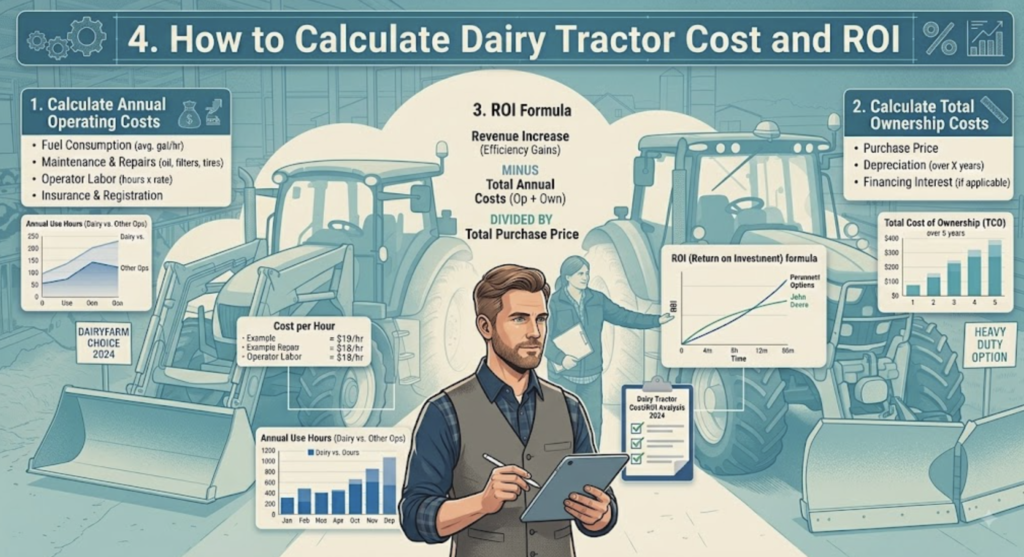
Purchase price is only one part of dairy equipment cost.
Iowa State University Extension separates machinery expenses into ownership and operating costs when estimating farm machinery economics. Ownership costs include items such as depreciation, interest, taxes, insurance, and housing, while operating costs include fuel, lubrication, repairs, and related variable expenses.
For beginners:
Ownership costs = costs that exist even when the tractor is parked
Operating costs = costs that generally rise as tractor hours increase
Ownership vs. Operating Costs
| Cost Type | Examples |
|---|---|
| Ownership | Depreciation, finance/interest, insurance, taxes, housing |
| Operating | Fuel, lubrication, repairs, maintenance, labor |
Penn State Extension also notes that machinery repair expenses vary with machine age, use, maintenance, and machinery type, which is why a low purchase price alone does not tell you the real ownership cost.
Simple Cost Model
Annual ownership cost = Depreciation + Finance/interest + Insurance + Taxes/storage
Annual operating cost = Fuel + Lubrication + Repairs + Maintenance + Labor
Total annual tractor cost = Ownership cost + Operating cost
Cost/hour = Total annual tractor cost ÷ Annual operating hours
Planning Example
Assume:
- purchase price = $120,000
- resale value = $40,000
- ownership period = 8 years
- annual use = 1,500 hr
- other annual costs = $28,000
Annual depreciation = ($120,000 − $40,000) ÷ 8 = $10,000/year
Total annual cost = $10,000 + $28,000 = $38,000/year
Cost/hour = $38,000 ÷ 1,500 = $25.33/hr
| Cost Item | Planning Example |
|---|---|
| Purchase price | $120,000 |
| Resale value | $40,000 |
| Ownership period | 8 yr |
| Annual use | 1,500 hr |
| Annual depreciation | $10,000 |
| Other annual costs | $28,000 |
| Total annual cost | $38,000 |
| Calculated tractor cost | $25.33/hr |
Planning example — not an industry-average ownership cost.
For real budgeting, use the farm’s actual purchase price, financing, fuel price, insurance, repair history, expected resale value, and annual hours. Iowa State provides machinery-cost tools specifically for estimating ownership and operating costs.
Calculate Cost Per Job
Suppose feeding requires 2.5 tractor hr/day.
Daily feeding tractor cost = 2.5 hr × $25.33/hr = $63.33/day
Annual feeding tractor cost = $63.33 × 365 = $23,115/year
For 500 cows:
Tractor feeding cost/cow/day = $23,115 ÷ 500 ÷ 365 = $0.127/cow/day
This calculation is often more useful than purchase price because it shows what the machine costs in a real production task.
How Farm Automation Changes Tractor Demand
As farm automation grows, the tractor workload may shift.
An automatic feed pusher can reduce push-up rounds. Automatic manure scrapers reduce manure-cleaning hours. Stationary or robotic feeding systems can reduce some distribution work.
That does not necessarily eliminate tractors.
Their role may shift toward:
loading + transport + field work + backup
When planning a modern dairy, calculate future tractor demand after deciding which repetitive jobs will be automated.
5. How to Choose the Right Dairy Tractor Before Buying
By this point, tractor selection should feel less like comparing brochures and more like matching a machine to a job.
Final Decision Matrix
| If Your Main Problem Is… | Prioritize |
|---|---|
| Mixer feels underpowered | PTO horsepower |
| Slow feed loading | Hydraulic flow + loader |
| Tractor cannot clear mixer | Loader lift height |
| Tight barn or yard | Compact dimensions + steering |
| Poor traction | Tires + ballast + MFWD/4WD |
| High fuel/operating cost | Transmission + correct machine sizing |
| Frequent breakdowns | Dealer support + reliability |
| Future automation | Avoid oversizing tractor fleet |
| Planned herd expansion | Moderate realistic capacity reserve |
| Very high annual hours | Durability + cost/hour |
Final Buyer Checklist
| Requirement | Verify Before Purchase |
|---|---|
| PTO hp meets implement requirement | Yes |
| PTO speed matches equipment | Yes |
| Hydraulic flow is sufficient | Yes |
| Loader capacity is adequate | Yes |
| Loader reaches mixer/feed wagon | Yes |
| Tractor fits barn doors | Yes |
| Turning area is adequate | Yes |
| Hitch/drawbar rating is sufficient | Yes |
| Tires and ballast match surfaces | Yes |
| Cab visibility is acceptable | Yes |
| Local service is available | Yes |
| Backup feeding plan exists | Yes |
| Cost/hour has been calculated | Yes |
| Future automation is considered | Yes |
Match the Tractor to the TMR Mixer
For many dairies, the TMR mixer is the first implement worth checking because it may be one of the most demanding machines used every day.
Use this sequence:
Mixer PTO requirement → PTO speed → hydraulic requirement → hitch/drawbar load → loaded mixer weight → terrain → tractor specification
Do not evaluate the mixer only when empty. Real feed weight matters.
The same logic applies to all other feeding equipment.
Service Support Is a Tractor Specification
A tractor with excellent numbers on paper can still be a poor choice if the nearest service support is far away or critical parts take weeks to arrive.
Ask:
- How quickly are common parts available?
- Is mobile service available?
- Are diagnostics supported locally?
- What happens during warranty downtime?
- Can the dealer provide emergency support?
- Is a backup tractor available?
For a tractor used for daily feeding, downtime has a real operational cost.
New vs. Used Dairy Tractor
A used tractor can reduce the upfront investment, but check more than the hour meter.
Inspect:
- service records;
- PTO wear;
- transmission operation;
- hydraulic pressure and flow;
- loader pins and bushings;
- tires;
- brakes;
- cooling system;
- electrical faults;
- emissions system where applicable.
For a critical feeding tractor, paying more for a machine with stronger maintenance history and better support may be more valuable than buying the lowest-priced unit.
Safety Matters
PTO-powered machinery requires careful operating practices. Penn State Extension emphasizes the importance of machinery safety education and proper operation around tractors and farm equipment.
Keep guards and shields in place, disengage equipment before service, and follow the tractor and implement manufacturers’ instructions.
Common Buying Mistakes
| Mistake | Better Approach |
|---|---|
| Buying from engine hp alone | Check PTO hp and actual workload |
| Choosing tractor before implements | Start with the hardest implement |
| Ignoring barn dimensions | Measure access before ordering |
| Buying at minimum specification | Evaluate realistic reserve |
| Ignoring loader lift height | Measure actual mixer height |
| Comparing purchase price only | Calculate total cost/hour |
| Ignoring dealer support | Include downtime risk |
| Buying only for today’s farm | Plan realistic expansion |
| Ignoring automation | Map future tractor workload |
Frequently Asked Questions
What size tractor does a dairy farm need?
There is no universal horsepower requirement. Light utility work may require much less power than a large mixer, forage equipment, or heavy transport. Start with the most demanding implement and verify PTO, hydraulic, hitch, weight, and braking requirements.
Is PTO horsepower more important than engine horsepower?
For PTO-driven equipment, PTO horsepower is one of the most important numbers because it describes the power available to the implement.
Is 4WD or MFWD useful on a dairy farm?
It can be especially valuable on wet yards, manure-covered concrete, silage areas, snow, slopes, or soft ground. Tires, ballast, working surface, and workload should all be considered.
Should I buy a larger tractor for future expansion?
Some additional capacity can be sensible, but excessive size increases purchase cost and may reduce maneuverability. Plan around the farm’s realistic 5–10 year workload.
Is a new or used dairy tractor better?
A used tractor can lower initial dairy equipment cost, but condition and service history become more important. For a daily feeding tractor, reliability, PTO condition, hydraulics, transmission, dealer support, and downtime risk deserve heavy weight in the decision.
How important is loader lift height?
Very important when loading a TMR wagon. Loader capacity is only useful if the attachment can safely reach high enough to clear the mixer.
Evidence Behind This Guide
| Principle / Data | Source |
|---|---|
| Ownership vs. operating machinery costs | Iowa State University Extension – Estimating Farm Machinery Costs |
| Machinery selection and ownership-cost components | Iowa State University Extension – Farm Machinery Selection |
| Repairs vary with machine age, use, and maintenance | Penn State Extension – Managing Machinery and Equipment |
| Machinery ownership vs. custom-hire considerations | Penn State Extension |
| Tractor and machinery safety education | Penn State Extension |
Engineering Note
The horsepower ranges, financial examples, and capacity reserves in this guide are preliminary planning tools. Final tractor selection should use the actual specifications of the TMR mixer, loader, trailer, manure equipment, and other implements. Verify PTO power and speed, hydraulic flow and pressure, axle loads, drawbar/hitch ratings, braking, tires, ballast, dimensions, terrain, and applicable local road and safety requirements.
Conclusion
The best dairy farm tractors are not necessarily the machines with the most horsepower.
They are the tractors that match the farm’s actual daily workload.
Start with the hardest job. Match the implement to PTO and hydraulic requirements. Confirm loader capacity and lift height. Measure barn access and turning space. Then calculate ownership and operating cost instead of comparing purchase price alone.
For feeding work, always match the tractor directly to the TMR mixer and related feeding equipment.
As farm automation expands, some repetitive tractor jobs may disappear while loading, transport, field work, and backup roles remain important.
A practical buying process is:
List jobs → Rank daily-critical work → Match implements → Check PTO and hydraulics → Confirm physical fit → Calculate cost/hour → Evaluate service → Plan future workload
Following this process makes choosing dairy farm tractors easier and reduces the risk of purchasing a machine that looks impressive in a brochure but performs poorly in everyday dairy farm operations.
Recommended Resources
- Dairy Farm Machine
- Iowa State University Extension – Farm Machinery Selection
- Iowa State University Extension – Machinery Costs
- Penn State Extension – Managing Machinery and Equipment
- Penn State Extension – Farm Equipment Safety
- University of Wisconsin–Madison Dairy Extension
- International Dairy Federation
- FAO – Dairy Production and Products
- National Dairy FARM Program
- Journal of Dairy Science
- Progressive Dairy
- Dairy Herd Management