TMR mixer maintenance keeps feeding consistent, reduces unexpected downtime, and helps extend the service life of one of the hardest-working machines on a dairy farm.
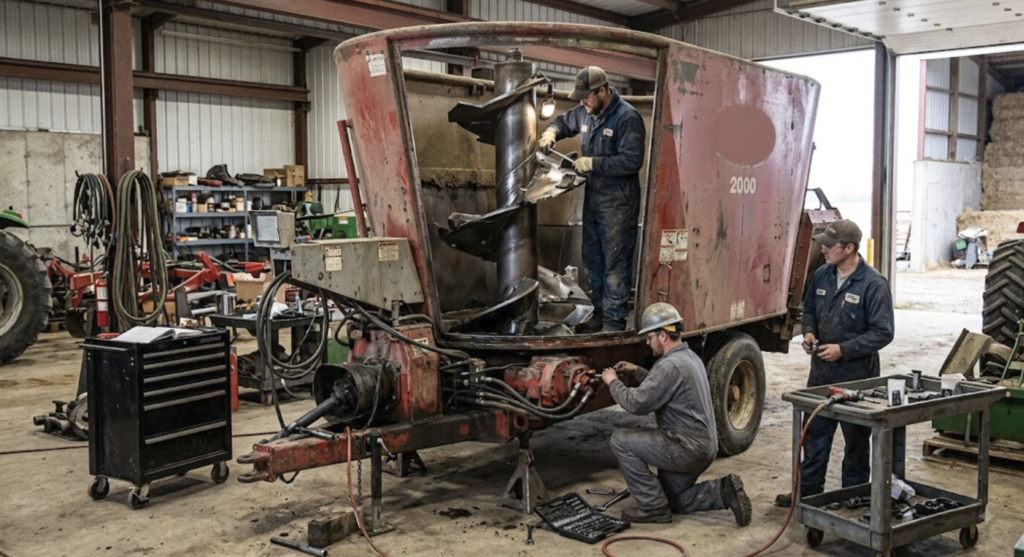
A TMR mixer operates in a demanding environment. Silage moisture, long forage, minerals, dust, repeated loading, and heavy mechanical loads gradually wear knives, augers, liners, bearings, gearboxes, conveyors, and weighing components. The machine may continue running even when these parts are already worn, so the first warning is often not a breakdown. Instead, operators may notice longer mixing time, uneven feed, inaccurate weighing, higher power demand, or slower unloading.
This matters because the mixer is the final machine between the formulated ration and the feed delivered to the cow. Penn State Extension emphasizes that scales on mixing equipment help control ingredient quantities and that load cells and scales should be kept in accurate working order.
Practical maintenance note: Service intervals vary by mixer design, ration, operating hours, working conditions, and manufacturer. The intervals below are practical inspection references. Always use the service schedule and safety procedures provided by your equipment manufacturer for the specific machine.
Why TMR Mixer Maintenance Matters
Good TMR mixer maintenance is not only about preventing a broken gearbox or bearing. It also protects mixing performance.
Knives provide a simple example. As their cutting edges wear, long forage can take longer to process. Operators sometimes compensate by increasing mixing time, but this can create another problem: excessive processing.
KUHN identifies worn knives as a possible cause of slower hay breakup and increased fuel consumption, while worn auger flighting can affect feed movement and processing.
The same principle applies throughout the machine.
| Component | Common Wear Sign | Possible Effect |
|---|---|---|
| Knives | Rounded or damaged edge | Longer forage processing |
| Auger flighting | Thin or rounded edge | Poor feed movement |
| Kicker plates | Worn edges | Reduced circulation |
| Liners | Thin spots | Tub damage |
| Bearings | Heat, noise, or play | Mechanical failure |
| Gearbox | Noise, heat, leakage | Drivetrain damage |
| Load cells | Unstable readings | Ingredient weighing errors |
| Conveyor | Slipping or uneven movement | Slow discharge |
How Poor Maintenance Affects Mixing
A worn machine can still operate, which is why gradual performance changes matter.
If the same ration previously mixed properly in four minutes but gradually requires five or six minutes, investigate the machine rather than automatically adding more mixing time.
Penn State Extension explains that under-mixing can leave long forage in clumps, while over-mixing can make particles too fine.
The goal is therefore not simply to keep the mixer turning. It is to maintain predictable cutting, mixing, weighing, and unloading performance.
Early Signs Your Mixer Needs Attention
Watch for changes such as:
- increasing mixing or processing time;
- more long forage remaining in the ration;
- unusually fine feed;
- rising tractor or motor load;
- new vibration or mechanical noise;
- hot bearings or gearbox;
- leaking oil or hydraulic fluid;
- unstable scale readings;
- slower or uneven unloading.
These symptoms do not automatically prove that a component has failed. Ingredient moisture, loading sequence, ration density, batch size, and operator technique can produce similar changes. Use them as signals to inspect the machine.
TMR Mixer Maintenance Schedule
A practical TMR mixer maintenance program divides work into small inspections instead of waiting for a major annual repair.
University of Delaware Extension recommends following manufacturer maintenance intervals and checking knives, scrapers, and shoes inside the mixer approximately every 90 days.
The following schedule can be used as a starting framework.
| Interval | Component | What to Check | Typical Action |
|---|---|---|---|
| Daily | Whole machine | Leaks, damage, loose parts | Inspect before operation |
| Daily | Mixer tub | Buildup or visible damage | Clean and inspect |
| Daily | Scale | Unstable or unusual reading | Test operation |
| Daily | Hydraulics | Hoses and leakage | Find source of leak |
| Weekly | Lubrication points | Grease condition | Lubricate per manual |
| Weekly | PTO/driveline | Wear or looseness | Inspect |
| Weekly | Gearbox | Oil level/leaks where applicable | Check per manual |
| Monthly | Knives | Rounded or damaged edges | Inspect/rotate/replace |
| Monthly | Auger and kicker plates | Wear and damage | Inspect |
| Monthly | Conveyor/discharge | Chain, belt, bearings | Adjust or service |
| ~90 days | Internal wear parts | Knives, scrapers, shoes | Detailed inspection |
| Manufacturer interval | Gearbox/drivetrain | Oil and service items | Scheduled service |
| Annual | Complete machine | Structure, scales, drivetrain | Full inspection |
These are inspection guidelines rather than universal replacement intervals.
Daily Maintenance Checklist
A useful daily inspection can often be completed during the normal pre-operation walk-around.
Check the ground beneath the mixer for fresh oil or hydraulic fluid. Look at hoses, guards, PTO components, tires, electrical cables, and visible fasteners. During operation, listen for noises or vibration that were not present previously.
Watch the scale during loading as well. A reading that suddenly jumps, drifts, or does not respond normally deserves investigation.
After feeding, observe whether the machine empties normally. Unusual material buildup can point toward scraper, auger, or discharge problems.
The operator should record unusual conditions instead of relying on memory.
| Date | Hours | Mixing Time | Scale | Noise/Leak | Action |
|---|---|---|---|---|---|
| Aug. 1 | 2.8 h | 4.0 min | Normal | None | — |
| Aug. 8 | 3.0 h | 4.4 min | Normal | None | Inspect knives |
| Aug. 15 | 3.1 h | 5.0 min | Normal | None | Replace worn knives |
This type of record makes gradual changes easier to see.
Weekly and Monthly Maintenance
Lubrication is basic dairy equipment maintenance, but lubrication intervals are machine-specific.
Do not assume that every bearing needs grease once per week. Some points may require attention after a certain number of operating hours, while others have longer intervals. Use the lubrication chart in the operator manual.
When greasing a component, inspect the surrounding area too. Check the grease fitting, line, bearing housing, shaft, universal joint, and mounting hardware.
Gearbox oil should be handled the same way. For example, Supreme International specifies an initial planetary oil change after 100 operating hours and subsequent changes every 1,500 hours or once per year for the referenced system. These figures illustrate why manufacturer instructions matter; they should not be applied automatically to another mixer.
Use the oil type, quantity, and service interval specified for your exact model.
90-Day and Annual Maintenance
A deeper inspection should focus on components that are difficult to evaluate during a quick daily walk-around.
The approximately 90-day internal inspection recommended by University of Delaware Extension is a useful opportunity to examine knives, scrapers, shoes, auger components, and internal wear surfaces.
Annual servicing can then include a broader review of structural condition, drivetrain components, weighing equipment, hydraulic systems, electrical connections, and safety guards.
Farms operating mixers for many hours every day should rely more heavily on operating-hour intervals because wear is related to use, not simply the calendar.
How to Inspect and Maintain Key TMR Mixer Parts
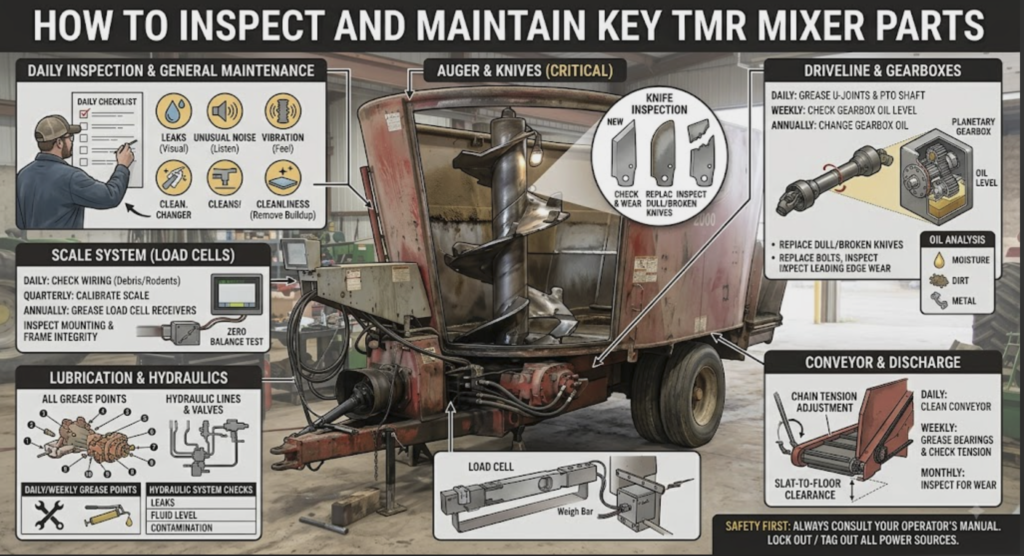
The highest-value inspections usually focus on components directly involved in cutting, moving, weighing, and discharging feed.
Knives and Cutting Components
Do not wait for a knife to break before inspecting it.
Look for rounded cutting edges, missing serrations, cracks, bent blades, damaged mounting holes, and obvious differences compared with a new replacement knife.
University of Delaware Extension specifically recommends checking that mixer knives remain sharp.
A practical warning sign is increasing forage-processing time. If ration ingredients and loading procedures have not changed but the mixer consistently takes longer, knife condition should be one of the first things checked.
Avoid compensating indefinitely by extending mixing time. The underlying wear remains, while unnecessary mixing can further reduce particle size.
Augers, Kicker Plates, and Liners
Auger flighting gradually becomes thinner and more rounded as feed moves through the chamber.
KUHN notes that worn flighting can affect feed movement and processing. Inspect the leading edges, flighting thickness, kicker plates, and areas receiving heavy ingredient impact.
Liners deserve similar attention. Replacing a worn liner before feed reaches the main tub structure is normally much easier than repairing structural damage later.
Loading also matters when evaluating wear and performance.
Mixer loading rate (%) = Actual batch weight ÷ recommended usable batch weight × 100 = 7,200 kg ÷ 8,000 kg × 100 = 90%
This calculation should not be used to establish a universal maximum. TMR mixer capacity depends on usable volume, ration density, ingredient characteristics, and manufacturer recommendations. Two rations with the same weight can occupy very different volumes.
Bearings, Gearboxes, and Drivelines
Noise, temperature, vibration, and leakage provide useful early warnings.
A bearing that becomes noticeably hotter or noisier than comparable components deserves investigation. The same applies to new driveline vibration or gearbox noise.
Do not continue operating a machine simply because it still turns. A small lubrication, bearing, or seal problem can become a more expensive shaft or gearbox repair.
For significant drivetrain problems, use the manufacturer’s troubleshooting procedure or a qualified technician rather than diagnosing internal components by guesswork.
Scales and Load Cells
A mechanically healthy mixer can still produce the wrong ration when the weighing system is inaccurate.
Penn State Extension emphasizes the importance of keeping load cells and scales accurate so the intended quantities of feed ingredients are loaded.
A simple check compares the indicated reading with a known test weight.
Scale error (%) = |Displayed weight − known weight| ÷ known weight × 100 = |980 kg − 1,000 kg| ÷ 1,000 kg × 100 = 2%
Whether a 2% error is acceptable should be determined from the scale manufacturer’s accuracy and calibration specifications rather than a generic limit.
If the reading is unstable, inspect load-cell mounting points, cables, connectors, junction boxes, and accumulated material around weighing components before calibration.
Common TMR Mixer Problems and Troubleshooting
Good TMR mixer maintenance also means watching the feed produced by the machine.
If a mixer suddenly takes longer to process the same ration, check knife condition, auger wear, ingredient changes, loading sequence, batch size, and mechanical resistance before simply increasing mixing time.
| Problem | Likely Cause | What to Check | Recommended Action |
|---|---|---|---|
| Longer mixing time | Worn knives | Cutting edges | Inspect/replace |
| Long forage clumps | Poor cutting or under-mixing | Knives and mixing procedure | Correct underlying cause |
| Too many fines | Excessive processing | Mixing time and auger | Reduce unnecessary processing |
| Uneven TMR | Poor feed circulation | Auger/kicker plates | Inspect wear |
| Higher power demand | Wear or mechanical resistance | Knives, bearings, drivetrain | Diagnose affected component |
| Scale drifts | Load-cell/electrical problem | Cables and load cells | Test/calibrate |
| Slow unloading | Discharge wear | Conveyor, chain, belt | Adjust/service |
| Gearbox noise | Lubrication/internal issue | Oil, leaks, service history | Stop and inspect |
Checking Mixing Consistency
The Penn State Particle Separator provides a practical method for evaluating particle distribution. Penn State’s procedure uses approximately 3 pints of forage or TMR and 40 total shakes, performed as eight sets of five, with a recommended shaking frequency of about 1.1 Hz and a stroke length of approximately 7 in. (17 cm).
For mixer troubleshooting, consistency matters more than a single isolated sample.
Samples taken from different points during unloading can help determine whether feed is being delivered uniformly. Penn State also notes that particle-size differences of more than approximately 3–5% between the original TMR and refusals can indicate sorting.
Feed inconsistency does not automatically mean the mixer is damaged. Before replacing parts, also check ration moisture, ingredient loading order, mixing time, batch size, and operating procedure.
Building a Long-Term TMR Mixer Maintenance Plan
The best maintenance program is one that operators can follow consistently.
Start with the manual supplied by the equipment manufacturer and convert the required service intervals into a simple farm maintenance record.
Track operating hours rather than relying only on calendar dates, especially on larger farms where mixers may run for several hours every day.
| Record | Why Track It |
|---|---|
| Operating hours | Schedule hour-based service |
| Lubrication | Prevent missed servicing |
| Gearbox oil | Protect drivetrain |
| Knife replacement | Measure wear rate |
| Auger/liner repairs | Monitor major wear |
| Scale calibration | Protect weighing accuracy |
| Mixing time | Detect performance changes |
| Repair cost | Measure ownership cost |
| Downtime | Evaluate reliability |
Maintenance Cost and Repair Decisions
Maintenance records become especially valuable as a mixer ages.
Calculate maintenance cost per operating hour each year and compare the trend.
Maintenance cost per operating hour = Annual maintenance and repair cost ÷ annual operating hours = $6,000 ÷ 2,000 h = $3.00/hour
A single expensive repair does not automatically justify replacing the machine. Look at repeated failures, downtime, structural condition, changing herd requirements, and whether the existing TMR mixer capacity still fits the feeding program.
| Situation | Usually Consider |
|---|---|
| Worn knives | Replace wear parts |
| Worn liner | Repair before structural damage |
| Single bearing failure | Repair |
| Scale/load-cell problem | Repair/calibrate |
| Repeated gearbox failures | Compare repair vs replacement |
| Major structural deterioration | Evaluate replacement |
| Frequent unplanned downtime | Calculate downtime cost |
| Mixer too small for current herd | Reassess capacity |
| Rapidly rising annual repair cost | Compare ownership alternatives |
This turns dairy equipment maintenance records into useful purchasing information instead of simply a history of repairs.
Working With Your Equipment Manufacturer
When ordering replacement parts or requesting technical support, provide the mixer model, serial number, year, operating hours, component location, and clear photographs when useful.
Parts that appear similar can have different dimensions, materials, mounting patterns, or operating clearances.
For major structural, drivetrain, hydraulic, electrical, or load-cell problems, follow manufacturer procedures or use a qualified technician. Supreme International similarly distinguishes routine owner maintenance from work that may require dealer support.
Safety should always come before maintenance speed. Isolate the machine from its power source and follow the manufacturer’s lockout procedure before reaching into or entering the mixing chamber. Never assume that a stopped PTO, hydraulic system, motor, or engine means the machine cannot move.
A reliable maintenance program ultimately combines mechanical inspection, lubrication, wear management, scale accuracy, feed-quality observation, and good records. When operators notice changes in mixing time, power demand, weighing accuracy, particle distribution, or unloading behavior early, relatively small problems are easier to investigate before they become major failures.
That is the practical goal of TMR mixer maintenance: keep the machine predictable, keep the ration consistent, and keep essential dairy farm equipment ready for the next feeding.
Recommend Resources
- Dairy Farm Machine
- Penn State Extension – Total Mixed Rations for Dairy Cows
- Penn State Extension – Penn State Particle Separator
- KUHN – TMR Mixer Maintenance Tips
- University of Delaware Extension – Maintain Your TMR Mixer
- International Dairy Federation (IDF)
- Food and Agriculture Organization (FAO) – Dairy Production
- National Dairy FARM Program
- Journal of Dairy Science
- Progressive Dairy
- Dairy Herd Management