Choosing the right dairy cow breed is one of the most important decisions for any dairy farmer. Among the many options available worldwide, Holstein vs Jersey vs Brown Swiss is one of the most common comparisons for both beginners and experienced producers. Each breed offers unique advantages in milk production, feed efficiency, adaptability, longevity, and milk quality.
In recent years, dairy farmers have paid increasing attention not only to production performance but also to cow genetics, sustainability, heat tolerance, disease resistance, and lifetime profitability. Advances in genetic selection and breeding technologies have made it possible to improve milk yield while enhancing animal health and reducing production costs. As a result, selecting the right breed has become a long-term investment rather than simply choosing the highest-producing cow.
There is no single “best” dairy cow breed. A large commercial dairy farm may prioritize maximum milk volume, while a small family farm may focus on lower feed costs, easier management, or higher butterfat and protein content. Understanding the strengths and limitations of the top dairy breeds helps farmers make informed decisions based on their climate, management system, available feed resources, and market demand.
This guide compares Holstein, Jersey, and Brown Swiss in detail, including milk production, milk composition, feed efficiency, temperament, adaptability, lifespan, and cow genetics, helping you determine which breed is the best fit for your dairy farming goals.
Holstein vs Jersey vs Brown Swiss: Key Differences at a Glance
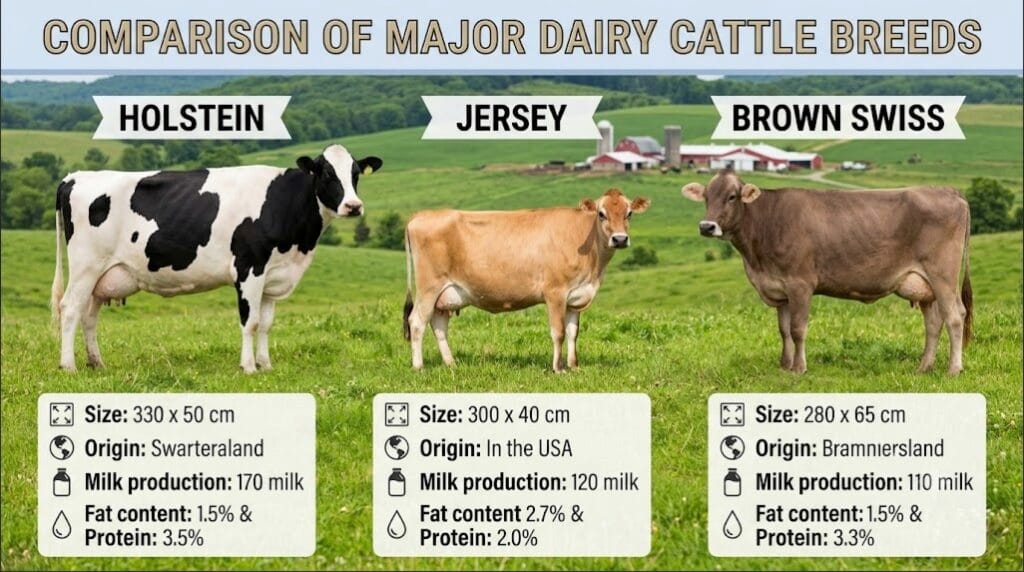
Before choosing a dairy cow breed, farmers should understand the basic characteristics of each option. Holstein cows are famous for producing large amounts of milk, Jersey cows are known for high-fat milk, and Brown Swiss cows are valued for their strength and long productive life.
| Feature | Holstein | Jersey | Brown Swiss |
|---|---|---|---|
| Origin | Netherlands | Jersey Island | Switzerland |
| Main Advantage | Highest milk production | High milk fat and protein | Strong health and durability |
| Body Size | Large | Small to medium | Large |
| Average Milk Production | 8,000–12,000 kg/lactation | 5,000–8,000 kg/lactation | 7,000–10,000 kg/lactation |
| Milk Fat | About 3.5–4% | About 4.5–5.5% | About 4–4.5% |
| Feed Requirement | High | Lower | Medium |
| Heat Tolerance | Moderate | Good | Good |
| Suitable For | Large dairy farms | Small farms and specialty milk markets | Long-term dairy operations |
The best breed depends on farm size, climate, feed availability, milk market, and management level.
Holstein Cows: The Best Choice for Maximum Milk Production
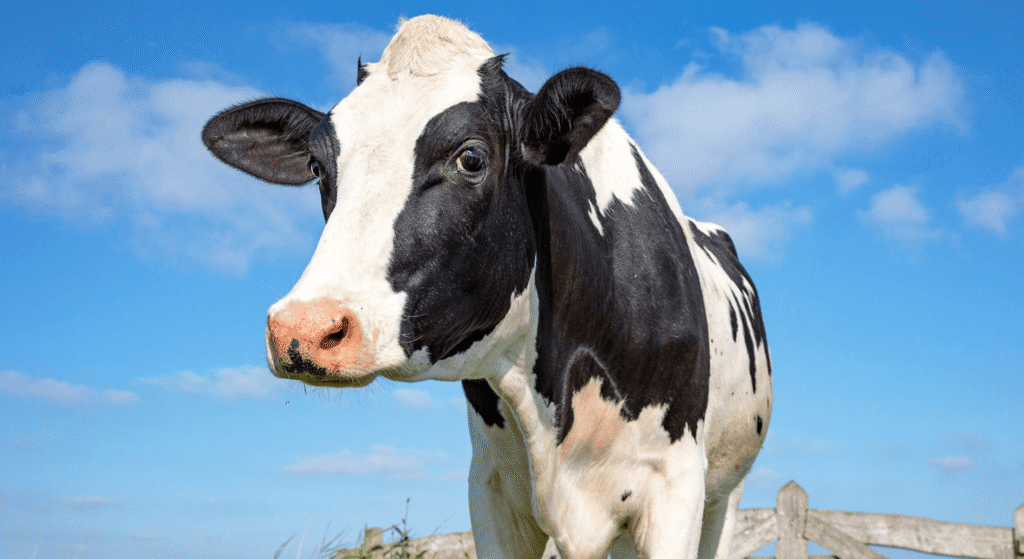
Image from: https://en.wikipedia.org/wiki/Holstein_Friesian
Why Do Farmers Choose Holstein?
Holstein cows are the world’s most popular dairy breed because they produce more milk than any other dairy cow breed. Although they require better nutrition and management, their high milk yield allows commercial farms to achieve lower production costs per liter of milk.
Today, over 80% of large commercial dairy farms use Holsteins because they fit well with automated milking systems, precision feeding, and modern dairy management.
Holstein cows are the world’s most popular dairy breed because they produce more milk than any other dairy cow breed. Although they require better nutrition and management, their high milk yield allows commercial farms to achieve lower production costs per liter of milk.
Today, over 80% of large commercial dairy farms use Holsteins because they fit well with automated milking systems, precision feeding, and modern dairy management.
Holstein Strengths and Weaknesses
| Category | Strengths | Weaknesses | Why It Matters |
|---|---|---|---|
| Milk Yield | ⭐⭐⭐⭐⭐ Highest milk production (9,000–12,000+ L/year) | Requires high-energy diet | Best for farms selling milk by volume |
| Butterfat | Moderate (3.5–3.8%) | Lower than Jersey | Less suitable for butter or specialty cheese |
| Protein | Good | Lower than Jersey | Cheese factories may prefer higher protein milk |
| Feed Efficiency | Produces more milk per cow | Eats more feed | High output offsets feed cost on large farms |
| Genetics | Excellent cow genetics with decades of breeding | High-producing genetics need careful management | Easy to improve herd through AI and genomic selection |
| Temperament | Generally calm | Larger body requires more space | Easy to handle in modern dairy farms |
| Adaptability | Performs well in temperate climates | Sensitive to heat stress | Cooling systems become important in hot regions |
| Disease Resistance | Improved through breeding | Higher risk of metabolic disorders after calving | Requires good transition cow management |
| Reproduction | Well studied with abundant breeding data | Fertility lower than some breeds | Good reproductive management is essential |
| Market Availability | Widely available worldwide | High-quality genetics can be expensive | Easy to purchase replacement heifers |
Why Holstein Became the World’s No.1 Dairy Breed
| Perspective | Explanation |
|---|---|
| Economics | Highest milk output generates the greatest revenue per cow. |
| Farm Efficiency | Fewer cows are needed to produce the same amount of milk. |
| Labor Saving | Compatible with robotic milking and automatic feeding systems. |
| Cow Genetics | The most advanced dairy breed for genomic selection and artificial insemination. |
| Global Supply Chain | Holstein semen, embryos, and replacement heifers are available almost everywhere. |
| Research Support | Most dairy nutrition and health studies are conducted using Holsteins, making management recommendations highly reliable. |
| Technology Compatibility | Precision dairy farming technologies are primarily designed around Holstein herds. |
When Holstein Is the Best Choice
| Farm Type | Suitable? | Reason |
|---|---|---|
| Large Commercial Dairy Farm | ⭐⭐⭐⭐⭐ | Maximum milk production and automation |
| Robotic Dairy Farm | ⭐⭐⭐⭐⭐ | Uniform size and excellent milking performance |
| Milk Processing Plant Supplier | ⭐⭐⭐⭐⭐ | High milk volume ensures stable supply |
| Family Dairy Farm (100+ cows) | ⭐⭐⭐⭐☆ | High profit with good management |
| Small Organic Farm | ⭐⭐⭐☆☆ | Higher feed costs may reduce profitability |
| Hot Tropical Farm | ⭐⭐☆☆☆ | Heat stress reduces production unless cooling is available |
Is Holstein Right for Every Farm?
Not necessarily.
Holsteins are often the best choice for farms focused on high milk production and modern dairy technology, but they are not ideal for every situation. Farms in hot climates, operations with limited feed quality, or businesses targeting premium butter or cheese production may benefit more from breeds such as Jersey or Brown Swiss. The best dairy breed depends on your climate, feeding program, labor resources, milk market, and long-term breeding strategy.
Jersey Cows: The Best Breed for High-Quality Milk
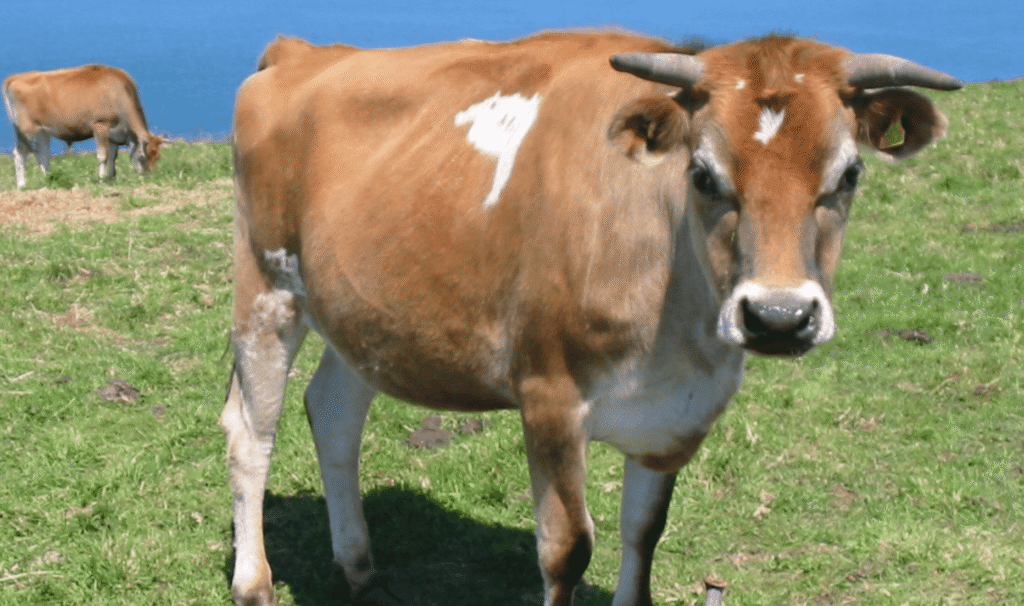
Image From: https://en.wikipedia.org/wiki/Jersey_cattle
Jersey cows are one of the world’s most popular dairy breeds, especially for farms that value high-quality milk over maximum milk volume. Although they produce less milk than Holsteins, Jersey cows are famous for their rich milk, excellent feed efficiency, gentle temperament, and lower maintenance costs.
Today, Jersey cattle are widely used by family farms, organic dairies, cheese producers, and premium dairy brands. Their superior milk composition makes them one of the top dairy breeds for producing butter, cheese, yogurt, and other value-added dairy products. In addition, continuous improvements in cow genetics have further enhanced Jersey cows’ productivity, fertility, and health, making them an increasingly attractive choice for modern dairy farming.
Jersey Cow Strengths and Weaknesses
| Category | Strengths | Weaknesses | Why It Matters |
|---|---|---|---|
| Milk Quality | ⭐⭐⭐⭐⭐ Very high butterfat (4.8–5.5%) and protein | Lower total milk volume | Ideal for premium dairy products |
| Milk Yield | Good production for body size | Produces less milk than Holstein | Income depends more on milk price than volume |
| Feed Efficiency | Excellent feed conversion | Cannot match Holstein’s total output | Lower feed cost per kilogram of milk solids |
| Body Size | Small, lightweight | Smaller market for beef | Requires less housing space and feed |
| Temperament | Gentle, curious, easy to handle | Can be more active than larger breeds | Suitable for family farms |
| Fertility | Excellent reproductive performance | — | Faster herd replacement and fewer breeding problems |
| Calving | Easy calving with fewer complications | — | Reduces veterinary costs and calf losses |
| Longevity | Long productive life | — | Improves lifetime profitability |
| Heat Tolerance | Better than Holstein | Still needs cooling in extreme climates | Performs well in warm regions |
| Cow Genetics | Strong genetic improvement for milk solids | Smaller global genetic pool than Holstein | Excellent choice for specialized dairy production |
Why Do Farmers Choose Jersey Cows?
Farmers choose Jersey cows because they produce more valuable milk, not necessarily more milk.
The higher butterfat and protein content increase the yield of cheese, butter, yogurt, and other dairy products. Many processors pay premiums for milk solids, allowing Jersey farmers to earn more from each liter of milk.
Other reasons include:
- Higher butterfat and protein increase milk value.
- Excellent feed efficiency reduces feeding costs.
- Smaller cows require less housing space.
- Easier calving lowers veterinary expenses.
- Better fertility improves reproductive efficiency.
- Longer productive lifespan increases return on investment.
- Gentle temperament simplifies daily management.
- Well suited for pasture-based and organic farming systems.
Is Jersey Suitable for Every Dairy Farm?
No.
Although Jersey cows excel in milk quality and efficiency, they are not the ideal choice for every dairy operation.
Large commercial dairies that are paid mainly by milk volume often prefer Holsteins because they produce significantly more milk per cow. However, farms that receive premiums for butterfat or protein frequently find Jersey cows to be more profitable despite their lower milk yield.
The best breed depends on how the farm earns its income rather than simply how much milk each cow produces.
Who Should Choose Jersey Cows?
| Farm Type | Suitable? | Why |
|---|---|---|
| Family Dairy Farm | ⭐⭐⭐⭐⭐ | Easy management and lower operating costs |
| Cheese Producer | ⭐⭐⭐⭐⭐ | High protein improves cheese yield |
| Butter Producer | ⭐⭐⭐⭐⭐ | Exceptional butterfat content |
| Organic Dairy Farm | ⭐⭐⭐⭐⭐ | Efficient grazing and lower feed requirements |
| Pasture-Based Dairy Farm | ⭐⭐⭐⭐⭐ | Excellent grazing ability |
| Premium Milk Brand | ⭐⭐⭐⭐⭐ | Rich, creamy milk attracts premium markets |
| Robotic Dairy Farm | ⭐⭐⭐⭐☆ | Smaller cows adapt well with proper system setup |
| Large Commercial Milk Farm | ⭐⭐⭐☆☆ | Lower milk volume may reduce total production |
| Farms Paid by Milk Volume Only | ⭐⭐☆☆☆ | Holsteins usually provide higher total revenue |
Should You Choose Jersey Cows?
Choose Jersey cows if your dairy business focuses on:
- Producing premium milk with high butterfat and protein.
- Manufacturing cheese, butter, yogurt, or specialty dairy products.
- Improving feed efficiency and reducing production costs.
- Managing a small or medium-sized dairy farm.
- Operating a pasture-based or organic dairy system.
- Maximizing lifetime profitability instead of total milk volume.
If your primary goal is producing the highest possible volume of fluid milk for a commercial processor, Holstein cows may be a better option. However, if your market rewards milk quality and milk solids, Jersey cows are among the best dairy breeds available.
Brown Swiss Cows: The Strong and Reliable Dairy Breed
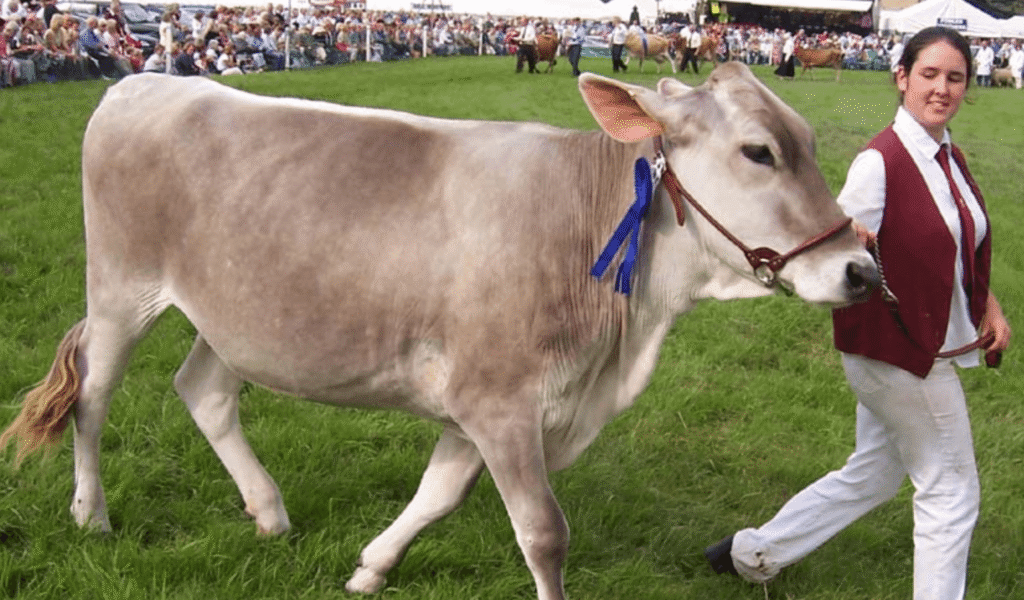
Image From: https://en.wikipedia.org/wiki/Brown_Swiss_cattle#/media/File:Brown_swiss.jpg
Brown Swiss cows are one of the oldest and most respected dairy cattle breeds in the world. Originating from the Swiss Alps, they are well known for their strength, durability, long productive life, and balanced milk production. While they may not produce as much milk as Holsteins or as much butterfat as Jerseys, Brown Swiss cows offer an excellent combination of production, health, and longevity.
Today, Brown Swiss cattle are popular among dairy farmers looking for reliable, low-maintenance cows that perform consistently under different farming conditions. Their calm temperament, strong feet and legs, and excellent cow genetics have made them one of the top dairy breeds for farms seeking long-term profitability rather than maximum short-term production.
Brown Swiss Strengths and Weaknesses
| Category | Strengths | Weaknesses | Why It Matters |
|---|---|---|---|
| Milk Production | High and consistent (7,000–10,000 L/year) | Lower than Holstein | Good balance between quantity and quality |
| Milk Quality | High protein and good butterfat (around 4.0%) | Butterfat lower than Jersey | Excellent for cheese production |
| Feed Efficiency | Efficient for medium to large cows | Larger body requires more feed than Jersey | Good lifetime feed efficiency |
| Body Size | Strong, muscular, durable | Requires larger housing than Jersey | Suitable for commercial farms |
| Temperament | Very calm and easy to manage | Slower maturity than some breeds | Reduces handling stress and labor |
| Longevity | ⭐⭐⭐⭐⭐ Exceptional productive lifespan | — | More lactations improve lifetime profitability |
| Feet and Legs | Excellent hoof strength and mobility | — | Lower lameness risk and veterinary costs |
| Disease Resistance | Strong immune system and fewer health issues | Still requires good management | Lower replacement rate |
| Heat & Cold Tolerance | Adapts well to both cold and warm climates | Extreme heat still requires cooling | Suitable for diverse environments |
| Cow Genetics | Excellent genetics for longevity, protein, and structural soundness | Smaller global population than Holstein | Popular for improving herd durability |
Why Do Farmers Choose Brown Swiss Cows?
Many farmers choose Brown Swiss because they provide reliable performance year after year, rather than focusing on record-breaking milk production.
Their combination of good milk yield, excellent health, and long productive life helps reduce replacement costs and improve overall farm profitability.
Common reasons include:
- Long productive lifespan with more lifetime milk.
- High milk protein ideal for cheese manufacturing.
- Strong feet and legs reduce lameness.
- Excellent fertility and calving performance.
- Calm temperament makes herd management easier.
- Adaptable to different climates and housing systems.
- Lower veterinary and replacement costs.
- Excellent cow genetics for breeding stronger, healthier dairy herds.
Is Brown Swiss Suitable for Every Dairy Farm?
Not entirely.
Brown Swiss cows are highly adaptable and perform well in many production systems, but they are not always the best choice.
Large commercial farms focused solely on maximum milk volume often prefer Holsteins. Farms producing premium butter may favor Jerseys because of their higher butterfat percentage.
Brown Swiss cows are best suited for farmers who value balanced performance, animal health, longevity, and lower lifetime operating costs.
Who Should Choose Brown Swiss Cows?
| Farm Type | Suitable? | Why |
|---|---|---|
| Family Dairy Farm | ⭐⭐⭐⭐⭐ | Easy management and dependable production |
| Cheese Production Farm | ⭐⭐⭐⭐⭐ | High protein improves cheese yield |
| Mountain or Hilly Farm | ⭐⭐⭐⭐⭐ | Strong feet and excellent mobility |
| Mixed Dairy and Beef Farm | ⭐⭐⭐⭐☆ | Large body provides additional beef value |
| Organic Dairy Farm | ⭐⭐⭐⭐☆ | Healthy, durable cows fit sustainable systems |
| Pasture-Based Dairy Farm | ⭐⭐⭐⭐☆ | Strong grazing ability and endurance |
| Large Commercial Dairy Farm | ⭐⭐⭐⭐☆ | Reliable production with lower replacement rates |
| Farms Focused Only on Milk Volume | ⭐⭐⭐☆☆ | Holstein generally produces more milk |
| Butter Production Farm | ⭐⭐⭐☆☆ | Jersey offers higher butterfat content |
Should You Choose Brown Swiss Cows?
Brown Swiss cows are an excellent choice if your dairy farm values:
- Long productive lifespan.
- Reliable milk production.
- High milk protein for cheese production.
- Strong feet, legs, and structural soundness.
- Lower replacement and veterinary costs.
- Adaptability to different climates.
- Calm temperament and easy herd management.
- Sustainable, long-term dairy farming.
If your primary goal is producing the highest possible milk volume, Holstein cows may be a better choice. If your business depends on exceptionally high butterfat content, Jersey cows are likely more suitable. However, if you want a breed that combines production, health, durability, and longevity, Brown Swiss is one of the most balanced dairy breeds available.
Conclusion
Holstein, Jersey, and Brown Swiss cows represent three different dairy farming strategies. Holstein is the best choice for maximum milk production, Jersey is ideal for high-quality milk and feed efficiency, while Brown Swiss is valued for cow health, durability, and longevity.
The right breed selection depends on your farm goals, including milk market, dairy nutrition, climate, herd management ability, and replacement planning. A successful dairy farm should consider not only daily milk yield but also long-term performance, production costs, and the number of replacement heifers needed to maintain a healthy and profitable herd.
Frequently Asked Questions (FAQ)
1. Which dairy cow breed produces the most milk?
Holstein cows produce the highest milk volume among the major dairy breeds. They are the preferred choice for large commercial dairy farms that focus on maximizing milk production.
2. Which is better: Holstein, Jersey, or Brown Swiss?
There is no single best breed.
- Holstein is best for maximum milk production.
- Jersey is best for high-quality milk, feed efficiency, and premium dairy products.
- Brown Swiss is best for longevity, cow health, and reliable long-term performance.
The best choice depends on your farm size, feeding system, milk market, and management goals.
3. Which dairy cow breed has the highest milk quality?
Jersey cows produce the highest-quality milk because of their high butterfat and protein content. Their milk is especially valuable for cheese, butter, yogurt, and specialty dairy products.
4. Which dairy cow breed is easiest to manage?
Jersey and Brown Swiss cows are generally easier to manage because they have good fertility, strong adaptability, and excellent cow health. However, proper herd management and dairy nutrition are still essential for all breeds.
5. Which dairy cow breed is best for a commercial dairy farm?
Holstein is usually the best choice for large commercial dairy farms because of its high milk production, advanced cow genetics, and compatibility with modern dairy systems such as automated feeding and robotic milking.
However, farms focused on premium milk products or long-term herd sustainability may benefit more from Jersey or Brown Swiss cows.