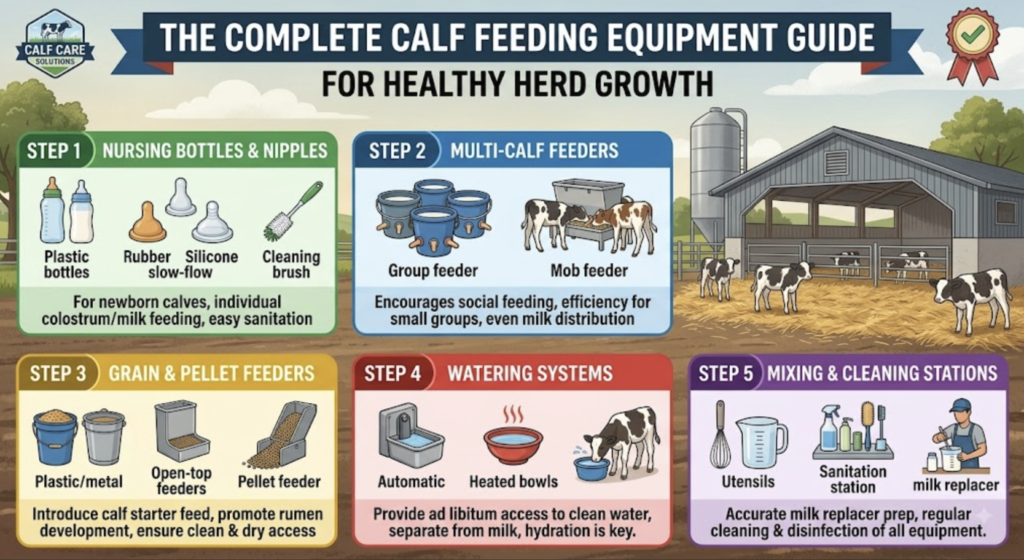
The Complete Calf Feeding Equipment Guide for Healthy Herd Growth
Calf feeding equipment includes colostrum bottles, tube feeders, nipple buckets, milk carts, automatic calf feeders, starter feeders, water buckets, measuring tools, and cleaning equipment. Small dairies can often use simple manual systems, while larger calf programs may benefit from milk carts or automated feeders that improve feeding consistency and provide individual feeding records.
Meta Description: Learn how to choose calf feeding equipment for dairy farms, from colostrum bottles and milk carts to automatic calf feeders, water systems, cleaning equipment, sizing, and automation.
For a beginner, it is easy to focus on the machine first. In practice, the feeding program should come first.
A $20 bottle used correctly can be more useful than an expensive automatic feeder that is poorly cleaned or incorrectly programmed. Good equipment should make feeding consistent, measurable, easy to clean, and easy to monitor.
Think about the calf’s feeding journey as four stages:
Colostrum → Milk or Milk Replacer → Water + Starter → Weaning
The equipment changes as the calf grows.
Quick Answer: Essential Calf Feeding Equipment
| Equipment | Main Job | Typical Application |
|---|---|---|
| Colostrum bottle | First colostrum feeding | Every dairy |
| Esophageal tube feeder | Deliver colostrum when required | Newborn calf management |
| Brix refractometer | Check colostrum quality | Colostrum program |
| Bottle/nipple bucket | Individual milk feeding | Small calf groups |
| Milk cart | Mix, transport and dispense milk | Medium–large groups |
| Automatic calf feeder | Individual feeding in group housing | Larger/automated programs |
| Starter feeder | Provide fresh dry starter | All preweaning programs |
| Water bucket/trough | Free-choice drinking water | All calves |
| Scale/thermometer | Feeding and growth control | All management levels |
| Cleaning station | Wash and sanitize equipment | Every feeding system |
Beginner takeaway: do not think of calf feeding equipment as one machine. It is a small system that changes as the calf moves from colostrum toward milk, starter feed, water, and eventually weaning.
1. What Calf Feeding Equipment Is Needed From Birth to Weaning?
A newborn calf and a seven-week-old calf have very different nutritional needs. Equipment should therefore follow the calf’s growth stage rather than forcing one feeding method across the entire preweaning period.
Colostrum Feeding Equipment
Colostrum is the first priority after birth.
A practical colostrum station normally includes:
- clean bottles and nipples;
- esophageal tube feeder;
- Brix refractometer;
- labeled storage bags or containers;
- refrigerator/freezer;
- controlled warming equipment;
- dedicated washing and drying area.
Colostrum quantity should follow the farm’s veterinary protocol and account for calf size and condition.
For liquid feeding after the colostrum period, current Penn State Extension guidance gives a general recommendation of approximately 10% of birth weight for milk or 12% for milk replacer. (Penn State Extension)
For example:
Milk-replacer example = 100-lb calf × 12% = 12 lb/day → 6 lb/feed when fed twice daily
Penn State notes that approximately 1 pint of liquid milk or milk replacer weighs 1 lb, making that example about 3 qt/feed when divided into two feedings. (Penn State Extension)
This is a useful reference, not a universal feeding prescription. Breed, weather, milk solids, health status, growth targets, and the farm’s nutrition program all matter.
Equipment by Calf Growth Stage
| Stage | Main Feed | Key Equipment | Main Goal |
|---|---|---|---|
| Birth–24 hr | Colostrum | Bottle, nipple, tube feeder, Brix meter | Colostrum management |
| Day 2–14 | Milk/milk replacer + water | Bottle/bucket, thermometer | Consistent liquid feeding |
| Week 2–5 | Milk + starter + water | Milk feeder, starter bin, water bucket | Rumen development |
| Week 5–8+ | Reduced milk + starter + water | Feeder, scale | Prepare for weaning |
| Group housing | Controlled milk allowance | Automatic calf feeder | Individual intake + monitoring |
The exact age ranges vary between calf programs. The important idea is the progression.
A newborn needs fast, reliable colostrum delivery. Later, the focus moves toward consistent liquid nutrition. As the calf develops, water and starter become increasingly important.
This is where good calf management matters more than owning a particular machine.
2. Bottle vs. Bucket vs. Milk Cart vs. Automatic Calf Feeder
For most dairy farms, the biggest equipment decision is how milk moves from the preparation area to the calf.
There are four common approaches.
Feeding System Comparison
| Function | Bottle | Nipple Bucket | Milk Cart | Automatic Feeder |
|---|---|---|---|---|
| Individual feeding | Yes | Yes | Yes | Yes |
| Automatic calf identification | No | No | No | Yes |
| Automatic intake records | No | No | Usually No | Yes |
| Automatic milk mixing | No | No | Model-dependent | Yes |
| Suitable for group housing | Limited | Limited | Yes | Yes |
| Repetitive feeding labor | High | High | Medium | Lower |
| Initial investment | Low | Low | Medium | High |
| Cleaning complexity | Low | Low | Medium | High |
| Good for newborns | Yes | Yes | Yes | Training required |
| Useful for large groups | Low | Low–Medium | High | High |
This table makes the buying logic easier to understand:
Few calves → bottles or buckets
More calves + repetitive transport → milk cart
Large group + individual feeding data → evaluate an automatic feeder
Manual Calf Feeding Equipment
Bottles and nipple buckets have one major advantage: simplicity.
Employees can see each calf during feeding and quickly notice a calf that refuses milk or behaves differently.
The problem appears when calf numbers increase.
Imagine filling, carrying, feeding, collecting, washing, and drying 10 bottles. That is manageable.
Now imagine doing the same for 100 calves, twice every day.
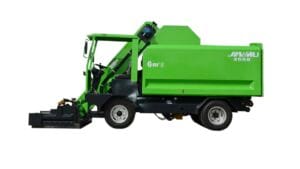
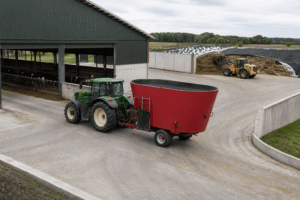
A milk cart can reduce this repetitive work by combining milk preparation, transportation, and measured dispensing in one machine.
Automatic Calf Feeders
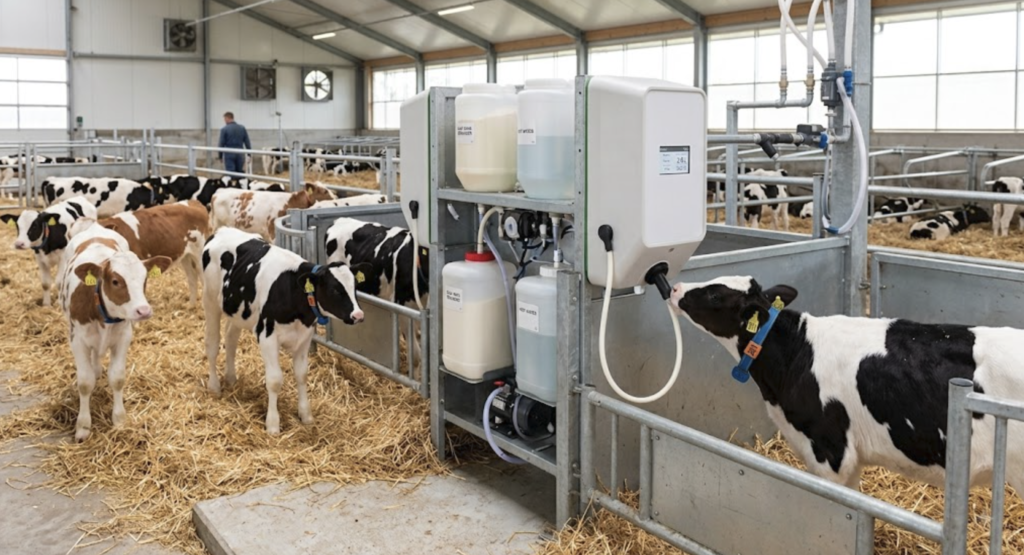
Automatic milk feeders represent a more advanced level of dairy automation.
The feeder identifies an individual calf—usually through electronic identification—and delivers milk according to a programmed allowance.
More importantly, the system can generate individual feeding data.
Research in the Journal of Dairy Science describes automated feeders recording information such as:
- daily milk intake;
- drinking speed;
- rewarded visits;
- unrewarded visits;
- feeding intervals.
A study involving 599 Holstein heifer calves found significant associations between calf health status and measures including total milk intake and drinking speed. The researchers concluded that automated feeder data may be useful as a screening tool for disease, rather than a stand-alone diagnosis. Read the Journal of Dairy Science study. (Journal of Dairy Science)
Another study across 8 dairy farms and 523 observations found that calves with bovine respiratory disease consumed 63% less of their daily milk allotment and drank 152 mL/min slower than calves without BRD. However, the researchers also found low specificity when individual feeding behaviors were used for disease identification. (Journal of Dairy Science)
That distinction matters for E-E-A-T:
Feeder data can tell you which calf deserves attention; it cannot tell you exactly what disease the calf has.
This is a practical example of smart farming supporting—not replacing—experienced stockpeople.
What Automation Cannot Replace
Automatic feeders still require people to:
- inspect calves;
- clean nipples and hoses;
- calibrate the machine;
- monitor milk powder or milk supply;
- train new calves;
- respond to alerts;
- maintain group hygiene.
A 2026 Journal of Dairy Science study also found that training calves to use automated feeders requires meaningful labor during the adaptation period. Feeding behavior could help predict training success, but automation does not eliminate this management work. (Journal of Dairy Science)
Good technology changes where labor is used. It does not remove calf management.
3. Water, Starter Feed and Cleaning Equipment
Milk receives most of the attention when farms buy calf feeding equipment, but water, starter, and sanitation equipment are equally important parts of the system.
Water Equipment
Milk is not a replacement for free-choice water.
Every calf program should have a practical way to provide fresh, clean water.
Useful equipment can be as simple as an individual bucket or, in group housing, a correctly positioned trough or automatic waterer.
The USDA/Bovine Alliance on Management and Nutrition feeding guide recommends keeping fresh, clean water available at all times. It also recommends introducing small quantities of fresh starter from about day 4. USDA/BAMN calf-feeding guide. (APHIS)
Water equipment should be:
- easy to reach;
- difficult to contaminate with manure;
- easy to empty;
- easy to scrub;
- protected from freezing where necessary.
A large water container is not useful if the water becomes dirty and remains there for several days.
Starter Feed Equipment
Starter feeders should keep feed fresh, dry, and easy for calves to access.
The USDA/BAMN guide recommends a high-quality starter containing approximately 22–25% crude protein on a dry-matter basis, equivalent to about 20–23% on an as-fed basis, in the program it describes. (APHIS)
The same guide gives a weaning-stage reference of at least 1.4 kg (3 lb) of starter per day for 3 consecutive days by weaning age for healthy calves under its program. (APHIS)
These numbers are useful examples, but the farm’s nutritionist should determine the actual starter specification and weaning protocol.
For beginners, the equipment lesson is simpler:
Do not use a large feeder as an excuse to leave old starter in front of calves.
Smaller quantities refreshed regularly can make freshness easier to manage.
Cleaning Equipment Is Feeding Equipment
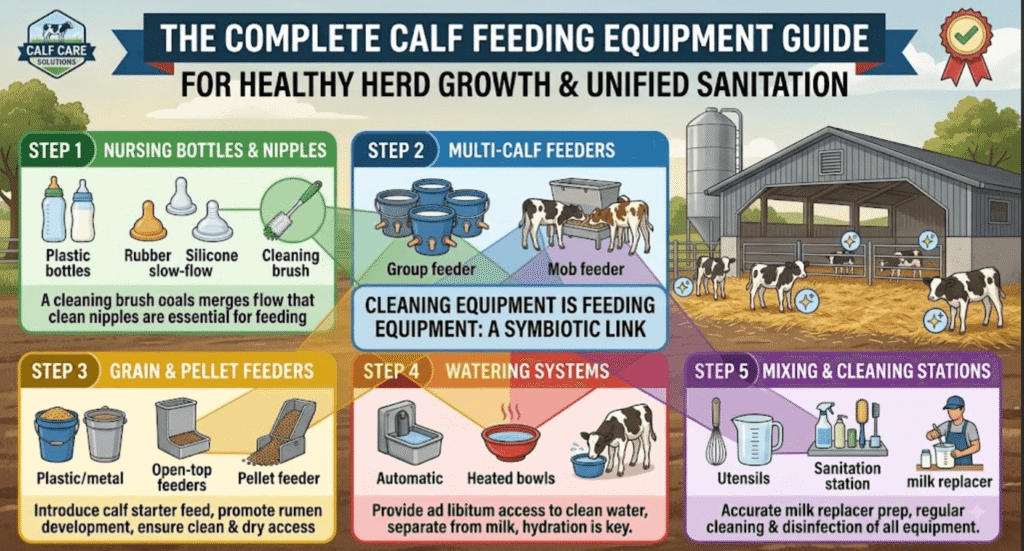
A feeding system is only as hygienic as its hardest-to-clean component.
| Cleaning Equipment | Purpose |
|---|---|
| Dedicated bottle brushes | Remove milk residue |
| Nipple brushes | Clean internal surfaces |
| Hot-water supply | Support washing |
| Appropriate detergent | Remove fat/protein deposits |
| Sanitizer | Reduce microbial contamination |
| Drying rack | Allow equipment to dry |
| Dedicated colostrum tools | Reduce cross-contamination |
| Cleaning log | Improve consistency |
Automatic feeders deserve particular attention because milk passes through internal hoses, valves, mixing chambers, and nipples.
The outside of a feeder can look spotless while internal surfaces still contain milk residue.
When comparing equipment, therefore, ask:
How long does feeding take?
but also:
How long does proper cleaning take?
Both numbers affect the real labor requirement.
4. How to Size Calf Feeding Equipment for Your Dairy Farm
Do not size calf equipment from the number of adult cows alone.
The more useful number is:
How many milk-fed calves will I need to feed at the same time during the busiest period?
A 1,000-cow dairy with year-round calving can have a very different peak workload from a 1,000-cow operation with concentrated calving.
Practical Starting Point by Calf Numbers
| Preweaned Calves at One Time | Practical Starting System |
|---|---|
| <20 | Bottles/nipple buckets |
| 20–50 | Buckets + milk cart |
| 50–100 | Milk cart or evaluate automation |
| 100–200 | Evaluate automatic/multi-station feeding |
| >200 | Multiple stations + centralized preparation |
Important: these are planning ranges, not research thresholds or manufacturer capacity specifications.
Actual capacity depends on milk allowance, feeding frequency, feeder throughput, group size, layout, labor, and the selected machine.
Calculate Daily Milk Capacity First
Use:
Daily liquid capacity = Number of milk-fed calves × Liters/calf/day
For 80 calves receiving 8 L/day:
Daily liquid requirement = 80 calves × 8 L = 640 L/day
If feeding twice daily:
Milk/feed = 640 L ÷ 2 = 320 L/feed
With a 150-L milk cart:
Cart trips/feed = 320 L ÷ 150 L = 2.13 → minimum 3 loaded trips/feed
That means the farm needs at least 6 loaded cart trips/day for two feeding rounds.
The calculation is more useful than simply asking whether a 150-L cart “looks big enough.”
Leave Capacity for Peak Demand
Suppose the same farm wants an illustrative 20% planning reserve for temporary peaks:
Planning capacity = 640 L/day × 1.20 = 768 L/day
The 20% is an example planning allowance, not an industry standard. Actual reserve capacity should reflect calving pattern, expansion plans, feeding protocol, and equipment redundancy.
Cold Weather Can Change Capacity
Cold weather can substantially change milk requirements.
The USDA/BAMN guide states that during cold weather below approximately 15°C (60°F), calves may be fed 50% more whole milk or milk replacer in a third feeding under the program described. (APHIS)
Using the previous example:
Cold-weather planning volume = 640 L/day × 1.50 = 960 L/day
That increase affects more than milk cost. It can change:
- mixer capacity;
- milk storage;
- hot-water demand;
- feeding time;
- cart trips;
- powder storage.
Equipment should therefore be checked against peak demand, not only average demand.
What About Automatic Feeder Capacity?
Do not select an automatic feeder only from a manufacturer’s maximum calf number.
Group size matters too.
A 2024 Journal of Dairy Science literature review reported that calves in larger groups—more than 12 calves per feeder in the research it reviewed—can face greater disease-transmission and competition risks than calves housed individually or in smaller groups. (Journal of Dairy Science)
This does not mean 12 calves is a universal maximum for every commercial machine.
It means feeder capacity, station access, group size, milk allowance, hygiene, and health management need to be evaluated together.
5. How to Choose and Manage Calf Feeding Equipment
Once the feeding protocol and capacity are known, equipment selection becomes much easier.
Which Feeding System Fits Your Farm?
| Farm Situation | Practical Starting Choice |
|---|---|
| Newborn calves | Bottle + nipple + colostrum tools |
| <20 preweaned calves | Bottle/nipple bucket |
| 20–50 calves | Bucket + milk cart |
| 50–100 calves | Milk cart or evaluate automation |
| 100+ group-housed calves | Evaluate automatic feeder |
| High repetitive labor | Consider more automation |
| Individual intake data required | Automatic feeder |
| Difficult sanitation conditions | Prioritize simple cleaning |
| Rapid expansion planned | Build additional capacity |
| Frequent power interruptions | Strong backup feeding plan |
Again, the calf-number ranges are planning examples, not universal purchasing thresholds.
5-Step Buying Checklist
Step 1: Define the Feeding Program
Before requesting equipment quotations, confirm:
- peak calf number;
- birth-weight range;
- colostrum protocol;
- whole milk or milk replacer;
- daily liquid allowance;
- feeding frequency;
- starter program;
- weaning target;
- winter adjustment.
Step 2: Calculate Peak Capacity
Use your busiest expected period rather than today’s average.
Required daily capacity = Peak milk-fed calves × Maximum daily liquid allowance
Then check mixer size, storage, transport, hot water, and feeding-station throughput.
Step 3: Check Measurement and Control
Useful tools include:
| Tool | What It Measures |
|---|---|
| Calf scale | Body weight |
| Digital thermometer | Milk/water temperature |
| Brix refractometer | Colostrum/solids management |
| Powder scale | Milk replacer |
| Measuring container | Liquid volume |
| Automatic feeder | Individual feeding behavior |
Modern dairy farm equipment can generate a great deal of data, but measurement is useful only when someone responds to it.
Step 4: Design the Cleaning Workflow
Ask the supplier to show how to clean:
- nipples;
- hoses;
- mixing chambers;
- tanks;
- valves;
- powder areas;
- milk-contact surfaces.
Look for dead spaces where milk can remain.
For automatic equipment, confirm both automatic cleaning cycles and the manual tasks employees must still perform.
Step 5: Calculate Total Ownership Cost
Do not compare only purchase prices.
Total ownership cost = Equipment + Installation + Energy + Hot Water + Detergent + Consumables + Maintenance + Labor + Service
Also consider software, electronic identification, replacement nipples, calibration, spare parts, and backup feeding equipment.
Common Buying Mistakes
| Mistake | Better Approach |
|---|---|
| Buying from adult herd size | Size from peak milk-fed calves |
| Ignoring winter demand | Calculate peak liquid requirement |
| Choosing automation only to cut labor | Include training, cleaning and observation |
| Ignoring sanitation | Inspect milk-contact surfaces |
| Buying at maximum capacity | Leave practical reserve |
| No backup system | Keep emergency manual feeding equipment |
| Collecting data without action | Build an alert-response routine |
Frequently Asked Questions
What calf feeding equipment does a small dairy need?
A practical basic setup includes colostrum bottles, nipples, a tube feeder, Brix refractometer, milk bottles or nipple buckets, water buckets, starter feeders, thermometer, measuring tools, and dedicated washing equipment.
When does an automatic calf feeder make sense?
It becomes more attractive when many calves are group housed, repetitive feeding labor is substantial, flexible milk delivery is useful, or managers want individual intake and feeding-behavior records. There is no universal herd-size threshold.
How much milk should a dairy calf receive?
Programs vary. Penn State currently gives a general reference of approximately 10% of birth weight for milk and 12% for milk replacer. Higher feeding rates may be used under appropriately designed programs. (Penn State Extension)
Do calves need water while drinking milk?
Yes. Calves should have access to fresh, clean water. USDA/BAMN guidance specifically recommends keeping water available to calves while starter is introduced. (APHIS)
Can an automatic feeder detect a sick calf?
It can help identify calves that deserve inspection. Research has associated changes in milk intake, drinking speed, and feeder visits with disease, but automated feeder data should not be used as the sole diagnostic method. (Journal of Dairy Science)
Evidence Behind This Guide
| Data / Recommendation | Evidence Source |
|---|---|
| Milk ≈ 10% birth weight | Penn State Extension |
| Milk replacer ≈ 12% birth weight | Penn State Extension |
| Cold-weather program: 50% additional milk/milk replacer | USDA/BAMN |
| Starter example: 22–25% CP DM | USDA/BAMN |
| Weaning reference: 3 lb starter/day × 3 days | USDA/BAMN |
| Automated-feeder data and calf disease associations | Journal of Dairy Science |
| Automated-feeder training behavior | Journal of Dairy Science |
Management Note
Feeding quantities should follow the dairy’s veterinarian and nutrition program rather than the capacity of the machine. Before final equipment selection, check milk-storage capacity, hot-water supply, electrical service, drainage, cleaning requirements, group size, station access, manufacturer specifications, and backup feeding arrangements.
Conclusion
The best calf feeding equipment is not necessarily the most expensive or most automated option.
It is the system that consistently provides the right feed while remaining practical to measure, clean, maintain, and monitor.
Small dairies may get excellent results from bottles and nipple buckets. As calf numbers grow, a milk cart can remove a large amount of repetitive transport work. Larger group-housed programs may benefit from automatic feeders that combine individualized milk delivery with feeding-behavior records and greater dairy automation.
Technology, however, should support the calf rather than become the goal itself.
Good nutrition, clean water, fresh starter, hygiene, comfortable housing, and daily observation remain fundamental. These calves are the future replacement heifers that will eventually enter the milking herd.
A practical equipment-selection process is:
Define the feeding program → Calculate peak demand → Choose equipment → Design cleaning → Measure performance
When these steps work together, calf feeding equipment becomes part of a stronger calf management system—one that combines practical husbandry, reliable dairy farm equipment, useful smart farming data, and consistent attention to the animals.
Recommended Resources
- Dairy Farm Machine
- Penn State Extension – Dairy Cattle
- USDA APHIS
- Journal of Dairy Science
- University of Minnesota Extension – Dairy
- University of Wisconsin–Madison Dairy Extension
- International Dairy Federation (IDF)
- FAO – Dairy Production and Products
- National Dairy FARM Program
- Progressive Dairy
- Dairy Herd Management