TMR Mixer Origins: The Story Behind the Innovation That Revolutionized Dairy Feeding
Imagine managing a dairy farm with 200 cows in the early 1960s. Every morning began before sunrise, and workers spent hours loading hay, corn silage, grain, and supplements into feed wagons by hand. Some cows eagerly ate the grain first, while others were left with mostly forage. Even though every animal received the same amount of feed, their nutrient intake varied significantly. Milk production fluctuated, feed waste increased, and digestive disorders such as acidosis became more common. Farmers knew there had to be a better way, and the idea of the modern TMR mixer was born.
The concept behind the mixer was closely linked to the development of the TMR feeding system, a nutritional strategy in which every mouthful contains the same balance of forage, grain, protein, minerals, vitamins, and other nutrients. Instead of allowing cows to choose their favorite feeds, the goal was to provide a completely mixed ration that delivered consistent nutrition throughout the day.
The innovation did not come from a single inventor working alone. During the 1950s and 1960s, agricultural engineers, dairy nutritionists, and equipment manufacturers in North America worked together to solve one of dairy farming’s biggest challenges—uneven feed intake. Researchers from universities such as the University of Wisconsin and Cornell University, together with progressive dairy farmers, demonstrated that mixing all feed ingredients before feeding improved rumen health, feed efficiency, and milk production. Equipment manufacturers then transformed this nutritional concept into practical machines capable of processing large quantities of forage and concentrates efficiently.
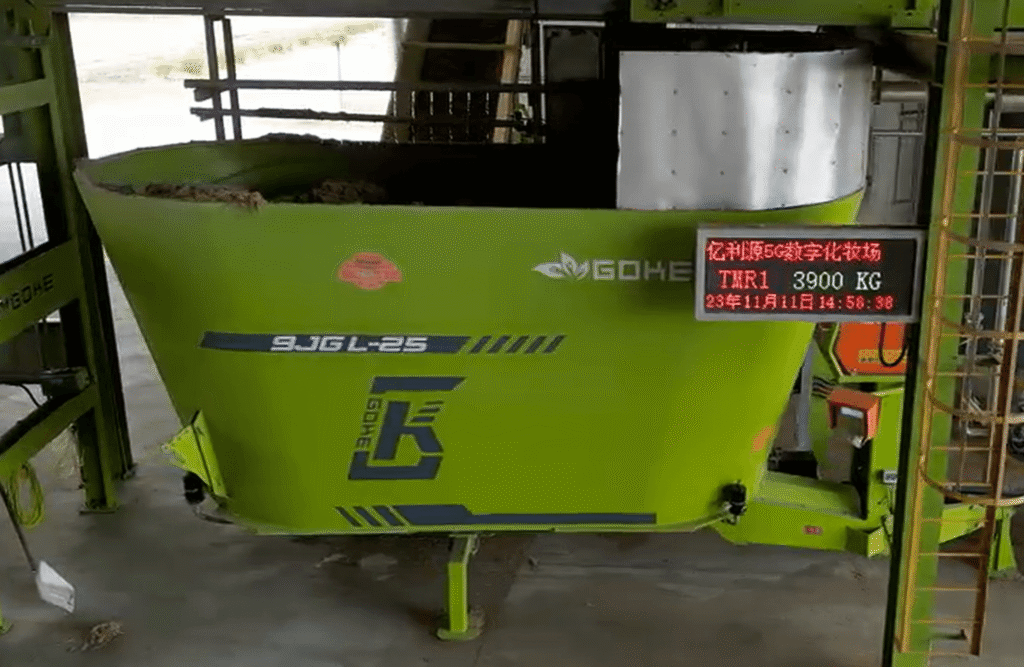
As dairy farms expanded from family operations with fewer than 100 cows to commercial farms with hundreds or even thousands of animals, manual feeding became increasingly impractical. Farmers required equipment that could reduce labor while maintaining consistent feed quality. Early feed wagons evolved into specialized TMR mixers equipped with augers, cutting knives, hydraulic discharge systems, and eventually electronic weighing technology.
Development Timeline of TMR Mixer Technology
| Period | Major Development | Why It Mattered |
|---|---|---|
| Before 1950 | Separate feeding of forage and grain | High labor demand and inconsistent nutrition |
| 1950–1965 | Early mechanical feed mixers introduced | Reduced manual mixing time |
| 1965–1985 | Commercial TMR mixers adopted by large dairy farms | Improved ration consistency and milk production |
| 1985–2005 | Electronic weighing systems added | More accurate ration formulation |
| 2005–Present | Automated and smart TMR mixers | Precision feeding and lower labor costs |
The widespread adoption of TMR mixers changed dairy production around the world. By preventing cows from sorting feed, farmers achieved more stable rumen fermentation and better nutrient utilization. Research has shown that properly mixed total mixed rations can reduce feed sorting by 10–20%, decrease feed waste by 5–15%, and improve milk production by approximately 2–8%, depending on herd management and ration formulation.
Today, the TMR mixer is far more than a feed mixing machine. It has become the foundation of modern dairy nutrition, connecting feed management, precision agriculture, and digital farm technology. What began as a practical solution to uneven feeding has evolved into one of the most influential innovations in the history of dairy farming, helping producers worldwide improve efficiency, profitability, and animal health.
How a TMR Mixer Works: Working Principle, Vertical vs Horizontal TMR Mixer Comparison, and Size Selection Guide
A TMR mixer is designed to blend forage, concentrates, minerals, vitamins, and feed additives into a uniform Total Mixed Ration (TMR). The objective is simple: every cow receives the same balanced nutrients in every bite, preventing feed sorting and improving rumen health. Whether managing 100 cows or 5,000 cows, understanding how a TMR mixer works helps farmers choose the right equipment and maximize feeding efficiency.
The mixing process consists of four basic stages: loading, cutting, mixing, and discharging. Each stage affects the quality of the final ration and ultimately influences milk production.
Basic Working Principle of a TMR Mixer
| Step | Process | Purpose |
|---|---|---|
| 1 | Load forage, silage, grain, and supplements | Prepare ingredients in the correct order |
| 2 | Cutting by augers and knives | Reduce particle size while preserving fiber |
| 3 | Mixing | Produce a uniform Total Mixed Ration |
| 4 | Discharge | Deliver consistent feed to the feed bunk |
The loading sequence is particularly important. Most nutritionists recommend adding long-fiber forage first, followed by silage, concentrates, and finally minerals and additives. This order helps improve mixing efficiency and prevents heavy ingredients from settling at the bottom.
Proper mixing usually takes 3–8 minutes after the last ingredient is loaded. Mixing for too little time results in poor uniformity, while excessive mixing may shorten fiber length and reduce chewing activity.
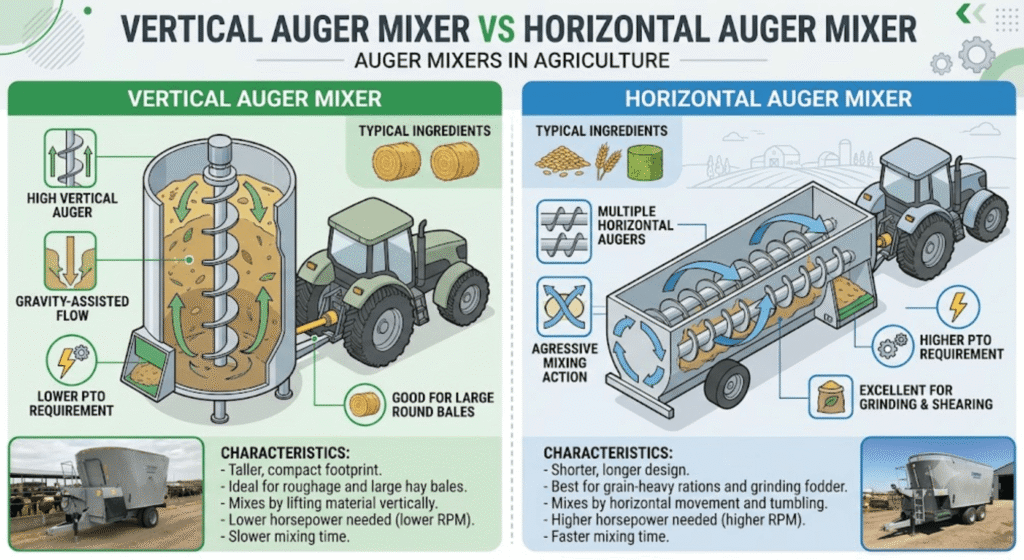
Vertical vs Horizontal TMR Mixer
The two most common mixer designs are the vertical vs horizontal TMR mixer. Although both produce Total Mixed Rations, they differ in mixing mechanism, performance, and ideal applications.
| Feature | Vertical TMR Mixer | Horizontal TMR Mixer |
|---|---|---|
| Mixing system | One or two vertical augers | Horizontal augers or paddles |
| Mixing time | 4–8 minutes | 3–6 minutes |
| Long hay processing | Excellent | Good |
| Fiber preservation | Excellent | Good |
| Loading height | Higher | Lower |
| Power consumption | Moderate | Slightly higher |
| Maintenance complexity | Lower | Moderate |
| Recommended farm size | Medium to very large farms | Small to medium farms |
Vertical mixers are particularly suitable for processing long-stem hay and high-fiber rations without requiring excessive pre-cutting. Horizontal mixers provide faster mixing and are often preferred where processed feed ingredients are commonly used.
Choosing the Right TMR Mixer Size
Selecting the correct mixer size depends primarily on herd size, daily feed intake, and feeding frequency. An undersized machine requires multiple batches, increasing fuel consumption and labor costs, while an oversized machine may not mix efficiently when partially loaded.
The following table provides general recommendations for dairy farms.
| Dairy Farm Size | Number of Cows | Recommended Mixer Capacity |
|---|---|---|
| Small | Less than 200 | 5–9 m³ |
| Medium | 200–500 | 9–15 m³ |
| Large | 500–1,000 | 15–25 m³ |
| Industrial | 1,000–3,000 | 25–40 m³ |
| Mega Dairy | More than 3,000 | 40–50+ m³ |
For example, a farm with 800 dairy cows consuming 50 kg of fresh TMR per cow per day requires approximately 40,000 kg of feed daily. Feeding twice a day means 20,000 kg per batch. Assuming an average TMR density of 450 kg/m³, the required mixing volume is about 44 m³. Considering an 85% loading efficiency, a 25–30 m³ mixer is typically the most practical choice because it provides efficient mixing without overloading the machine.
Understanding the working principle and selecting the correct mixer type and capacity are the first steps toward improving feed consistency, reducing labor requirements, and increasing dairy farm profitability. A properly matched TMR mixer can operate efficiently for 10–15 years, making it one of the most valuable long-term investments for modern dairy farms.
TMR Mixer Cost Analysis: Total Ownership Cost, Quality Comparison, Global Research, and Maintenance Requirements
A TMR mixer is a long-term investment for dairy farms, and the purchase price is only one part of the total cost. Farmers should evaluate the complete ownership cost, including equipment price, energy consumption, spare parts, labor savings, and service life. A high-quality TMR mixer may require a higher initial investment but can reduce operating costs and improve feeding efficiency over many years.
TMR Mixer Total Cost Breakdown
The total cost of a TMR mixer depends mainly on capacity, mixer type, automation level, and manufacturing quality.
| Cost Item | Typical Range | Notes |
|---|---|---|
| Small TMR mixer (5–9 m³) | $15,000–40,000 | Suitable for farms under 200 cows |
| Medium TMR mixer (10–25 m³) | $40,000–80,000 | Common choice for 200–1,000 cows |
| Large TMR mixer (25–40 m³) | $80,000–150,000 | Used by industrial dairy farms |
| Self-propelled TMR mixer | $100,000–250,000+ | High automation farms |
| Annual operating cost | $5,000–20,000 | Fuel, maintenance, and wear parts |
For example, a 30 m³ vertical TMR mixer used on a 1,000-cow dairy farm may require:
| Item | Annual Cost Estimate |
|---|---|
| Diesel consumption | $3,000–6,000 |
| Blade replacement | $500–2,000 |
| Lubrication and service | $500–1,500 |
| Unexpected repairs | $1,000–5,000 |
| Total annual operating cost | $5,000–15,000 |
TMR Mixer Quality Comparison: Low-Cost vs Premium Equipment
Different manufacturers use different materials, designs, and production standards. Equipment quality directly affects mixing accuracy, durability, and lifetime.
| Feature | Entry-Level Mixer | Premium Mixer |
|---|---|---|
| Service life | 5–8 years | 10–15 years |
| Steel structure | Standard steel | Heavy-duty reinforced steel |
| Mixing accuracy | Medium | High consistency |
| Blade lifetime | 500–1,000 operating hours | 1,500–3,000 operating hours |
| Weighing system | Basic | High-precision sensors |
| Downtime risk | Higher | Lower |
A premium mixer can provide better long-term value because it reduces downtime and maintains consistent feed quality.
Global TMR Mixer Research and Adoption by Country
Dairy farming systems differ significantly between countries. Equipment requirements are influenced by herd size, labor cost, and technology development.
| Country | Dairy Development Level | Typical TMR Mixer Application |
|---|---|---|
| USA | Advanced | 25–50 m³ mixers for large dairy farms |
| Germany | Advanced | Precision feeding and automation |
| Netherlands | Advanced | Robotic feeding systems |
| China | Rapid growth | 15–40 m³ mixers for large farms |
| Japan | Advanced but smaller farms | Compact and efficient systems |
| Southeast Asia | Developing | Cost-effective 5–25 m³ mixers |
In the United States, many dairy farms operate more than 1,000 cows, creating demand for large-capacity mixers and automated feeding systems. European countries focus more on precision feeding, energy efficiency, and reducing feed waste.
China has experienced rapid growth in large-scale dairy operations. Many modern farms with 500–5,000 cows now use vertical TMR mixers combined with automatic feeding systems.
TMR Mixer Maintenance: Protecting Your Investment
Proper TMR mixer maintenance is essential for maintaining mixing performance and extending equipment life. Regular inspection helps prevent expensive failures and ensures accurate feed preparation.
| Maintenance Item | Recommended Frequency |
|---|---|
| Check blades and knives | Daily |
| Remove leftover feed | Daily |
| Lubricate moving parts | Weekly |
| Check gearbox oil | Every 500–1,000 operating hours |
| Inspect hydraulic system | Monthly |
| Full equipment inspection | Every 6 months |
A well-maintained TMR mixer can achieve a service life of 10–15 years, while poorly maintained equipment may require major repairs after only 5–8 years.
For dairy farms, the best TMR mixer choice is not always the cheapest machine. The ideal equipment should balance purchase cost, operating efficiency, durability, maintenance requirements, and future farm expansion plans.
How to Choose the Right TMR Mixer for Your Dairy Farm Size: Capacity Calculation Guide and Practical Examples
Choosing the correct TMR mixer is one of the most important decisions for dairy farmers because equipment size directly affects feeding efficiency, labor cost, fuel consumption, and feed quality. A mixer that is too small requires too many batches every day, while an oversized mixer may increase investment costs and reduce mixing accuracy due to insufficient loading.
The key factor is selecting the correct TMR mixer capacity based on:
- number of dairy cows
- daily feed intake
- feeding frequency
- feed density
- loading efficiency
- future farm expansion plans
How to Calculate the Required TMR Mixer Capacity
The basic calculation formula is:
Required Mixer Capacity (m³) = Daily TMR Requirement ÷ Number of Feeding Batches ÷ Feed Density ÷ Loading Efficiency
Most dairy farms use:
- Fresh TMR intake: 40–60 kg/cow/day
- Feed density: 400–500 kg/m³
- Mixer loading efficiency: 80–90%
Example 1: Small Dairy Farm Calculation
Farm information:
| Item | Data |
|---|---|
| Number of cows | 200 cows |
| Fresh TMR intake | 50 kg/cow/day |
| Daily feed requirement | 10,000 kg/day |
| Feeding frequency | 2 times/day |
| Feed per batch | 5,000 kg |
| Feed density | 450 kg/m³ |
| Loading efficiency | 85% |
Calculation:
5,000 kg ÷ 450 kg/m³ ÷ 85%
= 13.1 m³
Recommended equipment:
12–15 m³ TMR mixer
Example 2: Large Dairy Farm Calculation
Farm information:
| Item | Data |
|---|---|
| Number of cows | 1,000 cows |
| Fresh TMR intake | 50 kg/cow/day |
| Daily feed requirement | 50,000 kg/day |
| Feeding frequency | 2 times/day |
| Feed per batch | 25,000 kg |
| Feed density | 450 kg/m³ |
| Loading efficiency | 85% |
Calculation:
25,000 kg ÷ 450 kg/m³ ÷ 85%
= 65.4 m³
Because a single 65 m³ mixer is usually inefficient, farms normally divide feeding into more batches.
Recommended:
- 2 batches per feeding period
- 25–35 m³ TMR mixer
Recommended TMR Mixer Size by Dairy Farm Scale
| Farm Size | Number of Cows | Daily Feed Requirement (Approx.) | Recommended Mixer Capacity |
|---|---|---|---|
| Small dairy farm | <200 | <10 tons/day | 5–9 m³ |
| Medium dairy farm | 200–500 | 10–25 tons/day | 9–15 m³ |
| Large dairy farm | 500–1,000 | 25–50 tons/day | 15–30 m³ |
| Industrial dairy farm | 1,000–3,000 | 50–150 tons/day | 25–40 m³ |
| Mega dairy farm | >3,000 | >150 tons/day | 40–60 m³ |
Important Factors When Selecting a TMR Mixer
1. Farm Expansion Plan
Farmers should not only consider current herd size. If a farm plans to increase from:
- 500 cows → 1,000 cows
within 3–5 years, selecting a slightly larger mixer can reduce future replacement costs.
2. Feed Ingredients Used
Different rations require different mixer designs.
| Feed Type | Recommended Mixer |
|---|---|
| High hay content | Vertical TMR mixer |
| High silage ration | Vertical or horizontal mixer |
| Processed concentrate ration | Horizontal mixer |
| Complete automatic feeding | Stationary mixer system |
3. Feeding Frequency
More frequent feeding improves feed freshness but changes mixer requirements.
| Feeding Times/Day | Effect |
|---|---|
| 1 time/day | Larger mixer required |
| 2 times/day | Most common system |
| 3–4 times/day | Smaller batches possible |
Common Mistakes When Choosing Mixer Size
Choosing Too Small a Mixer
Problems:
- too many mixing cycles
- higher diesel consumption
- increased labor cost
- longer feeding time
Example:
A 1,000-cow farm using a 10 m³ mixer may need:
- 5–7 mixing cycles/day
while a 30 m³ mixer may complete the same work in:
- 2–3 cycles/day
Choosing Too Large a Mixer
Problems:
- higher purchase cost
- incomplete mixing
- increased energy consumption
A mixer should normally operate at:
80–90% of rated capacity
for the best mixing performance.
Final Selection Guide
| Farm Situation | Best Choice |
|---|---|
| Small farm under 200 cows | 5–9 m³ mixer |
| Growing farm 200–500 cows | 9–15 m³ mixer |
| Professional dairy 500–1,000 cows | 15–30 m³ mixer |
| Large commercial farm 1,000+ cows | 25–40 m³ mixer |
| Automated mega dairy | 40 m³+ mixer |
Selecting the right TMR mixer size requires balancing current herd requirements, future expansion, feed type, and operating costs. A properly sized mixer improves ration consistency, reduces feed waste, lowers labor requirements, and supports long-term dairy farm profitability.
Common TMR Mixer Problems and Solutions: A Practical Troubleshooting Guide for Dairy Farms
A TMR mixer is one of the most important machines in modern dairy feeding systems. However, during daily operation, problems such as uneven mixing, excessive feed waste, equipment wear, and inaccurate weighing can reduce feeding efficiency and increase operating costs.
Understanding common TMR mixer problems and applying the correct solutions helps dairy farmers maintain consistent feed quality, extend equipment life, and reduce unexpected downtime.
1. Uneven Feed Mixing
Uneven mixing is one of the most common problems with TMR mixers. It can cause some cows to receive excessive energy while others receive insufficient nutrients.
Common Causes:
- incorrect loading sequence
- overloaded mixer
- insufficient mixing time
- worn auger or blades
| Problem | Typical Data | Solution |
|---|---|---|
| Mixing time too short | Less than 3 minutes | Increase mixing time to 5–8 minutes |
| Mixer overloaded | More than 100% capacity | Operate at 80–90% capacity |
| Poor ration uniformity | CV above 10% | Adjust loading and mixing process |
2. Feed Sorting After Mixing
Even after mixing, cows may separate large particles from fine particles. This reduces ration consistency and affects rumen health.
Main Causes:
- excessive particle size
- insufficient moisture
- poor mixing design
| Feed Particle Size | Recommended Range |
|---|---|
| Long forage particles | 2.5–7.5 cm |
| Corn silage particles | 1–3 cm |
| Concentrate particles | Less than 1 cm |
Solutions:
- adjust cutting time
- add proper moisture
- check knife sharpness
- improve ration formulation
3. Low Mixing Capacity and High Operating Cost
A mixer that is too small for the farm size increases daily workload and fuel consumption.
Example:
A 1,000-cow dairy farm may require approximately:
- Daily TMR requirement: 50,000 kg/day
- Feeding frequency: 2 times/day
- Feed per batch: 25,000 kg
Using an undersized mixer may increase:
| Item | Impact |
|---|---|
| Mixing cycles | +50–100% |
| Labor time | +2–4 hours/day |
| Fuel consumption | +20–40% |
Solution:
Select the correct mixer size based on herd size and feeding frequency.
4. Blade and Auger Wear
The auger and cutting blades directly affect mixing performance. Worn components increase mixing time and reduce feed processing quality.
| Component | Normal Service Life |
|---|---|
| Cutting blade | 1,000–3,000 operating hours |
| Auger edge | 2,000–5,000 operating hours |
| Gearbox oil | Replace every 500–1,000 hours |
Solutions:
- inspect blades daily
- replace damaged knives
- use wear-resistant materials
- avoid mixing foreign objects
5. Weighing System Errors
Modern TMR mixers depend on electronic weighing systems to ensure accurate ration preparation.
Small weighing errors can create large nutrient differences over time.
| Problem | Possible Error | Solution |
|---|---|---|
| Sensor inaccurate | ±2–5% deviation | Recalibrate sensors |
| Display unstable | Signal problem | Check wiring |
| Incorrect loading amount | >5% difference | Regular calibration |
6. Hydraulic and Mechanical Failures
Hydraulic systems control many important functions, including:
- discharge doors
- auger movement
- loading systems
| Failure Type | Common Cause | Solution |
|---|---|---|
| Hydraulic leakage | Damaged hose | Replace hose |
| Slow auger movement | Low hydraulic pressure | Check hydraulic oil |
| Gearbox noise | Low lubrication | Inspect gearbox |
Daily TMR Mixer Maintenance Checklist
| Maintenance Item | Frequency |
|---|---|
| Check blades | Daily |
| Remove remaining feed | Daily |
| Check oil leakage | Daily |
| Lubricate moving parts | Weekly |
| Inspect gearbox | Monthly |
| Full machine inspection | Every 6 months |
Conclusion
Most TMR mixer problems are caused by incorrect operation, poor maintenance, or selecting the wrong machine size. By maintaining proper loading procedures, checking wear parts regularly, and operating within recommended capacity limits, dairy farmers can improve mixing accuracy, reduce feed waste by 5–20%, and extend mixer service life from approximately 5–8 years to 10–15 years.