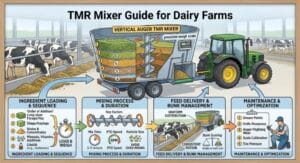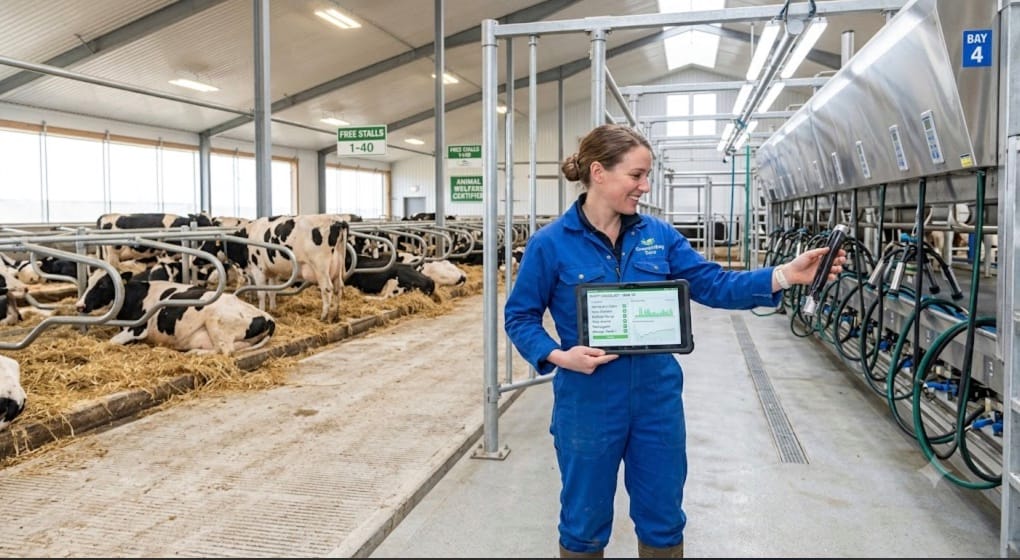
Dairy farm operations should be checked every day in seven areas: cows, feed and water, milking, barn conditions, equipment, records, and shift handover. A practical routine follows one simple sequence:
Cows → Feed & water → Milking → Barn → Equipment → Records → Handover
The purpose of a daily checklist is not to create more paperwork. It is to catch small changes before they become health, production, safety, or equipment problems. For beginners, the best checklist is short enough to use every day and clear enough that two employees understand the same standard.
| Daily Area | What to Check | Main Question |
|---|---|---|
| Cows | Behavior, movement, appetite | Does any cow need attention? |
| Feed | Ration, delivery, accessibility | Is the correct feed available? |
| Water | Cleanliness, supply, flow | Can cows drink freely? |
| Milking | Routine and equipment | Is milking consistent? |
| Barn | Bedding, alleys, cooling | Is the environment suitable? |
| Equipment | Leaks, noise, heat, wear | Is a failure developing? |
| Records | Exceptions and actions | What needs follow-up? |
The National Dairy FARM Program’s Animal Care Version 5 is active from July 1, 2024 through December 31, 2027 and requires participating farms to maintain relevant written protocols and records. (National Dairy FARM Program)
The checklist below is a practical framework rather than a universal standard. Adapt it to your herd size, climate, housing, equipment, veterinarian-approved protocols, manufacturer instructions, and local requirements.
1. Start Daily Dairy Farm Operations With Cows, Feed, and Water
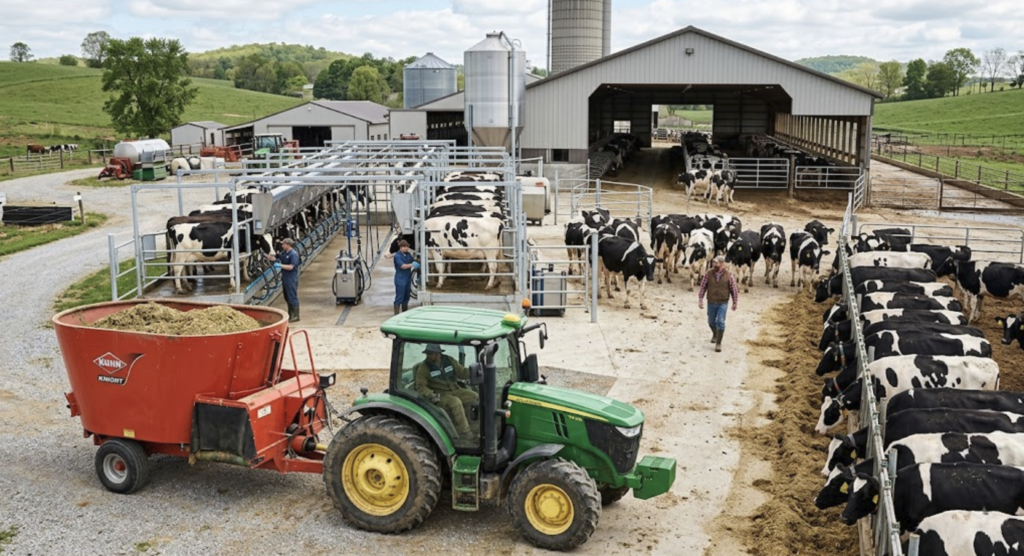
Start the day by observing cows and confirming that feed and clean water are available. Looking at animals before looking at reports often gives staff the earliest warning that something has changed.
Check the Cows First
Do not simply count animals. Watch how they eat, walk, rest, breathe, and interact with their surroundings.
| Check | Normal Observation | Warning Sign |
|---|---|---|
| Feed bunk | Normal eating activity | Sudden loss of interest |
| Walking | Comfortable movement | Limping or reluctance |
| Breathing | Calm for conditions | Rapid breathing/panting |
| Manure | Reasonably consistent | Sudden group change |
| Udder | No obvious abnormality | Swelling/injury |
| Fresh cows | Alert and eating | Weakness/poor appetite |
| Herd behavior | Normal resting/eating | Bunching/restlessness |
This is a simple but valuable part of cow health management. Observation does not diagnose disease; it identifies animals that deserve closer examination.
Heat stress is a useful example. UW–Madison Extension gives 60 breaths/minute as a practical rule of thumb for heat stress in lactating cows. Panting cows may average around 100 breaths/minute, while the normal resting range for adult cattle is approximately 25–50 breaths/minute. (Dairy Extension Wisconsin)
UW–Madison Extension – Animal Handling During Heat Stress
Verify Feed Delivery
The feeding system should provide the intended ration to the correct group at the planned time.
A daily feed check only needs four questions:
Correct ration → Correct group → Even distribution → Feed within reach
Penn State Extension identifies fresh-feed delivery and milking as two major drivers of feed-bunk activity. It recommends having feed available when cows return from milking and, particularly where bunk space is limited, pushing feed up within about 90 minutes after cows return. (Penn State Extension)
Penn State Extension – Feed Bunk Management
For daily recording, one simple calculation is useful:
As-fed feed/cow = Total feed delivered ÷ Number of cows = 5,000 kg ÷ 100 cows = 50 kg/cow/day
The 50 kg result is only an example of the calculation, not a recommended intake. Actual requirements depend on ration dry matter, production level, cow size, lactation stage, weather, and nutritional formulation.
Check Water Availability
Water should be checked during normal barn rounds, not saved for weekly maintenance.
Penn State reports that a lactating cow may drink approximately 30–50 gal/day (114–189 L/day) when water is available, and intake may double under heat-stress conditions. Its guidance also recommends valves capable of approximately 10 gal/min (38 L/min) where several cows may drink simultaneously. (Penn State Extension)
| Daily Water Check | Practical Reference |
|---|---|
| Lactating-cow drinking water | 30–50 gal/day |
| Suggested high-capacity valve flow | 10 gal/min |
| Daily inspection | Clean, filled, flowing |
For daily management, staff do not need to measure the whole water system every morning. Check:
Cleanliness → Water level → Flow → Leaks → Cow access
Detailed pipe sizing, trough dimensions, pump calculations, and water-quality testing belong in a separate water-system plan.
Penn State Extension – Clean Drinking Water Is Essential to Cows
2. Standardize Milking and Cow Health Checks
Milking should be one of the most repeatable parts of dairy farm operations. A consistent routine helps employees work predictably while supporting milk quality and udder health.
Follow a Repeatable Milking Routine
For conventional milking, University of Minnesota Extension provides useful preparation benchmarks:
| Milking Step | Reference |
|---|---|
| Teat stimulation | 10–20 sec |
| Teat-dip contact | 30 sec |
| Prep-lag before attachment | 60–120 sec |
| Standing after milking | ~30 min |
UMN defines prep-lag as the period from initial teat contact until the milking machine is attached. It also notes that the teat sphincter and post-dip need about 30 minutes after milking before closure/drying. (University of Minnesota Extension)
A practical conventional sequence is:
Cow enters → Inspect/forestrip → Pre-dip → Contact time → Dry → Attach → Monitor → Detach → Post-dip → Exit
University of Minnesota Extension – Timing the Milking Procedure
The farm’s exact SOP should follow its veterinary and milk-quality protocols and the instructions for its specific milking equipment.
Use Milking to Identify Exceptions
Milking is also a useful observation point. Instead of performing a second general health inspection, use information discovered during milking to identify cows needing follow-up.
Examples include abnormal milk appearance, unusual milking behavior, unexpected production changes, udder abnormalities, or monitoring alerts.
Use one workflow:
Exception detected → Identify cow → Examine → Follow farm protocol → Record action → Recheck
This avoids checking the same thing twice and connects daily milking directly with cow health management.
At the same time, operators should watch the equipment they are already using:
| Equipment Area | Look For |
|---|---|
| Vacuum | Abnormal/unstable operation |
| Pulsation | Obvious irregularity |
| Liners | Visible damage/wear |
| Hoses | Cracks or leaks |
| Clusters | Damage or contamination |
| Take-offs | Abnormal operation |
| Wash cycle | Incomplete cycle/alarm |
| Robotic system | Unresolved alarms |
| Milk cooling | Abnormal temperature/alarm |
A useful dairy equipment guide should distinguish daily observation from technical maintenance. Operators should recognize and report abnormal conditions rather than make adjustments beyond their training or manufacturer procedures.
3. Inspect the Barn, Manure System, and Critical Equipment
Use the same barn inspection route every day and look for conditions that affect cows, employees, or machinery. A fixed route reduces the chance that less-visible areas are forgotten.
Follow the Cow’s Route
An easy inspection sequence is:
Stall → Alley → Water → Feed bunk → Holding area → Milking area
| Area | Daily Question |
|---|---|
| Stalls | Is bedding clean and usable? |
| Alleys | Is manure being removed? |
| Floors | Is footing safe? |
| Feed bunk | Can cows reach feed? |
| Waterers | Are they operating? |
| Holding area | Is crowding/heat stress developing? |
| Fans | Are required units operating? |
| Soakers | Are they functioning? |
| Manure equipment | Is removal operating normally? |
During warm conditions, pay particular attention to breathing rate, panting, bunching, water access, and cooling equipment. UW–Madison recommends using animal-based signs rather than relying on THI alone because individual animals can respond differently to the same environment. (Dairy Extension Wisconsin)
Identify Equipment Problems Early
A daily equipment inspection should be short. Its purpose is to identify a developing failure, not perform the entire preventive-maintenance program.
Use five checks:
Leak → Sound → Heat → Wear → Safety
| Equipment | Main Daily Observation |
|---|---|
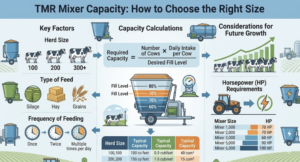
| TMR mixer | Scale, discharge, leaks |
| Tractor/loader | Fluids, tires, warnings |
| Feed pusher | Battery, route, safety devices |
| Milking system | Operation, hoses, cleaning |
| Fans | Rotation, noise, guards |
| Water pumps | Pressure, leaks, noise |
| Manure scraper | Movement, chain/cable |
| Generator | Readiness |
| Sensors | Alarms/communication |
| Milk cooling | Temperature/alarms |
Operators do not need to diagnose every mechanical problem. They need to recognize when normal operation has changed.
Use three responses:
STOP NOW: serious safety risk, overheating, major leak, exposed/damaged safety component, or critical failure.
REPORT NOW: abnormal noise, unstable performance, repeated alarm, or unexpected operating change.
SCHEDULE: wear or maintenance items that have reached the farm’s planned service threshold but do not require an immediate shutdown.
The manufacturer’s manual should determine actual inspection, lubrication, replacement, and service intervals.
4. Record Exceptions and Use Smart Dairy Farming Data Wisely
Record what changed and what was done rather than collecting unnecessary information. The objective is to make sure a problem does not disappear between shifts.
A useful exception record can be very short:
Time → Cow/equipment/location → Problem → Action → Status
Example:
06:45 → TMR Mixer #2 → Abnormal conveyor noise → Inspection requested → Open
This provides more management value than a simple “equipment checked” box.
Prioritize Exceptions
| Priority | Meaning | Response |
|---|---|---|
| 1 – Critical | Immediate animal, safety, milk, or operating risk | Act now |
| 2 – Important | Requires prompt correction | Complete this shift |
| 3 – Planned | Non-critical maintenance/improvement | Schedule |
An empty water supply, serious animal problem, or critical milking failure should not wait for tomorrow’s maintenance meeting. Normal component wear may be handled through the planned maintenance schedule.
Use Data to Trigger Action
This is where smart dairy farming can improve daily management.
Milking software, activity monitors, feed-management systems, temperature sensors, and machine controllers can automatically collect information. But collecting more data is not the objective.
The useful process is:
Data → Exception → Alert → Employee verifies → Action → Result recorded
Technology is most valuable when it helps employees notice meaningful changes sooner. Physical observation is still necessary because a sensor reports what it measures—not everything happening to the cow, barn, or machine.
5. Build a Daily Dairy Farm Operations Checklist Staff Will Actually Use
A useful checklist gives each critical task a clear standard, time, and owner. Avoid creating a 100-item form that employees eventually complete without thinking.
Essential Daily Checklist
| Stage | Check | Normal Standard | If Abnormal |
|---|---|---|---|
| Start shift | Cow groups | Normal behavior | Identify/check cow |
| Start shift | Water | Clean and flowing | Correct/report |
| Feeding | Ration | Correct feed/group | Stop and verify |
| After feeding | Feed bunk | Feed accessible | Redistribute |
| Milking | Milking SOP | Procedure followed | Correct/report |
| Milking | Equipment | Normal operation | Record exception |
| Barn round | Bedding | Suitable for use | Service |
| Barn round | Alleys/manure | Removal operating | Correct/report |
| Barn round | Cooling | Operating as required | Correct/report |
| Equipment round | Critical machines | Normal operation | Prioritize problem |
| End shift | Health alerts | Reviewed | Follow up |
| End shift | Open issues | Recorded | Update status |
| Handover | Unfinished work | Communicated | Assign owner |
The table intentionally focuses on daily decisions. Detailed veterinary protocols, machine-maintenance procedures, ration formulation, and water-system engineering should remain in their own SOPs.
Assign Clear Responsibility
Every critical task needs an owner:
Task → Standard → Owner → Time → Exception record
For example:
Waterers → Clean and operating → Barn employee → Start-of-shift round → Record abnormality
or:
Milking system → No unresolved critical alarms → Milking lead → Every milking → Report exception
Clear responsibility becomes increasingly important as the farm grows because important routines cannot depend only on one experienced employee remembering what to do.
End With a Short Handover
The outgoing team should communicate only what the next shift needs to act on:
Priority cows → Treatments → Feed changes → Equipment problems → Unfinished work → Critical alerts
A short structured handover closes the daily management loop.
Reliable dairy farm operations are built from consistent routines rather than complicated paperwork. Start with cows, confirm feed and water, follow the milking SOP, inspect the barn and equipment, record exceptions, and communicate unfinished work.
The complete daily sequence remains simple:
Observe → Operate → Inspect → Record → Manage
Modern milking equipment, an automated feeding system, sensors, and other smart dairy farming technologies can make this process faster and more consistent. They do not replace good observation. Technology helps reveal problems; good management makes sure someone acts on them.
Recommended Resources
- National Dairy FARM Program – Animal Care — Animal-care standards, protocols, and management resources.
- National Dairy FARM Program – Animal Care Version 5 — Current Version 5 animal-care program resources.
- University of Minnesota Extension – Timing the Milking Procedure — Evidence-based milking preparation and timing guidance.
- Penn State Extension – Feed Bunk Management — Practical feed availability and push-up guidance.
- Penn State Extension – Clean Drinking Water Is Essential to Cows — Dairy-cow water intake, availability, and waterer guidance.
- UW–Madison Extension – Animal Handling During Heat Stress — Heat-stress signs, handling, water, and cooling guidance.
- Dairy Farm Equipment – AIG Machinery — Dairy equipment categories and applications.