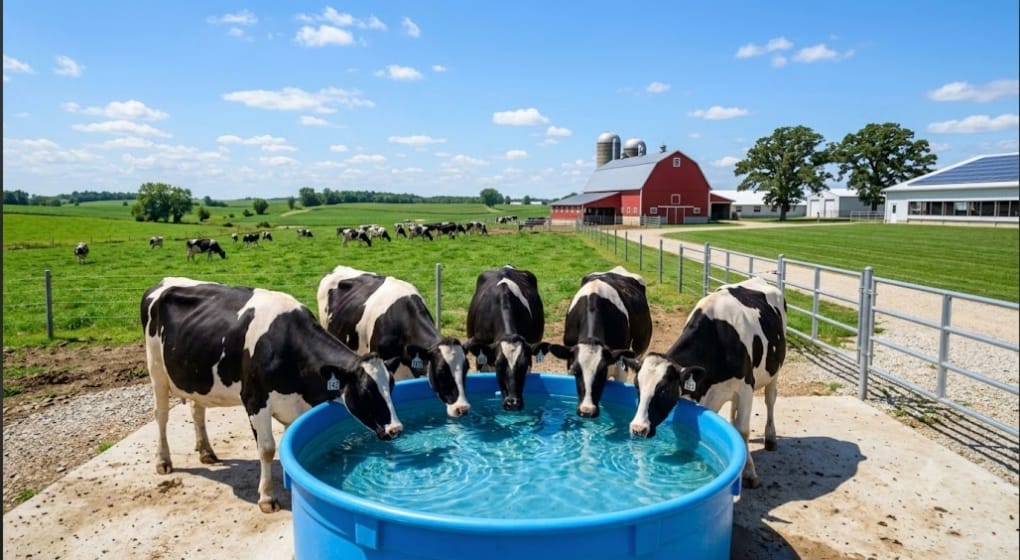
Dairy farm water supply is one of the most important systems on a dairy operation because cows need reliable access to clean water every hour of the day—not only when the farm is milking or feeding.
Learn how to plan a reliable dairy farm water supply, including cow water needs, trough sizing, flow rates, water quality, pumps, storage, and water reuse.
Water is easy to underestimate. It does not arrive in a feed wagon or appear as an ingredient in a TMR recipe, yet it affects feed intake, heat-stress management, cleaning, cooling, and milk production.
A high-producing lactating cow may drink about 25–35 gallons (95–132 L) per day in hot weather, according to University of Minnesota Extension. Cows can also consume a large share of their daily water around milking, creating short periods of very high demand.
This means good water planning is about more than total gallons per day. The system must also deliver enough water at the moment cows want to drink.
Quick Answer: How Much Water Does a Dairy Farm Need?
A practical starting point is 25–35 gallons (95–132 L) per lactating cow per day during hot weather. At this range, 500 cows could require about 12,500–17,500 gallons (47,300–66,200 L) of drinking water per day. This does not include water for cooling, parlor cleaning, equipment washing, calves, or manure flushing.
Dairy Water Supply: Key Numbers at a Glance
| Planning Question | Practical Reference |
|---|---|
| Hot-weather drinking water | 25–35 gal/cow/day |
| Metric equivalent | 95–132 L/cow/day |
| Cow drinking rate | About 3–5 gal/min |
| Water access | 2 linear in/cow |
| Minimum trough depth | 3 in |
| 500 cows at 30 gal/day | 15,000 gal/day |
| 1,000 cows at 30 gal/day | 30,000 gal/day |
| TDS needing closer investigation | >1,000 mg/L |
| Sulfate reference for adult cattle | <1,000 ppm |
Beginner takeaway: daily gallons help estimate source and storage capacity. Gallons per minute help determine whether pumps, pipes, valves, and troughs can keep up during peak drinking periods.
1. How Much Water Does a Dairy Cow Drink Per Day?
Water is sometimes called the forgotten nutrient. In practice, it deserves the same daily attention as feed.
According to University of Minnesota Extension, a high-producing lactating cow may drink approximately 25–35 gal/day during hot weather. Actual intake changes with temperature, milk production, body size, feed moisture, salt intake, and other factors.
For practical dairy farm management, water should therefore be monitored rather than treated as an unlimited utility.
Estimated Drinking Water by Herd Size
| Lactating Cows | 25 gal/cow/day | 30 gal/cow/day | 35 gal/cow/day |
|---|---|---|---|
| 100 | 2,500 gal | 3,000 gal | 3,500 gal |
| 300 | 7,500 gal | 9,000 gal | 10,500 gal |
| 500 | 12,500 gal | 15,000 gal | 17,500 gal |
| 1,000 | 25,000 gal | 30,000 gal | 35,000 gal |
| 2,000 | 50,000 gal | 60,000 gal | 70,000 gal |
The calculation is simple:
Daily Drinking Water = Number of Cows × Expected Water Intake per Cow
For 500 cows using 30 gal/day:
500 × 30 = 15,000 gal/day
That is approximately 56,800 liters per day.
These figures cover drinking water only. Total farm demand will be higher after adding cooling, cleaning, calf water, milk-room use, equipment washing, and other operations.
2. Why Peak Flow Matters More Than Many Beginners Expect
A farm can have enough water for the entire day and still run short at the trough.
The problem is peak flow.
Cows do not drink exactly the same amount every hour. Demand can rise sharply around feeding, milking, and hot periods.
Guidance from University of Minnesota Extension indicates that cows may drink at approximately 3–5 gallons per minute while actively drinking.
Consider 20 cows drinking simultaneously at an average 4 gal/min:
20 cows × 4 gal/min = 80 gal/min
If the pipe, valve, pump, or storage system cannot support that short-term demand, the trough level falls even though the well produces enough water over 24 hours.
Think of a hotel with 100 rooms. Its total water supply might be sufficient for the day, but if dozens of guests shower at the same time, an undersized pipe system still creates low pressure.
The same principle applies to dairy farm water supply.
This is why designers should calculate both:
Daily volume → gallons/day
and
Peak demand → gallons/minute
They solve different problems.
3. Which Water Source Is Best for a Dairy Farm?
Most dairies rely on wells, municipal systems, springs, surface water, storage reservoirs, or a combination of sources.
There is no single best source.
| Water Source | Main Advantage | Main Risk or Limitation |
|---|---|---|
| Deep well | Independent supply | Minerals, iron, hardness |
| Municipal | Treated, predictable quality | Cost and supply restrictions |
| Spring | Potentially low operating cost | Seasonal variation |
| Surface water | Potentially large volume | Higher contamination risk |
| Storage reservoir | Handles demand peaks | Requires cleaning and management |
| Two-source system | Better redundancy | More infrastructure |
For beginners, evaluate five things:
quantity, flow, quality, reliability, and cost.
A well may produce plenty of water over 24 hours but have a low instantaneous flow rate. Municipal water may be reliable but expensive at large herd sizes.
This is similar to selecting machinery from a dairy equipment guide. The largest system is not automatically the right system; capacity has to match actual farm demand.
Where possible, large farms should also consider redundancy. Losing drinking water during a hot afternoon can become an urgent animal-welfare and operational problem.
4. What Water Quality Is Suitable for Dairy Cows?
Clear water is not automatically good water.
A laboratory analysis can identify problems that cannot be seen or smelled.
Penn State Extension’s dairy drinking-water guidance recommends evaluating parameters such as total dissolved solids (TDS), sulfate, nitrate, hardness, iron, manganese, pH, and microbial contamination.
Penn State notes that water above approximately 1,000 mg/L TDS deserves closer mineral evaluation. Its livestock water-quality guidance also provides a sulfate reference below approximately 1,000 ppm for adult cattle, with a lower reference of 500 ppm for calves.
Important Dairy Water Tests
| Test | Why Check It? | Reference / Action |
|---|---|---|
| TDS | Total dissolved mineral load | Investigate >1,000 mg/L |
| Sulfate | Can affect intake/mineral balance | <1,000 ppm adult cattle |
| Sulfate, calves | Young animals are more sensitive | <500 ppm |
| pH | Acidity/alkalinity indicator | Interpret with full analysis |
| Iron | Taste, staining, deposits | Investigate if elevated |
| Manganese | Taste and deposits | Investigate if elevated |
| Nitrate | Potential health concern | Laboratory assessment |
| Coliform bacteria | Sanitation indicator | Investigate contamination |
The useful rule is:
Test first. Treat second.
Do not automatically install a softener, chlorinator, or expensive filtration system because the water “doesn’t look right.”
Different problems require different treatment.
For example, softening water does not solve every microbial problem, while a basic sediment filter cannot remove all dissolved minerals.
5. How Much Water-Trough Space Do Dairy Cows Need?
Trough design is where water engineering meets dairy barn design.
For heat-stress planning, University of Minnesota Extension recommends approximately 2 linear inches of accessible water space per cow, with troughs at least 3 inches deep.
The basic calculation is:
Number of Cows × 2 in = Total Accessible Water Edge
For 200 cows:
200 × 2 = 400 in
400 ÷ 12 = 33.3 ft
Water Access by Group Size
| Group | Accessible Edge at 2 in/cow | Metric Equivalent |
|---|---|---|
| 50 cows | 8.3 ft | 2.5 m |
| 100 cows | 16.7 ft | 5.1 m |
| 200 cows | 33.3 ft | 10.2 m |
| 500 cows | 83.3 ft | 25.4 m |
This does not mean a 200-cow pen needs one 33-ft-long trough.
Several well-positioned water stations can provide the required total access and often distribute cows more effectively.
That matters for cow comfort. A technically large enough trough can still perform poorly if dominant animals block other cows or if drinking creates congestion in a crossover.
6. Where Should Water Troughs Be Located?
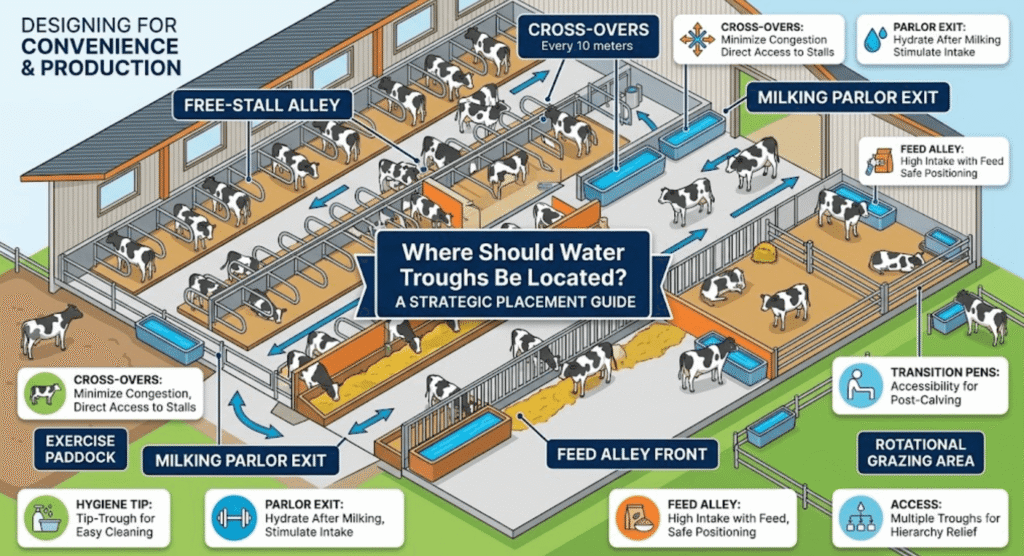
Put water where cows naturally want to drink, but avoid creating traffic jams.
Common locations include:
- return routes from the milking area;
- crossovers;
- near feeding areas;
- transition and fresh-cow pens;
- holding-area exits;
- grazing areas.
A simple indoor traffic pattern is:
Milking → water → feed → stalls
Avoid placing the only major water point in a narrow passage. Several thirsty cows stopping together can block animals behind them.
For grazing systems, University of Wisconsin–Madison Extension reports that when water is within roughly 600 ft of all parts of a paddock, cows are more likely to drink individually. When travel distances exceed around 900 ft, group drinking and tank crowding become more likely.
The beginner lesson is simple:
A trough’s location can be just as important as its capacity.
Water planning should therefore be completed alongside cow traffic, feeding areas, and the overall dairy barn design, not after the concrete is finished.
7. How Should Pumps, Pipes, Tanks, and Valves Be Sized?
A water system is only as strong as its weakest restriction.

The typical path is:
Source → pump → storage → main pipe → branch pipe → valve → trough
Before buying equipment, answer these five questions:
| Component | Number You Need to Know |
|---|---|
| Water source | Sustainable gal/min |
| Pump | Delivered gal/min at required pressure |
| Storage | Usable gallons available |
| Main pipe | Flow at acceptable pressure loss |
| Trough valve | Refill gal/min |
A common mistake is buying a large trough but connecting it through a low-capacity valve.
Imagine a 200-gallon trough. The volume looks impressive, but if cows rapidly remove 100 gallons and the valve refills slowly, the large tank does not solve the peak-demand problem.
Pipe diameter should also be calculated from flow requirement, pipe length, elevation, fittings, and allowable pressure loss rather than selected from herd size alone.
For complicated networks, multiple barns, major elevation differences, or large herds, have the hydraulic system calculated professionally.
8. How Much Emergency Water Storage Does a Dairy Need?
Storage provides a buffer between water production and water consumption.
It also buys time when a well pump, electrical supply, valve, or source fails.
Suppose 500 cows normally drink 30 gal/day:
500 × 30 = 15,000 gal/day
If the farm wants a theoretical 12-hour drinking-water reserve:
15,000 ÷ 2 = 7,500 gallons
For a 24-hour reserve:
15,000 gallons
These are planning calculations, not universal storage standards.
Actual storage should consider local climate, source reliability, backup wells, generators, fire requirements, cleaning demand, cooling systems, local regulations, and how quickly emergency repairs can be made.
Example Emergency Drinking Reserve
| Herd | Daily Demand at 30 gal/cow | 12-Hour Reserve* |
|---|---|---|
| 100 | 3,000 gal | 1,500 gal |
| 300 | 9,000 gal | 4,500 gal |
| 500 | 15,000 gal | 7,500 gal |
| 1,000 | 30,000 gal | 15,000 gal |
| 2,000 | 60,000 gal | 30,000 gal |
*Simple drinking-water planning calculation only.
A reserve tank should not create a false sense of security. The farm still needs a plan for pump failure, power failure, frozen pipes, or contamination.
9. How Often Should Dairy Water Troughs Be Cleaned?
A full trough is not useful if cows are reluctant to drink from it.
Feed, manure, algae, sediment, and biofilm can accumulate over time, especially during warm weather.
A practical inspection program might look like this:
| Frequency | Task |
|---|---|
| Daily | Check water level |
| Daily | Check valve operation |
| Daily | Look for manure/feed contamination |
| Weekly or as needed | Drain and scrub trough |
| Monthly | Inspect leaks and valves |
| Seasonally | Inspect heaters and insulation |
| Periodically | Laboratory water analysis |
| After unusual taste/odor | Investigate and retest |
Cleaning frequency should be adjusted to actual conditions. A trough that becomes dirty in three days should not wait for a seven-day schedule.
This is where good dairy farm management matters more than simply installing expensive hardware.
One easy check is to look into the trough during the daily barn walk. Water condition, refill speed, leakage, and unusual consumption patterns can often be spotted before they develop into larger problems.
10. How Do You Keep Dairy Water From Freezing?
Cold climates create the opposite challenge from summer heat.
University of Minnesota Extension’s cold-weather dairy guidance notes that frozen or excessively cold water can reduce intake and gives a preferred water-temperature range of approximately 40–65°F (4–18°C).
Common winter solutions include:
| Solution | Best Use |
|---|---|
| Insulated trough | Reduce heat loss |
| Heated trough | Severe cold |
| Recirculation loop | Long distribution networks |
| Buried insulated pipe | Protect supply lines |
| Thermostatic heater | Automatic freeze protection |
| Frost-free valve | Outdoor water points |
Heating equipment still needs inspection.
A failed heater during a cold night can quickly turn a normal drinking station into an unusable block of ice.
Winter water checks should therefore become part of routine dairy farm management.
11. Can Dairy Farms Reuse Water?
Yes—but the second use must match the quality of the water.
Milk cooling is one useful example. Water passing through a plate cooler absorbs heat from milk. Where water quality, system design, and local regulations allow, this water may sometimes be collected for another suitable use instead of immediately going to waste.
Practical Water-Reuse Options
| Water Stream | Possible Second Use |
|---|---|
| Suitable plate-cooler water | Storage/drinking where appropriate |
| Clean cooling water | Washdown |
| Rainwater | Cleaning or irrigation |
| Appropriately treated wash water | Manure flushing |
| Contaminated wastewater | Treatment system |
Do not assume reused water is automatically safe for drinking.
Water quality, contamination risk, storage conditions, local environmental requirements, and the intended second use must all be considered.
For farms moving toward smart dairy farming, meters can make water reuse much easier to evaluate because managers can see exactly how many gallons are being captured and where they are being used.
12. How Can Smart Dairy Farming Improve Water Management?
Water systems are becoming measurable rather than invisible.
A modern farm can monitor:
- total water consumption;
- individual barn demand;
- tank level;
- pump operation;
- abnormal continuous flow;
- water temperature;
- pressure;
- selected water-quality parameters.
Consider a farm that normally uses 30,000 gallons/day.
If monitoring suddenly records 38,000 gallons/day without hotter weather or more cows, the extra 8,000 gallons may justify an immediate inspection.
Possible causes include a leaking pipe, overflowing trough, stuck valve, cooling-system problem, or a genuine change in herd demand.
This is one practical benefit of smart dairy farming: the system helps managers notice abnormal conditions sooner rather than discovering them through a large water bill or an empty tank.
13. Complete 500-Cow Dairy Farm Water Supply Example
Consider a 500-cow dairy operating during warm weather.
Use a drinking-water planning value of:
30 gal/cow/day
Step 1: Daily Demand
500 × 30 = 15,000 gal/day
Approximately:
56,800 L/day
Step 2: Drinking Access
At 2 linear in/cow:
500 × 2 = 1,000 in
1,000 ÷ 12 = 83.3 ft
So the group needs approximately 83.3 ft (25.4 m) of total accessible drinking edge using this planning reference.
Step 3: Emergency Reserve
For a simple 12-hour drinking reserve:
15,000 ÷ 2 = 7,500 gal
Step 4: Check Peak Flow Separately
Daily volume does not tell us the required pump flow.
That requires information about simultaneous drinking, trough storage, refill rate, barn layout, pipe length, elevation, and other water uses.
500-Cow Planning Summary
| Item | Example |
|---|---|
| Lactating cows | 500 |
| Drinking assumption | 30 gal/cow/day |
| Daily drinking water | 15,000 gal |
| Metric equivalent | ~56,800 L |
| Total water edge | 83.3 ft |
| 12-hour drinking reserve | 7,500 gal |
| Cow drinking rate reference | 3–5 gal/min |
| Peak pump requirement | Calculate separately |
These figures demonstrate the planning process; they are not a final engineering specification.
The farm still needs to account for cleaning, cooling, calves, milk-room demand, washdown, fire protection where applicable, and other uses.
14. When Should You Call a Water-System Engineer?
Simple herd-demand calculations can be done by farm owners, but professional hydraulic design becomes valuable when the system includes:
- several barns or distant pens;
- large elevation changes;
- multiple wells;
- long underground mains;
- large storage tanks;
- high-demand cooling systems;
- automatic water treatment;
- significant pressure loss;
- frequent low-pressure problems;
- major expansion;
- emergency/fire-water requirements.
A professional calculation can determine pipe diameter, pressure loss, pump duty, storage strategy, valve capacity, and system redundancy.
General farm guidance helps you understand what needs to be calculated, but final engineering should use actual site measurements.
15. Five Dairy Water Supply Mistakes to Avoid
| Mistake | Why It Causes Problems |
|---|---|
| Designing only from gal/day | Ignores peak demand |
| Too few drinking points | Creates competition and congestion |
| Low refill rate | Trough empties faster than it refills |
| Skipping water tests | Hidden mineral/microbial issues remain |
| Installing water after barn design | Creates poor routes and expensive changes |
The first four can often be corrected with equipment or management changes.
The fifth can be much more expensive.
Once floors, walls, crossovers, and underground utilities are fixed, moving a major water line or adding drainage can become a construction project.
That is why water planning belongs inside the original dairy barn design.
Frequently Asked Questions About Dairy Farm Water Supply
How many gallons of water does a dairy cow drink per day?
A high-producing lactating cow may drink approximately 25–35 gallons (95–132 L) per day during hot weather. Actual intake varies with temperature, milk production, diet, feed moisture, body size, and management.
How much drinking water does a 500-cow dairy need?
Using 25–35 gal/cow/day, 500 lactating cows would require approximately 12,500–17,500 gallons (47,300–66,200 L) per day for drinking alone.
How much water does a 1,000-cow dairy farm need?
At a planning value of 30 gal/cow/day:
1,000 × 30 = 30,000 gallons/day, or approximately 113,600 liters/day, for cow drinking. Cleaning and cooling demand must be added separately.
How much water-trough space should dairy cows have?
A practical heat-stress planning reference from University of Minnesota Extension is approximately 2 linear inches of accessible water space per cow, with trough depth of at least 3 inches.
Is well water safe for dairy cows?
It can be, but appearance alone cannot confirm quality. Well water should be tested for relevant parameters such as TDS, sulfate, nitrate, iron, manganese, pH, hardness, and microbial contamination.
How large should a dairy farm water storage tank be?
There is no universal tank size. Storage depends on herd demand, source capacity, peak use, desired emergency reserve, cooling and cleaning demand, source reliability, and local requirements.
Where should water troughs be located in a dairy barn?
Water should be easy to reach near high-traffic areas such as milking return routes, crossovers, and feeding areas without allowing drinking cows to block normal cow movement.
Conclusion: Treat Water as a Production System
A reliable dairy farm water supply is much more than a well connected to several troughs.
Think of it as one continuous system:
Source → treatment → storage → pump → pipes → valves → troughs → drainage → monitoring
For beginners, start with four questions:
How many cows need water?
How many gallons does each cow need?
How quickly must the system deliver that water?
How long should the farm operate if the main source fails?
Then look at water quality, trough placement, cleaning, winter protection, and future expansion.
Good water access supports cow comfort, feeding behavior, heat-stress management, and reliable daily routines. It also prevents a surprisingly common problem: having plenty of water at the source but not enough water where and when cows actually need it.
Modern monitoring can take this further. As smart dairy farming develops, flow meters, pressure sensors, tank-level monitoring, and automated alerts can make water another measurable part of farm performance.
The best dairy farm water supply is not necessarily the one with the largest pump or storage tank. It is the one that consistently delivers clean water at the required volume, flow rate, and location—while leaving enough capacity for tomorrow’s herd.