Automation does not necessarily mean replacing an entire feeding operation with robots. For many dairy farms, the first practical step is simply automating feed pushsers. For larger, expanding, or newly designed dairies, automating weighing, mixing, transportation, distribution, and feed pushing can provide much greater value.
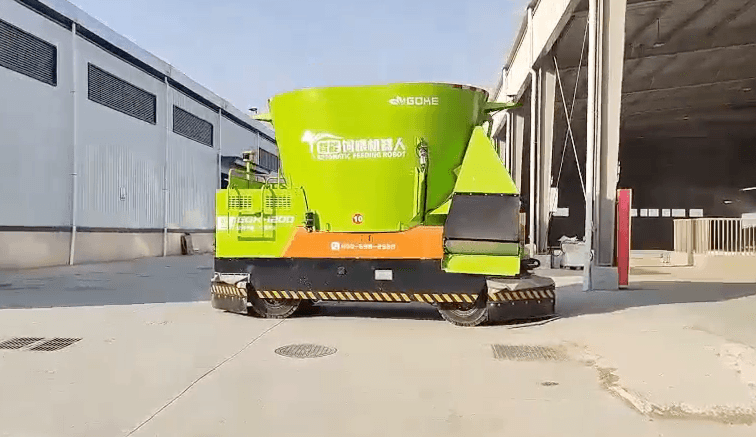
That creates an important choice between a feed pusher robot and feeding robots for dairy farms.
Although both machines can work around the feed alley, their functions are very different. A feed pusher mainly keeps existing TMR close enough for cows to reach. A complete feeding robot can prepare, transport, and distribute fresh rations according to programmed schedules and cow groups.
The right choice depends on herd size, existing equipment, labor costs, barn layout, feeding groups, future expansion, and expected return on investment.
This guide compares both technologies using practical numbers, research findings, and simple ROI calculations to help dairy farm owners and equipment buyers make a more informed decision.
1. Why Feed Availability Matters Before We Discuss Robots
Before comparing machines, it is important to understand the problem they are designed to solve.
Cows cannot eat feed they cannot reach.
University of Minnesota Extension recommends keeping feed available to transition cows for at least 23 hours per day, with feed push-up every 4 hours. Its TMR feeding guidance also recommends pushing TMR toward cows six or more times per day.
Penn State Extension recommends fresh feed delivery at least 2 times per day and frequent feed push-ups when discussing ways to maximize transition-cow dry matter intake.
These recommendations help explain why feeding management requires more than delivering one large batch of feed each morning.
A typical TMR feeding cycle looks like this:
TMR delivery → cows eat → feed moves away → feed is pushed back → cows regain access
With traditional equipment, every additional feed push requires another worker or tractor movement.
Automation changes this relationship.
Instead of organizing feed push-ups around employee availability, farms can schedule them around feeding-management requirements.
2. What Is a Feed Pusher Robot?
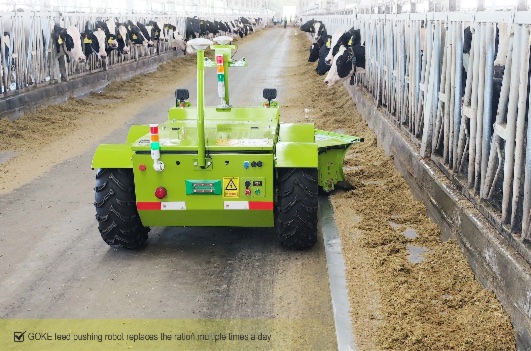
A feed pusher robot is an autonomous machine designed primarily to move already-delivered feed back toward the feed barrier.
It normally does not prepare the ration, load silage, or replace the TMR mixer.
Its job is much simpler:
Keep feed within cows’ reach throughout the day and night.
Modern feed pushers can operate automatically according to programmed routes and schedules. Depending on the manufacturer, navigation may use magnetic guidance, sensors, wheel positioning, ultrasound, LiDAR, mapping technology, or combinations of these technologies.
The robot travels along the feed alley, pushes displaced TMR closer to the feed barrier, completes its route, and returns to its charging area.
Feed Pusher vs. Feeding Robot: Core Functions
| Feature | Feed Pusher Robot | Feeding Robot |
|---|---|---|
| Push TMR | Yes | Yes* |
| Weigh Ingredients | No | Yes |
| Mix TMR | No | Yes |
| Transport Feed | No | Yes |
| Distribute Feed | No | Yes |
| Multiple Rations | No | Yes |
| Scheduled Operation | Yes | Yes |
| Feed Kitchen | No | Yes* |
| Retain TMR Mixer | Yes | Optional |
*Functions depend on system design and configuration.
The difference is easy to understand.
A feed pusher automates one repetitive feeding job. A feeding robot can automate multiple stages of the complete feeding process.
This makes the feed pusher one of the simplest ways for an existing farm to enter smart dairy farming without replacing its current TMR mixer or tractor immediately.
3. Why Automate Feed Push-Up?
Feed naturally moves away from the feed barrier while cows eat, sort, and push the ration.
Once feed moves beyond comfortable reach, cows may have less access even though plenty of TMR remains in the feed alley.
Manual pushing solves this problem, but it requires repeated tractor trips.
Consider a simple schedule.
| Time | Feeding Activity |
|---|---|
| 05:00 | Fresh TMR delivery |
| 07:00 | Feed push-up |
| 09:00 | Feed push-up |
| 12:00 | Feed push-up |
| 15:00 | Feed push-up |
| 18:00 | Feed push-up |
| 21:00 | Feed push-up |
| 00:00 | Feed push-up |
| 03:00 | Feed push-up |
A farm worker could perform all these push-ups.
But having someone drive through the barn at midnight and again at 3:00 a.m. is rarely an efficient use of skilled labor.
This is where a robot becomes useful.
It does not get tired, require a night shift, or forget a scheduled push-up.
However, farmers should avoid assuming that installing a robot automatically produces a fixed increase in milk yield. Milk production depends on many factors, including ration formulation, forage quality, dry matter intake, heat stress, cow comfort, stocking density, water availability, genetics, and lactation stage.
The more defensible benefit is more consistent feed access with less repetitive labor.
4. What Are Feeding Robots for Dairy Farms?
Feeding robots for dairy farms take automation much further than feed pushing.
Depending on system configuration, the complete process can include:
Feed storage → ingredient loading → weighing → mixing → transportation → distribution → feed push-up
This creates an automatic feeding system rather than simply an automatic feed-pushing machine.
For example, a farm might divide 800 cows into four feeding groups:
| Cow Group | Example Herd Size | Feeding Strategy |
|---|---|---|
| Fresh cows | 80 | Fresh-cow ration |
| High-production cows | 250 | High-energy ration |
| Mid/late lactation | 370 | Production-adjusted ration |
| Dry cows | 100 | Controlled-energy ration |
A conventional system requires operators to prepare and distribute these rations correctly.
An automated system can use programmed recipes, weighing systems, scheduled feeding times, and group-specific delivery.
This is where feeding automation becomes part of precision farming.
The objective is not simply to replace a tractor. It is to make feed preparation and delivery more repeatable.
5. Feeding Frequency: Manual vs. Automated Systems
One advantage of automation is the ability to perform more feeding activities without adding more driving hours.
| Feeding Activity | Conventional System | Automated System |
|---|---|---|
| Fresh feed delivery | 1–2 times/day | 4–8+ times/day* |
| Feed push-up | 3–6 times/day | 6–12+ times/day* |
| Night operation | Labor required | Automatic |
| Driver required | Yes | No during automatic cycle |
| Scheduling flexibility | Limited | High |
*Planning ranges only. Actual frequency depends on equipment capacity, ration requirements, barn layout, management strategy, and manufacturer specifications.
More frequent feeding does not automatically mean more milk.
The important advantage is flexibility.
A farm manager can schedule feeding around cow groups instead of organizing every delivery around tractor-driver availability.
Published research also provides useful context. A 2025 commercial-farm observational study compared 16 dairy farms using automatic milking systems: eight used conventional feeding and eight used automated feeding robots.
The study reported lower daily variation in several feed-bunk nutritional measures on farms using automated feeding. However, bulk-tank milk fat and protein were not significantly different between the two groups.
This is an important distinction for equipment buyers: automation can improve consistency and management flexibility, but unrealistic production guarantees should be avoided.
6. Feed Pusher vs. Feeding Robot: Investment & Operation
| Factor | Feed Pusher Robot | Feeding Robot |
|---|---|---|
| Initial Investment | Low–Medium | High |
| Installation Complexity | Low | Medium–High |
| Existing TMR Mixer | Retained | Optional |
| Feed Kitchen | Not required | Usually required |
| Barn Modification | Usually minor | Often required |
| Feeding Labor Reduction | Partial | High potential |
| Retrofit Suitability | Excellent | Project-dependent |
| New-Build Suitability | Good | Excellent |
| Multiple Rations | No | Yes |
| Automation Level | Partial | Full-cycle |
A feed pusher normally makes more sense when the farm already has an efficient TMR mixer and feeding tractor.
The farm does not need to replace equipment that still works.
Instead, it removes one repetitive task.
Full feeding robots for dairy farms become more attractive when loading, weighing, mixing, driving, distribution, and feed pushing are all creating labor or management problems.
7. Which System Fits Different Dairy Farm Sizes?
Herd size provides a useful starting point, but it should never be the only factor used to select equipment.
| Herd Size | Feed Pusher | Feeding Robot | Starting Point |
|---|---|---|---|
| <100 cows | Optional | Usually difficult to justify | Manual/semi-auto |
| 100–300 cows | Highly suitable | Case-by-case | Feed pusher |
| 300–500 cows | Highly suitable | Worth evaluating | Compare ROI |
| 500–1,000 cows | Highly suitable | Highly suitable | Compare labor |
| 1,000–3,000 cows | Multiple units possible | Strong potential | System automation |
| >3,000 cows | Multiple units | Strong potential | Central feeding strategy |
These ranges are planning references rather than technical limits.
A 300-cow farm in a high-wage region may have a better business case for automation than a 1,000-cow farm with inexpensive and readily available labor.
The same applies to barn design.
A well-designed 600-cow freestall barn with one central feed alley may be easier to automate than an older 1,000-cow farm divided among several disconnected buildings.
8. Check Your Barn Before Buying a Robot
The machine must fit the farm—not just the herd size.
Before requesting a quotation, measure the feeding area carefully.
| Checkpoint | What to Confirm | Why It Matters |
|---|---|---|
| Feed Alley | Width | Robot clearance |
| Doorway | Minimum opening | Route accessibility |
| Turning Area | Turning radius | Maneuverability |
| Floor | Slope and traction | Safe movement |
| Feed Barrier | Dimensions | Feed positioning |
| Route | Total distance | Cycle capacity |
| Cow Groups | Number | Ration scheduling |
| Feed Kitchen | Location | Transport efficiency |
| Charging Area | Position/power | Robot uptime |
| Expansion | Future layout | Long-term capacity |
Turning radius deserves particular attention.
A machine may have enough capacity for the herd but still be unsuitable if it cannot turn safely at the end of a narrow feed alley.
For new construction, consider automation before finalizing the barn layout.
Changing a CAD drawing is much easier than changing concrete after construction.
9. Feed Pusher Labor-Saving Calculation
Before asking whether a feed pusher is expensive, calculate what manual pushing currently costs.
Assume:
- 5 push-ups/day
- 18 minutes/push-up
- $22/hour labor
- 365 days/year
Calculation
Daily labor:
5 × 18 = 90 minutes/day
Annual labor:
90 ÷ 60 × 365 = 547.5 hours/year
Annual labor cost:
547.5 × $22 = $12,045/year
| Item | Example |
|---|---|
| Push-ups | 5/day |
| Time per push | 18 min |
| Daily labor | 1.50 hr |
| Annual labor | 547.5 hr |
| Labor cost | $22/hr |
| Annual push labor | $12,045 |
This does not mean the robot automatically saves $12,045.
Workers may simply be reassigned to higher-value jobs, and the robot still has electricity, maintenance, financing, and service costs.
But the calculation provides a measurable starting point for ROI analysis.
10. Feeding Robot ROI Example
A full feeding robot requires a broader calculation because it can replace several feeding activities.
Use:
Annual Net Saving = Labor Saving + Tractor Saving + Other Measurable Savings − Robot Operating Cost
Then:
Simple Payback = Total Installed Cost ÷ Annual Net Saving
Consider a hypothetical 700-cow dairy.
Before automation:
- 8 feeding labor hours/day
- $22/hour labor cost
After automation:
- 2 feeding labor hours/day
Labor reduction:
6 × $22 × 365 = $48,180/year
Now assume:
- tractor, fuel, and maintenance savings = $10,000/year;
- robot operating and maintenance costs = $12,000/year;
- total installed investment = $300,000.
| ROI Item | Annual Value |
|---|---|
| Labor saving | +$48,180 |
| Tractor/fuel saving | +$10,000 |
| Robot operating cost | −$12,000 |
| Net annual saving | $46,180 |
| Installed investment | $300,000 |
| Simple payback | 6.50 years |
Calculation:
$300,000 ÷ $46,180 = 6.50 years
These are hypothetical numbers used to explain the calculation—not universal market prices or guaranteed savings.
Every farm should replace them with its own quotation, wages, energy prices, financing costs, maintenance contract, and infrastructure expenses.
11. Final Buyer Comparison
| Feature | Feed Pusher Robot | Feeding Robot |
|---|---|---|
| Low Entry Cost | Yes | No |
| Easy Retrofit | Yes | No* |
| Keep Existing Mixer | Yes | Optional |
| Night Feed Push | Yes | Yes* |
| Auto Weighing | No | Yes |
| Auto Mixing | No | Yes |
| Fresh Feed Delivery | No | Yes |
| Multiple Rations | No | Yes |
| Full Automation | No | Yes |
*Depends on barn layout and feeding-system configuration.
This table provides the simplest way to make an initial decision.
If you already have a good TMR mixer and the main problem is repetitive feed pushing, the feed pusher is usually the logical starting point.
If you want to automate ration preparation, weighing, mixing, transportation, distribution, and group feeding, a complete feeding robot should be evaluated.
12. Five Common Mistakes When Buying Feeding Automation
1. Selecting Equipment Only by Herd Size
Cow numbers are important, but barn dimensions, feeding groups, route length, ration volume, and feeding frequency can be equally important.
2. Looking Only at Purchase Price
The lowest purchase price does not always produce the lowest long-term cost.
Calculate equipment, installation, construction, electricity, maintenance, labor, financing, and expected service life.
3. Assuming Robots Mean Zero Labor
Robots still require inspection, cleaning, maintenance, ingredient management, and troubleshooting.
Automation changes labor requirements; it does not eliminate management.
4. Expecting Guaranteed Milk Increases
A robot can improve feeding consistency and feed availability, but milk yield also depends on nutrition, forage quality, cow comfort, health, heat stress, genetics, and many other factors.
5. Buying for Today’s Herd Only
A 500-cow farm planning to reach 800 cows should evaluate equipment against the future 800-cow requirement.
This is especially important for the feed kitchen, robot capacity, charging system, routes, and number of feeding groups.
13. Frequently Asked Questions
Are feeding robots for dairy farms better than feed pushers?
Not automatically. They solve different problems. A feed pusher automates feed push-up, while a feeding robot can automate several stages of feed preparation and delivery. Choose according to the farm’s actual bottleneck.
How often should feed be pushed toward dairy cows?
University of Minnesota Extension recommends pushing TMR toward cows six or more times per day in its TMR feeding guidance. Actual schedules should be adapted to cow groups, stocking density, feed delivery, and farm management.
Can a feed pusher increase milk yield?
Maintaining feed access supports good feeding management, but a fixed milk increase cannot be guaranteed. Milk production is affected by many nutritional, environmental, health, and management factors.
Can feeding robots replace workers completely?
No. They can reduce repetitive feeding labor, but farms still need people for feed management, ingredient control, maintenance, inspection, cleaning, and troubleshooting.
Are feeding robots suitable for existing barns?
Yes, in some cases. Before installation, check feed-alley width, turning radius, doorways, floor condition, route distance, charging location, feed storage, and electrical infrastructure.
Conclusion: Automate the Bottleneck First
A feed pusher robot and full feeding robots for dairy farms should not be considered two versions of the same machine.
They represent two different levels of automation.
A feed pusher solves a specific problem:
keeping existing TMR accessible to cows with less repetitive labor.
A feeding robot addresses a much larger process:
weighing → mixing → transporting → distributing → scheduling → pushing.
For established dairy farms with reliable mixers and tractors, automating feed pushing can be a practical first step toward smart dairy farming.
For new or expanding farms facing labor shortages, multiple ration groups, and high feeding costs, a complete automatic feeding system may offer greater long-term value.
Before purchasing either system, calculate four numbers:
1. Annual feeding labor hours
2. Annual tractor and mixer operating costs
3. Total installed automation cost
4. Expected annual net savings
Then evaluate the barn layout, turning radius, feed routes, feeding groups, future herd size, maintenance support, and equipment capacity.
Successful precision farming is not about installing as much technology as possible. It is about using the right technology where it creates measurable value.
The best feeding automation system is therefore not necessarily the most advanced one.
It is the one that fits the cows, the barn, the labor situation, and the economics of the individual dairy farm.