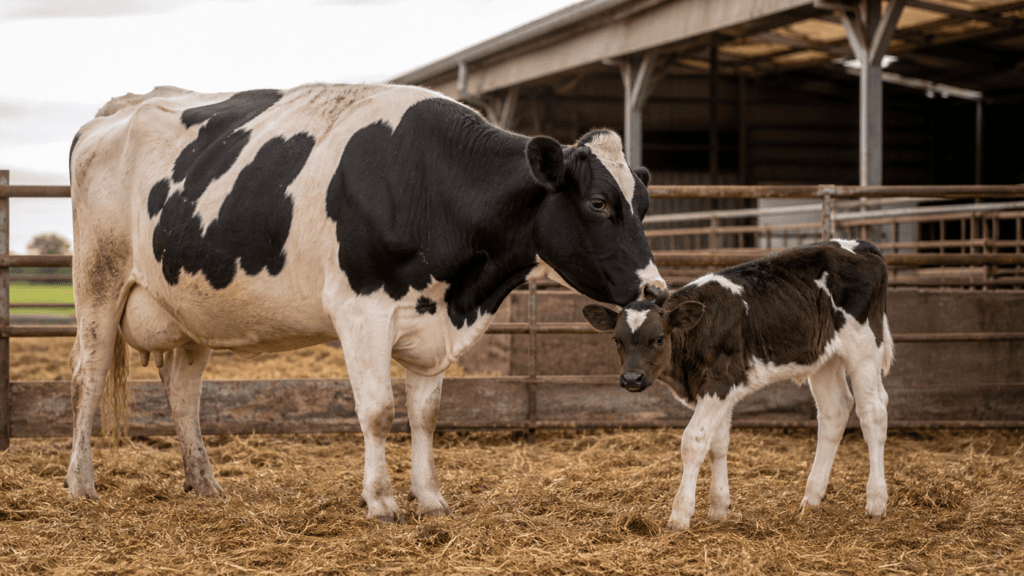
Crossbreeding beef and dairy cattle means mating a dairy female to a beef sire to produce a calf intended for the meat supply rather than the dairy replacement herd. For a dairy farm, the key question is not simply which beef breed to use. It is how many cows can enter the beef-on-dairy program without leaving too few replacement heifers for future herd needs. A sound plan starts with expected culling, growth targets, conception performance, calf survival, and heifer retention. Only then should managers allocate matings, match individual sires to suitable females, and consider local buyer requirements. Done carefully, the strategy can improve calf usefulness while protecting long-term herd stability.
How Crossbreeding Beef and Dairy Works—and Why Farms Use It
What a Beef-on-Dairy Mating Produces
Crossbreeding beef and dairy cattle usually means mating a dairy female to a beef sire to produce a terminal calf for meat production. The calf is not intended to become a dairy replacement. The farm therefore manages two outputs: enough dairy heifers for its herd and crossbred calves that may better suit a beef supply chain.
A Journal of Dairy Science review describes beef-on-dairy as a breeding strategy whose results depend on the dairy female, beef sire, production system, and market.
Potential Benefits for Calf Usefulness and Herd Strategy
Once replacement needs are covered, matings can be assigned to beef semen. This lets managers concentrate dairy-replacement production among females chosen for genetics, health, fertility, and future herd fit. Background on the top dairy breeds can help readers understand the maternal side, but breed labels alone do not determine mating success.
Crossbred calves may attract stronger buyer interest where purchasers value their expected growth or carcass fit. That benefit remains market-dependent. A useful calf is one that matches the needs of the next owner, not merely one with a beef sire.
Trade-Offs Behind the Opportunity
A plan for crossbreeding beef and dairy should balance several objectives rather than chase the highest possible number of beef matings.
| Objective | Potential Benefit | Main Risk | Farm Variable to Verify |
|---|---|---|---|
| Protect replacements | Maintains future cow supply | Too few heifers | Culling, growth, survival, retention |
| Improve calf usefulness | Better fit for a defined buyer | Weak or inconsistent demand | Buyer specifications and local market |
| Use surplus matings | Directs selected cows away from replacement breeding | Incorrect mating allocation | Conception and pregnancy performance |
| Manage calving | Matches sire traits to the female | Longer gestation or assisted birth | Parity, cow size, sire calving data |
The table shows why no single advantage stands alone. Research has found meaningful breed and within-breed variation in calving outcomes, so an easy general label cannot replace individual-sire data and dam matching (Ahmed et al., 2024). The practical goal is a repeatable calf crop without weakening replacement supply or creating avoidable calving and marketing problems.
Build the Breeding Plan Around Replacement Needs
Estimate How Many Dairy Replacements the Herd Needs
Before crossbreeding beef and dairy cattle, calculate how many heifers must enter the milking herd. That target should reflect expected culling, mortality, planned expansion, and the heifers already in inventory. Penn State Extension recommends managing heifer numbers against future herd needs rather than raising replacements without a defined target.
Use a two-stage planning calculation:
- Required dairy conceptions = target replacement heifers entering the herd ÷ (female-calf probability × live-birth probability × survival-and-retention probability)
- Required dairy inseminations = required dairy conceptions ÷ conception probability
Here is an illustrative calculation, not a herd recommendation. Assume the farm needs 100 replacement heifers, with a 48% female-calf probability, 95% live-birth probability, 85% survival and retention to first calving, and 40% conception probability.
Required dairy conceptions = 100 ÷ (0.48 × 0.95 × 0.85) = 258 conceptions
Required dairy inseminations = 258 ÷ 0.40 = 645 inseminations
Replace every assumption with current farm records. A practical model may also need a safety margin, service timing, existing heifer inventory, repeated services, and changing culling pressure. This keeps the plan tied to current performance rather than guesswork. The University of Wisconsin Extension similarly begins economic planning with the number of replacement females required.
Decide Which Females Should Receive Dairy or Beef Semen
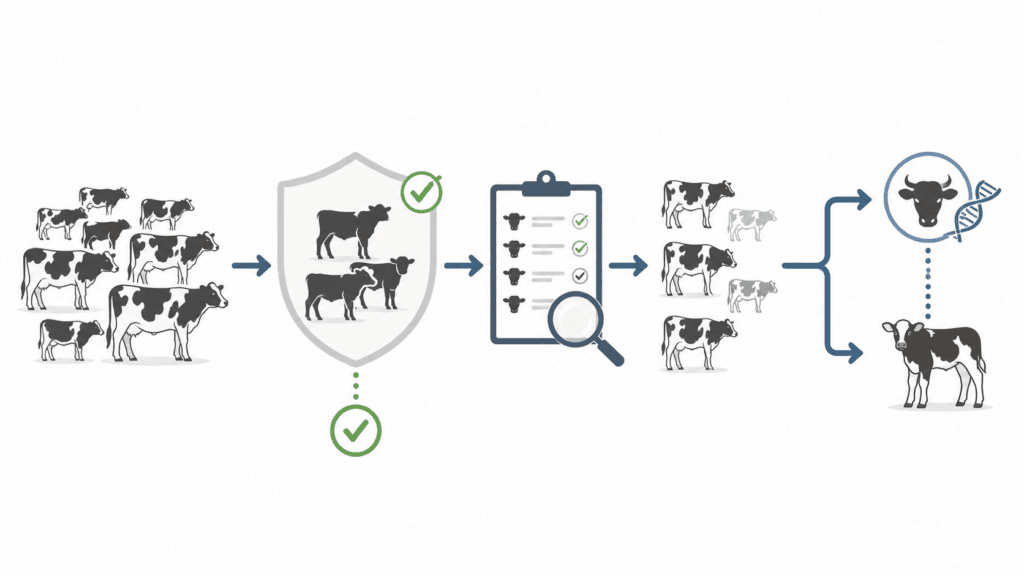
After setting the dairy-mating requirement, rank females for their role. Decisions can combine cow genetics, parity, body size, health, fertility, calving history, expected productive life, and planned culling. The strongest candidates for dairy matings are females likely to produce useful replacements. Guidance on selecting replacement heifers can support the next stage of that pipeline.
Low genetic merit alone does not make a cow suitable for beef semen. A small heifer, a cow with previous calving difficulty, or an animal likely to leave the herd may require a different mating or no breeding at all.
Compare Two Farm Scenarios
The table uses the same illustrative assumptions above and assumes 700 total insemination opportunities.
| Scenario | Target Replacements | Required Dairy Inseminations | Remaining Beef Inseminations | Interpretation |
|---|---|---|---|---|
| Replacement-constrained | 100 | 645 | 55 | Little room for beef matings |
| Replacement-surplus | 70 | 452 | 248 | More matings may be allocated to beef |
These figures show why a fixed herd percentage is unreliable. With identical reproductive assumptions, changing only the replacement target materially changes the available beef-mating pool. Crossbreeding beef and dairy therefore starts with inventory and reproduction records, not a universal semen ratio.
Choose Beef Sires and Control the Main Risks
Select Traits That Matter in Dairy Females
Sire selection for crossbreeding beef and dairy cattle must balance calving, fertility, calf performance, and buyer needs. Start with direct calving ease where available, gestation length, birth-weight indicators, and service-sire fertility. Then examine calf survival, growth, muscling, carcass fit, and proof accuracy, using progeny records when available.
Breed averages can hide important differences among individual sires. A multi-farm study found breed and within-breed variation in calving outcomes. Male calves, calves with higher birth weight, and calves born after longer gestations were each associated with greater calving difficulty (Ahmed et al., 2024). U.S. breeding records also showed variation in conception-rate estimates among individual beef sires, so beef semen should not be assumed to improve fertility automatically (McWhorter et al., 2020).
| Trait | Why It Matters | Higher-Risk Group | Data to Request | Evidence Source |
|---|---|---|---|---|
| Calving ease | Helps manage assistance risk | Heifers, small cows, previous difficult calving | Direct calving-ease EPD or proof and its accuracy | BIF Bull/Semen Selection Guidelines; Ahmed et al., 2024 |
| Gestation length | Affects calving timing and calf size | Cows near transition constraints | Gestation proof and progeny records | Basiel et al., 2024 |
| Service-sire fertility | Influences pregnancy opportunity | Repeat breeders | Sire conception estimate and reliability | McWhorter et al., 2020 |
| Growth and carcass fit | Influences downstream usefulness | Calves sold to specification buyers | Growth, muscling, carcass, and buyer data | Berry et al., 2023 |
The table is a screening tool, not a breed ranking. A sire that reduces one risk may give up performance elsewhere. Balanced selection uses reliable individual-sire records and checks whether the calf matches the intended market.
Match the Sire to the Dam and Market
Heifers and smaller cows generally need the most conservative calving-risk screen. Mature cows may offer more flexibility, while females with previous calving difficulty deserve individual review. Good dairy cow nutrition and transition management remain necessary because genetics cannot compensate for poor cow condition or weak calf care.
EPDs are generally compared within the same breed and genetic evaluation. Cross-breed comparison requires valid across-breed EPD adjustment factors for the breeds and trait concerned; raw EPD values should not be compared directly across breeds (Beef Improvement Federation). Match the sire to the dam first, then check buyer or feedlot specifications. Research supports considering calving, gestation, calf price, slaughter timing, and carcass outcomes together rather than selecting on one trait (Berry et al., 2023).
Avoid Common Selection Mistakes
Common errors include choosing on semen price, breed name, hide color, or low birth weight alone. Another is treating an “easy-calving” label as a guarantee. Each shortcut ignores either the dam, the reliability of the sire data, or downstream calf requirements.
A sound crossbreeding beef and dairy program documents why each sire fits its assigned females and market. If that explanation relies only on reputation or price, the selection is incomplete.
Manage Crossbred Calves and Measure the Results
Give Crossbred Calves Full Newborn Care
Crossbred calves need the same disciplined care as dairy replacements: prompt colostrum, permanent identification, suitable nutrition, clean housing, health checks, and treatment when needed. Before movement, confirm each calf is healthy and fit for transport under local rules.
The Calf Care & Quality Assurance Manual provides practical guidance for newborn care, handling, health, and transport. A multi-farm study detected no difference in transfer-of-passive-immunity status between dairy and dairy × beef calves, reinforcing the need for equally careful colostrum management in both groups (Kern et al., 2025). Genetics cannot correct weak colostrum delivery or inconsistent daily care.
Track Outcomes Against a Dairy-Sired Baseline
Good herd management turns each mating into usable evidence. For crossbreeding beef and dairy cattle, compare results with the farm’s dairy-sired calves from a similar period rather than relying on impressions.
Record conception and pregnancy performance, gestation length, assisted births, stillbirths, early health events, and survival. At sale, capture calf age, weight, price, sale date, buyer, and market conditions. Buyer feedback and repeat demand matter because a higher sale price in one week may reflect the market rather than genetics.
Continue watching replacement-heifer inventory as well. Review results by sire, dam group, parity, season, and buyer. This reveals whether the program protects replacements, controls calving risk, and produces calves that customers consistently want.
What a Good Beef-on-Dairy Decision Looks Like
A sound plan for crossbreeding beef and dairy starts with the number of replacement heifers the farm needs—not the number of beef matings it hopes to make. Use current herd records to reserve enough dairy matings, then assign only the remaining suitable females to beef semen. Choose individual sires by verified calving, fertility, gestation, growth, and carcass information, and match each sire to the dam’s parity, size, health, and calving history. Give every crossbred calf disciplined newborn care. Finally, monitor conception, calving, calf health, sale results, buyer feedback, and replacement inventory, then adjust the breeding plan from evidence.
Frequently Asked Questions
Is Beef Semen Suitable for Dairy Heifers?
Yes, but only when the individual sire has dependable calving-ease data and suits the heifer’s size and expected calving risk. Apply a more conservative sire screen than for mature cows, and remember that an “easy-calving” label does not eliminate risk.
How Many Dairy Cows Should Be Bred to Beef?
No universal percentage is reliable. First calculate replacement needs, including a safety margin based on farm records for conception, live births, survival, retention, culling, and growth. Assign beef semen only to the suitable females remaining after dairy matings are reserved.
Which Beef Breed Is Best for Dairy Cows?
No breed is best for every herd or market. Select individual sires using reliable data for calving, gestation, fertility, calf survival, growth, and carcass fit. Match those traits to the dam and buyer requirements instead of relying on breed reputation.
Can Beef-on-Dairy Breeding Increase Calf Value?
It may increase value when crossbred calves suit a buyer’s needs. Results depend on local demand, calf care, sire choice, sale timing, and marketing. Test any expected premium against the farm’s sale records rather than treating it as guaranteed profit.
Does Crossbreeding Reduce the Number of Replacement Heifers?
Crossbreeding beef and dairy cattle can reduce dairy-replacement births if too many females receive beef semen. Prevent shortages by reserving sufficient dairy matings first, monitoring pregnancies and heifer inventory, and revising allocation when reproduction, culling, or expansion plans change.