Understanding the Complete Dairy Farm Equipment List

A modern dairy farm requires much more than cows, feed, and a milking area. As dairy operations become larger and more competitive, farmers need reliable equipment systems to improve productivity, reduce labor costs, maintain animal health, and ensure consistent milk quality.
This dairy farm equipment list provides a complete overview of essential machines used in small, medium, and large-scale dairy farms. Whether you are planning a new dairy setup, upgrading an existing farm, or researching a dairy machinery list for investment, understanding each equipment category is important for making the right decisions.
Modern dairy farm equipment can be classified into five categories based on operational importance, automation level, technology level, and investment priority.
| Category | Classification Basis | Simple Definition |
|---|---|---|
| Essential Equipment | Required for basic dairy farm operation | Core equipment needed for daily dairy production |
| Automation Equipment | Uses automatic control, sensors, or robots to reduce manual labor | Equipment that improves efficiency and reduces labor costs |
| Advanced Equipment | Uses AI, robotics, data analysis, and smart farming technologies | High-tech equipment for smart dairy farms |
| Supporting Equipment | Helps maintain daily operation, safety, and equipment reliability | Auxiliary equipment that supports farm activities |
| Optional Equipment | Selected based on farm size, budget, and management goals | Additional equipment for improving efficiency or comfort |
Essential Equipment
Classification Basis:
Equipment required for basic dairy production. Without these systems, a dairy farm cannot operate efficiently.
Main purpose:
- Daily feeding
- Milking
- Cow housing
- Manure handling
Examples:
| Category | Equipment |
|---|---|
| Feeding System | TMR Mixer, Feed Wagon |
| Milking System | Milking Machine, Milking Parlor |
| Barn System | Cow Stalls, Ventilation System |
| Manure System | Manure Scraper, Slurry System |
This article works as a practical dairy equipment guid for farmers, investors, and dairy equipment professionals.
1. Complete Dairy Farm Equipment List Overview
The following table summarizes the main equipment required for modern dairy farming.
| Equipment Category | Main Equipment | Main Purpose |
|---|---|---|
| Feeding System | TMR mixer, feed wagon, silage equipment, feed pusher | Provide balanced nutrition and reduce feed waste |
| Milking System | Milking machine, milking parlor, milk cooling tank | Efficient milk collection and quality control |
| Housing System | Cow stalls, ventilation fans, cow brushes | Improve animal comfort and productivity |
| Cleaning System | Scrapers, slurry pumps, manure equipment | Maintain hygiene and farm environment |
| Farm Automation | Smart collars, sensors, robots | Improve management efficiency |
| Transportation | Tractors, loaders, trailers | Support daily farm operations |
| Maintenance | Workshop tools, spare parts, cleaning equipment | Ensure equipment reliability |
A professional dairy operation usually combines multiple systems instead of relying on individual machines.
2. Feeding Equipment – The Foundation of Dairy Production
Feed management directly affects milk yield, cow health, and production cost. Among all dairy investments, feeding equipment often provides one of the highest returns because feed represents the largest operating expense on most dairy farms.
Essential Feeding Equipment
| Equipment | Function | Suitable Farm Size |
|---|---|---|
| TMR mixer | Mix complete feed rations evenly | Medium and large farms |
| Feed wagon | Transport and distribute feed | Small to large farms |
| Silage cutter | Prepare silage materials | Farms using silage |
| Feed pusher robot | Push remaining feed closer to cows | Automated farms |
| Grain grinder | Process grains for feed | Farms producing own feed |
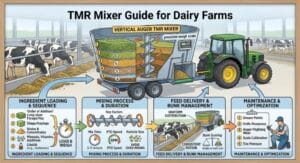
TMR Mixer – The Core Machine for Modern Feeding
A TMR mixer (Total Mixed Ration mixer) is one of the most important machines in modern dairy farming.
Traditional feeding methods often create problems:
- Uneven nutrient distribution
- Feed sorting by cows
- Higher labor requirements
- Increased feed waste
A TMR system combines:
- Silage
- Hay
- Corn
- Soybean meal
- Minerals
- Supplements
into one balanced ration.
Benefits include:
| Benefit | Result |
|---|---|
| Uniform mixing | Each cow receives similar nutrition |
| Reduced sorting | Better feed intake consistency |
| Lower labor cost | Less manual feeding work |
| Improved production | Supports stable milk yield |
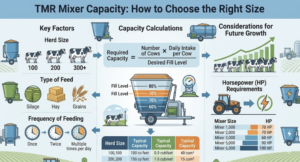
For farms with hundreds or thousands of cows, selecting the correct TMR mixer capacity is critical.
Common choices include:
| Farm Size | Recommended TMR Capacity |
|---|---|
| 50-200 cows | Small trailer mixer |
| 200-800 cows | Medium TMR mixer |
| 800+ cows | Large vertical or horizontal mixer |
3. Milking Equipment – Improving Milk Efficiency and Quality
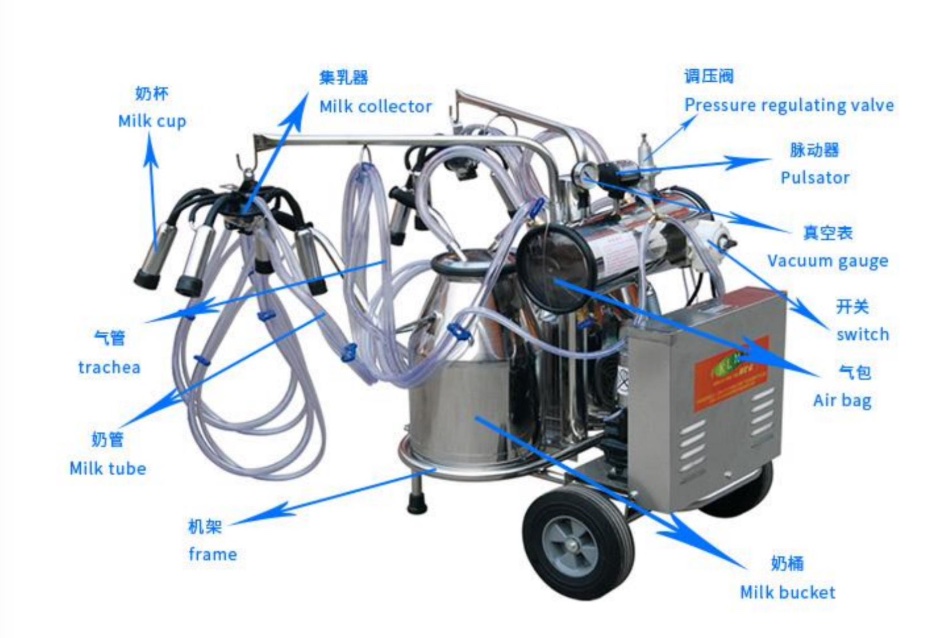
The milking system is another major part of every dairy machinery list.
Modern farms no longer depend only on manual milking. Professional operations use advanced milking equipment to improve efficiency, hygiene, and animal welfare.
Main Milking Equipment
| Equipment | Function |
|---|---|
| Milking parlor | Provides organized cow milking areas |
| Milking machine | Extracts milk efficiently |
| Milk pipeline system | Transfers milk automatically |
| Milk cooling tank | Quickly reduces milk temperature |
| Cleaning system | Maintains hygiene standards |
Types of Milking Systems
| System Type | Best For | Characteristics |
|---|---|---|
| Bucket milker | Small farms | Simple and affordable |
| Pipeline milking | Medium farms | Efficient and cleaner |
| Parallel parlor | Large farms | High throughput |
| Rotary milking system | Very large farms | Continuous operation |
| Robotic milking | Smart farms | Automatic milking and monitoring |
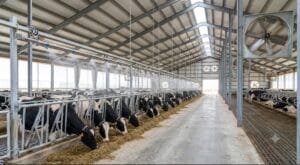
4. Barn Equipment – Creating a Comfortable Cow Environment
Cow comfort directly influences:
- Milk production
- Animal health
- Reproductive performance
- Longevity
Modern farms invest heavily in barn equipment to create better living conditions.
Essential Barn Equipment List
| Equipment | Purpose |
|---|---|
| Cow stalls | Provide resting areas |
| Ventilation fans | Control heat stress |
| Cooling systems | Reduce temperature stress |
| Cow brushes | Improve comfort and hygiene |
| Drinking systems | Ensure sufficient water supply |
| Lighting system | Support cow activity |
Why Barn Design Matters
A poorly designed barn can cause:
| Problem | Result |
|---|---|
| Poor ventilation | Heat stress and lower milk production |
| Wet floors | Higher disease risk |
| Limited resting space | Reduced cow comfort |
| Poor air quality | Respiratory problems |
Modern dairy farms combine equipment design with scientific management principles to improve overall performance.
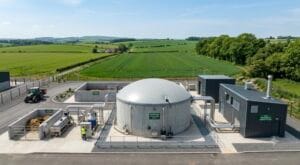
5. Manure Management Equipment – Maintaining Farm Hygiene and Sustainability

As dairy farms expand, manure handling becomes one of the most important operational challenges. Efficient manure management systems help farms maintain cleanliness, reduce environmental impact, and improve labor efficiency.
Without proper manure management equipment, dairy farms may face:
- Poor barn hygiene
- Increased disease risk
- Higher labor costs
- Environmental compliance problems
Modern dairy farms usually combine mechanical cleaning systems, storage systems, and transportation equipment.
Essential Manure Management Equipment
| Equipment | Function | Application |
|---|---|---|
| Automatic manure scraper | Removes manure from barn alleys | Freestall barns |
| Slurry pump | Moves liquid manure | Large dairy farms |
| Manure separator | Separates solids and liquids | Farms with manure recycling |
| Slurry tanker | Transports manure to fields | Crop-dairy operations |
| Manure storage tank | Stores waste safely | Medium and large farms |
Benefits of Modern Manure Systems
| Benefit | Impact |
|---|---|
| Cleaner barns | Improves cow health |
| Less manual labor | Reduces operating costs |
| Better waste utilization | Supports sustainable farming |
| Improved environmental control | Helps meet regulations |
Many modern dairy farms reuse separated manure solids as bedding materials or apply treated manure as fertilizer for feed crops.
6. Farm Machinery for Dairy Farm Operations
Besides specialized dairy equipment, farms also require general agricultural machinery to support daily operations.
A complete dairy equipment checklist should include supporting machines used for transportation, feeding preparation, and field management.
Common Farm Machinery List
| Machinery | Main Function |
|---|---|
| Tractor | General farm power source |
| Front loader | Handling feed and materials |
| Telehandler | Moving heavy loads |
| Trailer | Transporting equipment and materials |
| Silage harvester | Producing forage |
| Bale wrapper | Preserving hay quality |
| Water tanker | Supporting farm operation |
Role of Machinery in Dairy Production
Efficient machinery helps farmers:
- Reduce physical labor
- Improve working speed
- Handle larger herd sizes
- Maintain consistent production
For example:
A farm feeding 1,000 cows manually requires many workers and significant daily labor. A modern feeding system using a TMR mixer, loader, and feed management system can complete the same work with much higher efficiency.
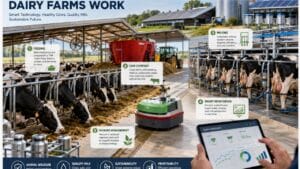
7. Smart Dairy Equipment – The Future of Dairy Farming
Digital technology is transforming traditional dairy operations into intelligent production systems.
Modern smart farms use sensors, automation, and data analysis to improve decision-making.
Smart Dairy Equipment List
| Equipment | Function |
|---|---|
| Smart cow collar | Tracks activity, health, and reproduction |
| Automatic feeding robot | Provides accurate feeding |
| Robotic milking system | Automates milking process |
| Farm management software | Analyzes production data |
| Environmental sensors | Monitors barn conditions |
Advantages of Smart Dairy Systems
| Traditional Farm | Smart Dairy Farm |
|---|---|
| Manual observation | Real-time monitoring |
| Experience-based decisions | Data-based decisions |
| High labor requirement | Automated operation |
| Delayed problem detection | Early warning system |
Smart technology is especially valuable for large farms where managing thousands of animals manually becomes difficult.
8. Dairy Equipment Checklist Before Starting a Farm
Before purchasing equipment, farmers should evaluate:
- Herd size
- Farm layout
- Available labor
- Feed system
- Future expansion plans
- Investment budget
The following dairy equipment checklist can help investors prepare.
Dairy Farm Equipment Checklist
| Category | Equipment Required | Priority |
|---|---|---|
| Feeding | TMR mixer, feed wagon, loader | Essential |
| Milking | Milking machine, milk tank | Essential |
| Barn | Fans, stalls, drinking system | Essential |
| Cleaning | Scraper system, manure pump | Essential |
| Transportation | Tractor, trailer | Recommended |
| Automation | Sensors, robots, software | Optional but valuable |
| Maintenance | Tools and spare parts | Necessary |
9. How to Choose the Right Dairy Farm Equipment
Selecting equipment is not only about buying the cheapest machine. A professional farm should consider long-term operating costs.
Important factors include:
| Factor | Why It Matters |
|---|---|
| Farm size | Determines equipment capacity |
| Reliability | Reduces downtime |
| Energy consumption | Controls operating costs |
| Maintenance support | Ensures long-term operation |
| Spare parts availability | Reduces repair time |
| Supplier experience | Provides technical support |
Equipment Selection Example
A 500-cow dairy farm may require:
| Equipment | Recommendation |
|---|---|
| Feeding system | Medium-size TMR mixer |
| Milking system | Pipeline or parlor system |
| Barn system | Ventilation and cooling equipment |
| Manure system | Automatic scraper and storage |
| Automation | Cow monitoring system |
Choosing equipment according to actual farm conditions prevents unnecessary investment.
10. Farm Machinery Standards and Equipment Quality
Professional dairy farms should consider farm machinery standards when selecting equipment.
Equipment quality affects:
- Worker safety
- Machine lifespan
- Production efficiency
- Animal welfare
Important considerations include:
| Standard Area | Requirement |
|---|---|
| Safety design | Protect operators and animals |
| Material quality | Resist corrosion and wear |
| Manufacturing process | Ensure reliability |
| Maintenance design | Easy inspection and repair |
| Environmental performance | Reduce energy consumption |
Working with experienced manufacturers helps farms select machines that match international expectations.
11. Recommended Dairy Farming Resources for Equipment Planning
Farmers should continue learning before investing in large equipment projects.
Useful dairy farming resources include:
| Resource | Main Value |
|---|---|
| International Dairy Federation (IDF) | Global dairy knowledge |
| Food and Agriculture Organization (FAO) | Agricultural development information |
| Journal of Dairy Science | Scientific research |
| Progressive Dairy | Practical dairy management |
| Dairy Herd Management | Industry news and farm practices |
These resources help farmers understand modern production methods and improve decision-making.
12. How Dairy Equipment Improves Livestock Production
The final purpose of investing in equipment is improving livestock production.
Good equipment helps farmers achieve:
- Better nutrition
- Improved animal comfort
- Higher labor efficiency
- Better milk quality
- More sustainable operation
The relationship is simple:
| Better Equipment | Farm Result |
|---|---|
| Accurate feeding | Better cow nutrition |
| Efficient milking | Higher milk quality |
| Comfortable barns | Healthier animals |
| Automated monitoring | Faster problem detection |
| Proper manure systems | Cleaner environment |
Conclusion: Building a Complete Dairy Farm Equipment System
A successful dairy farm depends on a complete equipment ecosystem rather than a single machine.
This dairy farm equipment list covers the essential systems required for modern dairy operations:
- Feeding equipment
- TMR mixer
- milking equipment
- barn equipment
- manure management
- Farm machinery
- Smart automation systems
- Maintenance tools
For beginners, understanding the complete dairy machinery list helps avoid costly mistakes when planning a new farm.
For professional dairy producers, upgrading equipment systems can improve efficiency, reduce operating costs, and support long-term growth.
Modern dairy farming is moving toward automation, data-driven management, and sustainable production. Choosing the right dairy setup equipment today can create a stronger foundation for future livestock production.
Frequently Asked Questions (FAQ)
1. What equipment is most important for a dairy farm?
The most important equipment includes feeding systems, milking systems, barn equipment, and manure handling systems. Among them, feeding equipment such as a TMR mixer has a major impact on daily operation efficiency.
2. What machines are needed for a 100-cow dairy farm?
A 100-cow farm usually needs:
- Small TMR mixer
- Milking equipment
- Feed storage system
- Barn ventilation
- Manure cleaning tools
- Basic farm machinery
3. How much does dairy farm equipment cost?
The investment depends on:
- Herd size
- Automation level
- Equipment brand
- Farm layout
Small farms may start with basic machines, while large commercial farms require advanced automated systems.
4. Why is a TMR mixer important for dairy farms?
A TMR mixer ensures feed ingredients are evenly distributed, helping cows receive balanced nutrition and reducing feed sorting and waste.
5. How do modern dairy farms use automation?
Modern dairy farms use:
- Smart collars
- Robotic milking
- Automatic feeding
- Data management software
- Environmental monitoring systems
These technologies improve management efficiency and support better decision-making.
Summary
A complete dairy farm equipment list includes feeding, milking, housing, manure handling, transportation, and smart farming systems. Selecting the right dairy equipment based on herd size, farm goals, and future expansion plans helps farmers build efficient, profitable, and sustainable dairy operations.