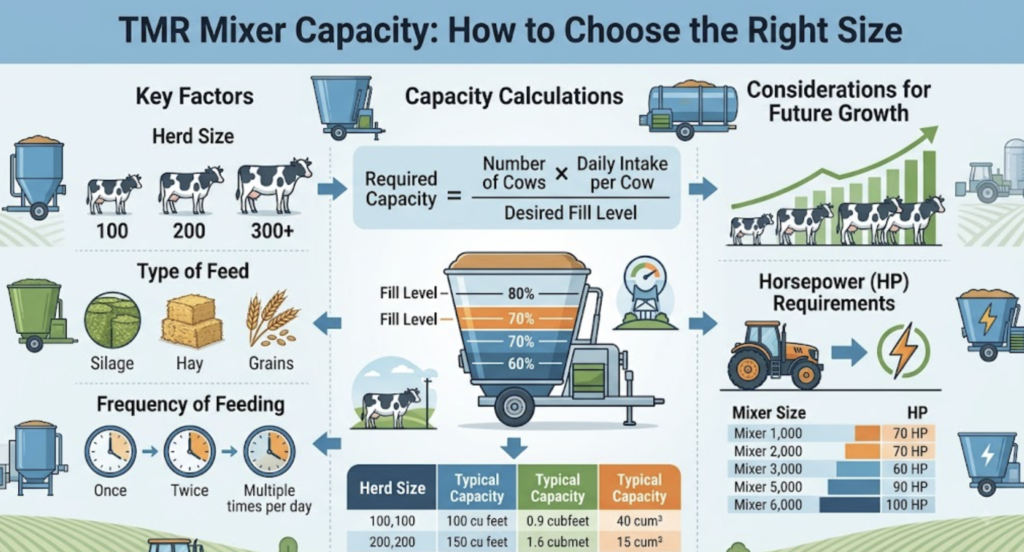
TMR mixer capacity tells you how much feed a mixer can effectively handle in one batch. Choosing the right size is not simply a matter of counting cows. You also need to know how much each cow eats, how many cows are fed in each group, how often you feed, the density of the ration, and the usable capacity of the machine.
For a quick estimate, start with five numbers:
| What You Need | Example |
|---|---|
| Cows in the largest feeding group | 200 cows |
| As-fed intake | 100 lb/cow/day |
| Feedings | 2/day |
| TMR density | 20 lb/ft³ |
| Required effective volume | 500 ft³ |
The numbers above are an example, not a universal recommendation. Actual intake and ration density vary between farms.
A common mistake is asking, “I have 300 cows. What size TMR mixer should I buy?” A better question is, “What is my largest batch, how much does it weigh, and how much volume does that ration occupy?”
That change in thinking can prevent both undersizing and unnecessary oversizing.
What Does TMR Mixer Capacity Mean?
Mixer capacity is normally expressed as volume, such as cubic feet (ft³) or cubic meters (m³). Batch weight, however, is expressed in pounds or kilograms.
These measurements are related, but they are not the same.
| Term | Typical Unit | Meaning |
|---|---|---|
| Mixer volume | ft³ or m³ | Space available inside the mixer |
| Effective mixing capacity | ft³ or m³ | Volume that can actually be used for proper mixing |
| Batch weight | lb or kg | Total weight of ingredients |
| TMR density | lb/ft³ or kg/m³ | Weight of feed per unit of volume |
| As-fed intake | lb/cow/day or kg/cow/day | Feed consumed including moisture |
This distinction matters because 5,000 lb of one ration may occupy more space than 5,000 lb of another.
For example, ration ingredients differ in size, shape, moisture, density and adhesiveness. UC Cooperative Extension notes that these physical properties affect how ingredients behave during mixing. Heavy ingredients tend to sink while lighter ingredients can move upward, and moisture also changes how materials interact.
So you should not assume that a mixer rated for a particular volume will always carry the same feed weight.
Why Usable Capacity Matters
The capacity printed on a specification sheet needs to be understood correctly. Ask whether the number represents total physical volume or the manufacturer’s recommended usable mixing capacity.
Overloading a mixer can restrict the movement needed to distribute ingredients properly. At the other extreme, buying a machine far larger than required may create problems when preparing small batches for dry cows, fresh cows or heifers.
This becomes particularly important when comparing different TMR mixer types. Vertical, horizontal/reel, stationary and self-propelled mixers do not all use the same geometry or mixing mechanism.
Instead of applying one universal fill percentage to every machine, confirm the recommended minimum and maximum batch size with the manufacturer.
Penn State also emphasizes that consistency in ingredient weight, total batch weight, particle distribution, mixing order and mixing time matters to the ration actually delivered to cows.
Capacity is therefore only one part of good TMR preparation.
How to Calculate the TMR Mixer Capacity You Need
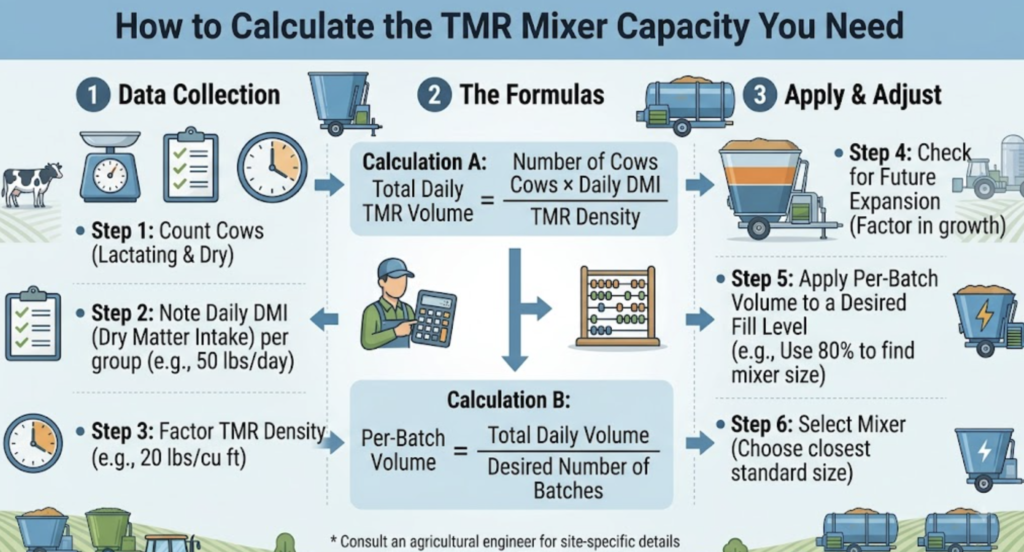
The calculation can be kept simple.
Required TMR mixer capacity = (Cows per batch × As-fed intake per cow ÷ Feedings per day) ÷ TMR density
Suppose a farm has 200 cows in its largest feeding group. Each cow requires 100 lb of as-fed TMR per day, cows are fed twice daily, and the example ration density is 20 lb/ft³.
Example: 200 cows × 100 lb/cow/day ÷ 2 feedings/day ÷ 20 lb/ft³ = 500 ft³
Under those assumptions, the farm needs approximately 500 ft³ of effective mixing volume per batch.
The important word is effective. This calculation does not automatically mean an advertised 500 ft³ machine is the correct choice. The manufacturer still needs to confirm whether that model can properly mix a 500 ft³ batch.
Here is how the same calculation changes with group size:
| Cows per Batch | Feed per Batch | Example Density | Effective Volume Needed |
|---|---|---|---|
| 50 | 2,500 lb | 20 lb/ft³ | 125 ft³ |
| 100 | 5,000 lb | 20 lb/ft³ | 250 ft³ |
| 150 | 7,500 lb | 20 lb/ft³ | 375 ft³ |
| 200 | 10,000 lb | 20 lb/ft³ | 500 ft³ |
| 300 | 15,000 lb | 20 lb/ft³ | 750 ft³ |
| 500 | 25,000 lb | 20 lb/ft³ | 1,250 ft³ |
These figures are calculation examples, not standard mixer recommendations. Every row assumes 100 lb of as-fed feed per cow per day, two feedings and a density of 20 lb/ft³.
Actual farm data should replace these assumptions before buying equipment.
Do Not Calculate from Herd Size Alone
Consider two 300-cow dairies.
Farm A keeps 300 cows in one feeding group.
Farm B divides 300 cows into three 100-cow groups with different rations.
Even though both farms milk the same number of cows, their largest individual batches can be very different.
Penn State notes that TMR systems may use separate high-, medium- and low-production lactating groups as well as different dry-cow and heifer groups.
That is why TMR mixer capacity should normally be based on the largest actual batch rather than total herd size alone.
You also need to check the other end of the range. If your largest batch is for 200 cows but your smallest special group contains only 30 cows, ask the manufacturer whether the same mixer can effectively handle both.
What Can Change the TMR Mixer Capacity You Need?
Once you have a basic calculation, check it against real farm conditions.
| Factor | Typical Effect | Reason |
|---|---|---|
| More cows per batch | More capacity | More feed per batch |
| Higher as-fed intake | More capacity | Greater feed weight |
| Lower-density ration | More capacity | Feed occupies more volume |
| Bulky or long forage | Often more volume | More physical space required |
| More feedings per day | Smaller batches | Daily feed is divided |
| More feeding groups | Different batch range | Large and small batches are required |
| Herd expansion | More future capacity | Larger future groups |
| Automatic feeding | Different sizing strategy | Smaller, frequent batches may be possible |
Ration Density and Forage Matter
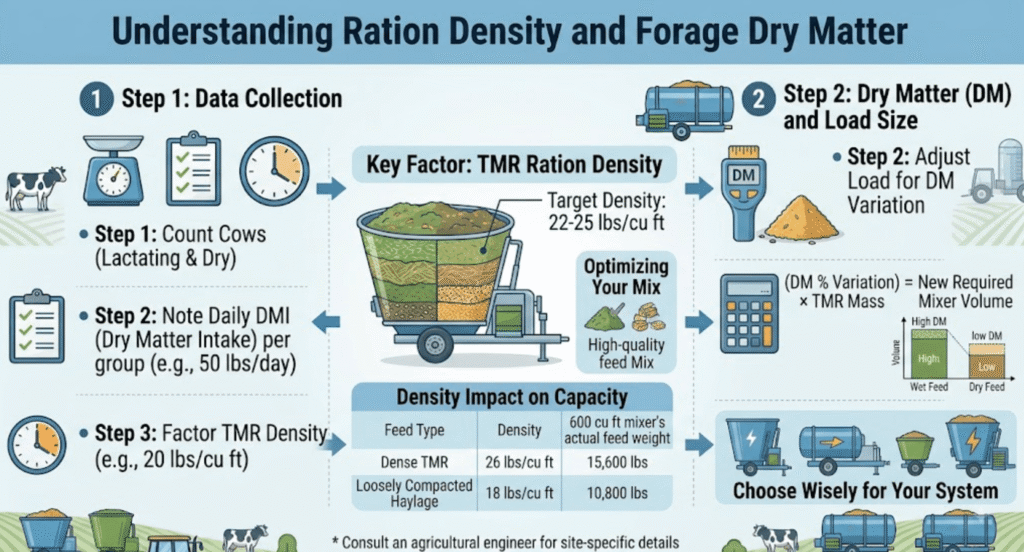
Ration density is one of the easiest factors to overlook.
Imagine two 10,000 lb batches. If one is relatively dense and the other contains bulky forage, they do not necessarily occupy the same volume.
This is why copying a generic “X cows = Y ft³ mixer” chart from the internet can produce a poor equipment decision.
Moisture matters as well.
Penn State provides an example in which 85 Holstein cows required 9,361 lb/day of delivered feed at 48% dry matter. When the example ration changed to 42% dry matter, maintaining the same 52 lb dry-matter intake required approximately 10,682 lb/day including refusals.
That is a useful reminder that changes in feed moisture can change the amount of as-fed material going into the mixer even when the cows’ nutritional target remains similar.
Forage characteristics also affect mixing. UC Cooperative Extension explains that mixer type and ingredient properties should influence loading order. It notes that many vertical mixer wagons can process unprocessed hay, while horizontal auger mixers equipped with knives may produce better uniformity when hay has already been processed.
Use your own farm’s normal ration whenever possible when confirming capacity.
Plan for Growth Without Simply Buying Bigger
Future expansion deserves consideration.
If a farm has 200 cows today but plans to reach 300 cows within three years, sizing a machine only around today’s feeding groups could result in replacing equipment earlier than expected.
But automatically buying the largest mixer available creates another problem: the machine still has to prepare today’s smaller batches properly.
A better approach is to calculate:
Current largest batch → current smallest batch → expected future largest batch
Then ask the supplier which machine can operate effectively across that range.
How to Choose TMR Mixer Capacity Before Buying
Once you know your approximate requirement, prepare real farm information before requesting a quotation.
This makes the equipment conversation much more useful than simply telling a supplier your herd size.
| Information to Confirm | Farm Data Example |
|---|---|
| Total lactating cows | 300 |
| Largest feeding group | 180 cows |
| Smallest feeding group | 40 cows |
| As-fed intake | 95 lb/cow/day |
| Feedings | 2/day |
| Estimated TMR density | 18 lb/ft³ |
| Main forage | Corn silage + haylage |
| Long-stem hay | Yes/No |
| Available tractor PTO | ___ hp |
| Maximum barn/alley width | ___ |
| Loading equipment height | ___ |
| Expected future herd size | 400 cows |
These numbers form a practical TMR buying guide for capacity selection.
After capacity has been calculated, compare the machine itself.
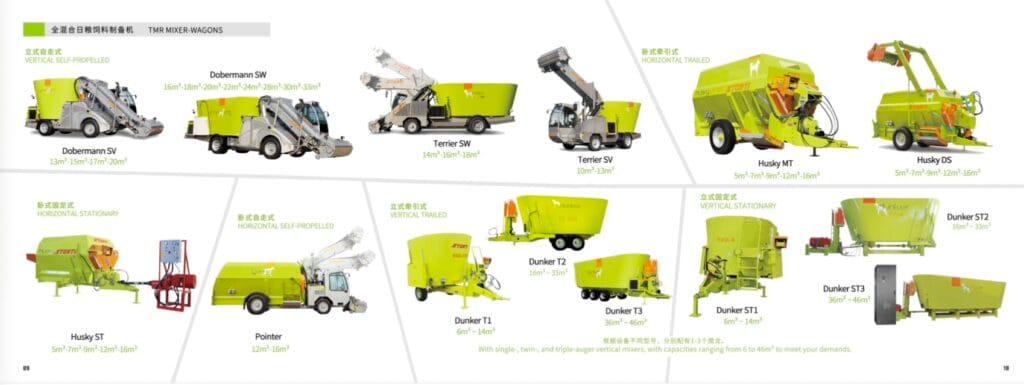
A vertical mixer may suit a farm that needs more forage processing capability. A horizontal/reel machine may suit another ration and feeding workflow. Stationary mixers can be integrated into centralized feeding installations, while self-propelled machines combine several feeding operations into one vehicle.
Capacity should therefore narrow your choice of TMR mixer types, not make the entire decision for you.
Also check tractor power, machine dimensions, loading height, alley width, discharge position and feed-bunk design before ordering. A mixer with the perfect calculated capacity is still the wrong machine if it cannot fit through the barn or work with your existing loading equipment.
Equipment condition matters after purchase as well. Penn State recommends maintaining mixing equipment properly and keeping load cells and scales accurate. It also recommends planning and carrying out a regular maintenance schedule.
Good TMR maintenance helps ensure that the ration calculated on paper is closer to the ration actually delivered.
For larger dairies, an automatic feeding system can change the calculation strategy. Instead of producing a few large batches, automation may allow smaller batches to be prepared and delivered more frequently. In that situation, capacity should be evaluated as part of the complete feeding workflow rather than by conventional mixer size alone.
TMR Mixer Capacity FAQ
What Size TMR Mixer Do I Need for 100 Cows?
There is no reliable capacity based only on cow numbers. You need as-fed intake, feeding frequency and ration density.
For example, if 100 cows consume 100 lb of as-fed TMR per day, receive two feedings, and the ration density is 20 lb/ft³:
100 cows × 100 lb ÷ 2 ÷ 20 lb/ft³ = 250 ft³
That is an illustrative effective-volume requirement, not a universal recommendation.
How Many Cows Can a 500 ft³ TMR Mixer Feed?
Using the same example assumptions—20 lb/ft³ density, 100 lb as-fed intake and two feedings—the calculation works backward:
500 ft³ × 20 lb/ft³ × 2 feedings ÷ 100 lb/cow/day = 200 cows
The actual number can be higher or lower depending on the ration and the mixer’s manufacturer-rated usable capacity.
Should I Buy a Larger Mixer for Future Expansion?
Allow room for realistic herd growth, but do not oversize blindly. Calculate your current smallest batch, current largest batch and expected future largest batch. The selected mixer should be capable of mixing that practical range effectively.
Is TMR Mixer Capacity Measured by Weight or Volume?
Mixer capacity is normally described by volume, such as ft³ or m³, while the actual batch is also measured by weight. Ration density connects the two. A lighter, bulkier ration requires more mixer volume for the same batch weight.
How Full Should a TMR Mixer Be?
There is no single fill percentage that should be applied to every mixer. Mixer geometry and mixing mechanisms differ. Use the manufacturer’s specified working capacity and recommended minimum and maximum batch sizes rather than assuming that total physical volume equals usable capacity.
Does a Larger TMR Mixer Mix Better?
Not necessarily. Correct capacity, ingredient properties, loading order, mixing time, particle size, scale accuracy and equipment condition all affect TMR consistency. Penn State emphasizes consistency in ingredient weights, particle distribution, mixing order and mixing time, while UC Cooperative Extension notes that ingredient properties and mixer design affect mixing behavior.
The goal is therefore not to buy the biggest mixer. It is to select a machine that can consistently handle the smallest and largest batches your farm actually needs.
Recommended Resources
- Dairy Farm Machine
- International Dairy Federation (IDF)
- Food and Agriculture Organization (FAO) – Dairy Production
- National Dairy FARM Program
- Journal of Dairy Science (JDS)
- Penn State Extension – Total Mixed Rations for Dairy Cows
- UC Cooperative Extension – Preparing the Total Mix Ration
- Progressive Dairy
- Dairy Herd Management