Feed Cost Reduction is usually the largest expense in dairy production, often accounting for 40–70% of total dairy farm operating costs. Improving feeding efficiency is one of the most effective ways to increase profitability.
Successful farms do not simply buy cheaper feed. Instead, they focus on improving dairy farm economics by reducing waste, optimizing feed ingredients, improving feed utilization, and using technology such as a TMR system, TMR mixer, and automatic feeding solutions.
There are several practical ways dairy farms can reduce feed costs while maintaining milk production.
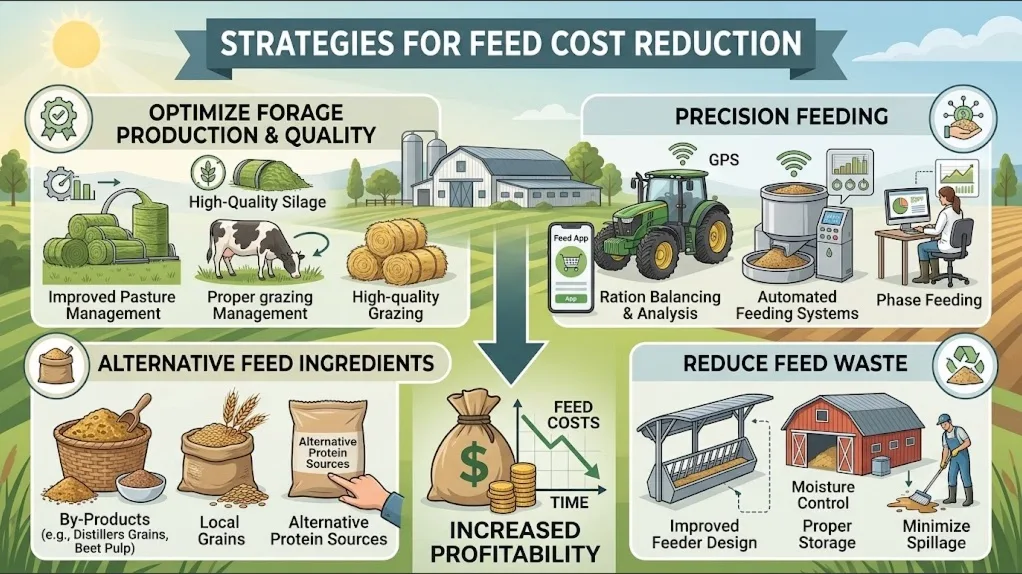
7 Practical Ways to Reduce Dairy Feed Costs
| Cost Reduction Strategy | Practical Method | Expected Cost Reduction |
|---|---|---|
| 1. Improve Feed Ingredient Selection | Choose cost-effective local ingredients and balance nutrients correctly | 5–15% feed cost reduction |
| 2. Produce High-Quality Silage | Improve forage production and reduce purchased feed dependence | 10–25% feed cost reduction |
| 3. Use a TMR System | Mix ingredients accurately and reduce feed sorting | 5–15% improvement in feed efficiency |
| 4. Reduce Feed Waste | Better storage, mixing, and feed delivery management | 3–10% reduction in feed loss |
| 5. Apply Automatic Feeding | Reduce labor costs and improve feeding consistency | 20–50% labor cost reduction |
| 6. Optimize Cow Nutrition | Adjust rations according to production stage | 5–10% improvement in feed conversion |
| 7. Monitor Feed Performance | Track feed intake, milk yield, and feed cost per kg milk | 5–15% cost improvement |
1. Optimize Feed Ingredients Selection
The first step in reducing feed costs is choosing the right combination of feed ingredients. The cheapest ingredient is not always the most economical choice. Farmers should focus on cost per unit of nutrients, not only purchase price.
Common strategies include:
- Using locally available grains and by-products
- Balancing protein and energy levels
- Replacing expensive ingredients with suitable alternatives
- Testing feed quality regularly
For example, soybean meal can sometimes be partially replaced with canola meal or DDGS when prices change, while maintaining proper dairy nutrition.
Example 1: High protein feed cost
A dairy farm depends heavily on soybean meal as the main protein source. When soybean prices increase, feed costs rise significantly.
Solution:
The farm can evaluate alternative feed ingredients such as canola meal, DDGS, cottonseed, or other local protein sources. By balancing protein and amino acid requirements, the farm can maintain dairy nutrition while reducing dependence on expensive ingredients.
Expected result:
Protein feed costs can potentially decrease by 5–15% without reducing milk production.
Example 2: Too much dependence on purchased forage
A farm purchases most of its hay and forage because it does not produce enough feed locally. During shortage seasons, forage prices increase sharply.
Solution:
Increase production of corn silage, grass silage, or other local forage crops. Good-quality farm-produced forage provides a more stable and economical feed source.
Expected result:
Purchased forage costs can be reduced by 10–25%.
2. Improve Silage Quality
High-quality forage is the foundation of economical dairy feeding. Producing good corn silage or grass silage reduces dependence on expensive purchased concentrates.
| Silage Improvement | Result |
|---|---|
| Better harvesting timing | 5–10% higher nutrient retention |
| Proper moisture control | 10–20% reduction in spoilage |
| Good sealing and storage | 5–15% lower feed loss |
Better silage quality allows farmers to use more home-produced feed and improve overall dairy farm economics.
Example 1: Nutrient loss from poor silage storage
A farm experiences mold growth and heating after opening the silo. A large amount of feed becomes unusable.
Solution:
Improve harvesting timing, maintain proper moisture content, compact the silage properly, and seal the silo quickly to prevent oxygen exposure.
Expected result:
Silage losses can be reduced by 5–15%, preserving more nutrients for cows.
Example 2: Low-quality silage reduces milk production
A farm uses immature or over-mature corn silage with low energy value. Cows consume less feed, and milk production becomes unstable.
Solution:
Harvest crops at the correct maturity stage and regularly test silage quality. Better silage provides more consistent energy for lactating cows.
Expected result:
Feed efficiency can improve by 5–10%.
3. Use a TMR System and TMR Mixer
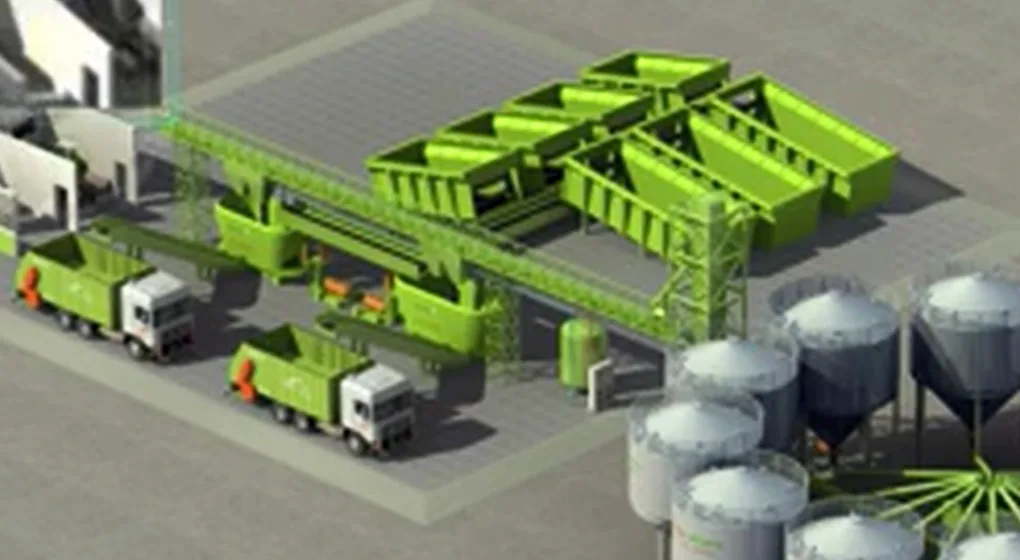
A TMR system combines forage, grains, protein sources, minerals, vitamins, and feed ingredients into one balanced ration.
Without a TMR system, cows may select preferred ingredients, causing nutrient imbalance and feed waste.
A modern TMR mixer improves:
- Mixing accuracy
- Feed consistency
- Labor efficiency
- Feed utilization
Typical results include:
| Item | Improvement Range |
|---|---|
| Feed sorting reduction | 30–50% |
| Feed waste reduction | 3–10% |
| Feed efficiency improvement | 5–15% |
Example 1: Cows sort feed ingredients
A farm notices that cows eat more grain and leave behind fiber. This creates an unbalanced diet and affects rumen health.
Solution:
Use a TMR mixer to combine forage, grains, protein sources, minerals, and feed additives evenly. A proper TMR system ensures every bite contains balanced nutrients.
Expected result:
Feed sorting can be reduced by 30–50%, improving nutrient intake consistency.
Example 2: Inaccurate manual feed measurement
Workers manually measure ingredients, causing differences between batches. Some cows receive too much energy while others receive insufficient nutrients.
Solution:
Use a TMR mixer with electronic weighing systems to accurately measure and mix ingredients.
Expected result:
Feed efficiency can improve by 5–15%.
4. Reduce Feed Waste
Feed waste directly increases production costs. Common causes include poor storage, inaccurate mixing, overfeeding, and leftover feed.
Practical solutions:
- Store feed in dry and protected areas
- Check leftover feed daily
- Adjust ration according to actual intake
- Use accurate weighing systems
Reducing only 5% feed waste can create significant savings on large dairy farms.
Example 1: Excess leftover feed
A farm prepares more feed than cows can consume, creating unnecessary waste.
Solution:
Monitor daily feed intake and adjust the ration according to cow numbers, milk production, and leftover feed quantity.
Expected result:
Feed waste can be reduced by 3–10%.
Example 2: Poor feed storage management
Feed ingredients become damaged because of moisture, pests, or incorrect storage.
Solution:
Improve storage conditions with proper covers, dry areas, and regular inventory checks.
Expected result:
Storage losses can decrease by 5–15%.
5. Adopt Automatic Feeding
Labor costs continue to increase in many regions. Automatic feeding technology helps farms prepare and deliver feed more efficiently.
Compared with manual feeding, automatic systems can:
- Reduce labor requirements
- Feed cows more frequently
- Maintain consistent ration delivery
- Improve cow feeding behavior
Large farms using automatic feeding systems may reduce feeding labor by 20–50%.
Example 1: High labor cost for feeding
A large dairy farm requires several workers every day to prepare and deliver feed.
Solution:
Introduce automatic feeding equipment to prepare and distribute feed more efficiently.
Expected result:
Feeding labor costs can decrease by 20–50%.
Example 2: Irregular feeding schedule
Workers cannot always deliver feed at the same time because of labor limitations.
Solution:
Use automatic feeding systems to provide fresh feed more frequently and maintain consistent feeding times.
Expected result:
Feed intake consistency can improve by 5–10%.
6. Optimize Cow Nutrition
Not every cow needs the same ration. Feeding high-producing cows, dry cows, and heifers with identical diets can increase costs.
A precision feeding strategy adjusts nutrition according to:
- Lactation stage
- Milk production level
- Body condition
- Cow health status
Better nutrition improves feed conversion, meaning cows produce more milk from the same amount of feed.
Example 1: All cows receive the same feed formula
A dairy farm uses one standard ration for all cows, including fresh cows, high-producing cows, mid-lactation cows, and dry cows. However, different cows have different nutritional requirements. This can lead to overfeeding some cows and underfeeding others.
Solution:
Develop different rations according to production stage, milk yield, and body condition. High-producing cows receive higher energy and protein levels, while dry cows receive a different balanced diet.
Expected result:
Better nutrient utilization can improve feed conversion efficiency by 5–10% and reduce unnecessary feed costs.
Example 2: Low milk production caused by an unbalanced ration
A farm increases concentrate feeding to increase milk production, but milk yield does not improve significantly. The problem is not the amount of feed, but the imbalance between energy, protein, and fiber.
Solution:
Analyze the ration and adjust the balance between forage, energy sources, protein sources, minerals, and feed additives. A professional TMR system helps maintain a consistent nutrient supply.
Expected result:
Milk production stability can improve by 5–15%, while avoiding unnecessary concentrate costs.
7. Monitor Feed Cost and Performance
Modern dairy farms use data to make better decisions. Important measurements include:
| Monitoring Item | Target Range |
|---|---|
| Feed cost percentage | 40–70% of operating cost |
| Feed waste | Less than 5–10% |
| Dry matter intake monitoring | Daily tracking |
| Feed cost per kg milk | Continuous improvement |
Regular monitoring helps farmers identify problems quickly and improve profitability.
Example 1: The farm does not know the real feed cost per kilogram of milk
A dairy farm records total feed purchases but does not calculate feed cost per kg of milk produced. As a result, expensive feed ingredients may be used without knowing their actual economic benefit.
Solution:
Track key indicators regularly:
- Daily feed intake
- Feed cost per cow
- Milk yield per cow
- Feed cost per kg of milk
Using this data helps farmers select better feed ingredients and improve overall dairy farm economics.
Expected result:
Better feed management decisions can improve cost control by 5–15%.
Example 2: Feed prices change but the ration remains unchanged
A farm continues using the same feed formula even when prices of corn, soybean meal, or other ingredients increase significantly.
Solution:
Review feed prices regularly and adjust the ration based on nutrient cost rather than ingredient price alone. For example, replace expensive ingredients with more economical alternatives while maintaining proper dairy nutrition.
Expected result:
Ingredient costs can potentially decrease by 5–10% without affecting cow performance.
New Trends in Dairy Feed Cost Reduction
Modern dairy farms are moving from traditional feeding management toward precision feeding, automation, and data-driven decision-making. The goal is no longer simply to reduce feed quantity, but to maximize the value of every kilogram of feed.
1. Precision Feeding with AI and Data Analysis
Traditional farms often use fixed feed formulas for large groups of cows. However, modern farms are using data from milk production, cow activity, body condition, and feed intake to create more accurate feeding programs.
AI-based feeding systems can analyze:
- Milk yield changes
- Cow health status
- Feed intake behavior
- Nutrient requirements
By adjusting rations more precisely, farms can avoid overfeeding and improve feed efficiency.
Expected result:
- 5–15% improvement in feed utilization
- Lower unnecessary feed ingredient costs
2. Smart TMR System with Automatic Feeding
The traditional TMR system requires workers to prepare and deliver feed manually. New-generation dairy farms are adopting automatic feeding technology combined with a TMR mixer and smart management software.
Modern automatic feeding systems can:
- Automatically load feed ingredients
- Mix rations accurately
- Deliver feed multiple times per day
- Push feed closer to cows automatically
More frequent feeding encourages cows to eat more consistently and improves dairy nutrition.
Expected result:
- 20–50% reduction in feeding labor
- 3–10% reduction in feed waste
3. Real-Time Feed Monitoring
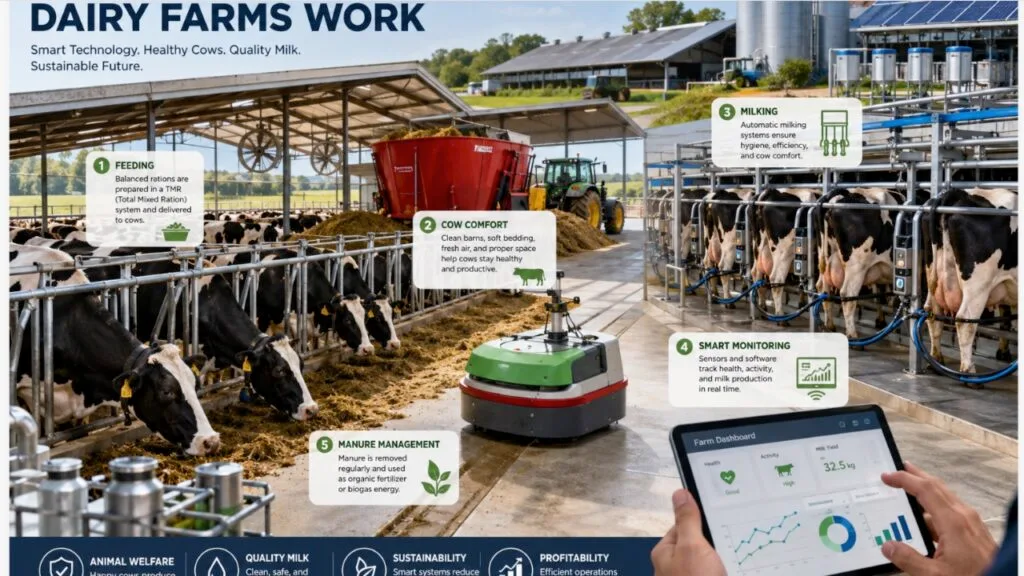
A new trend in dairy farming is monitoring feed performance in real time. Sensors and farm management software help farmers understand whether cows are actually converting feed into milk efficiently.
Farmers can monitor:
- Feed intake
- Leftover feed quantity
- Milk production response
- Feed cost per kg of milk
This improves dairy farm economics by helping farmers make faster decisions.
Expected result:
- 5–15% improvement in cost control
- Faster identification of feeding problems
4. Alternative Feed Ingredients and Circular Feeding
With increasing feed prices, farms are exploring alternative feed ingredients such as:
- DDGS
- Canola meal
- Brewers grains
- Food industry by-products
- Local agricultural residues
The focus is to replace expensive ingredients while maintaining proper nutrient balance.
For example, replacing part of soybean meal with suitable alternative protein sources can reduce feed costs without affecting milk production.
Expected result:
- 5–15% reduction in protein feed costs
5. Digital Feed Management and Farm Software
Large dairy farms are increasingly using digital platforms to connect feeding, milk production, inventory, and cost data.
These systems help farmers answer important questions:
- How much feed does each cow consume?
- Which feed ingredient provides the best economic return?
- How much does each kilogram of milk cost to produce?
Data-based decisions improve long-term profitability and reduce unnecessary expenses.
Future Direction
The future of dairy feeding will combine:
- Smart TMR system
- Automated feeding equipment
- AI nutrition recommendations
- Real-time cow monitoring
- Sustainable feed ingredients
The most successful dairy farms will not be those using the cheapest feed, but those using technology to achieve the highest milk production efficiency from every kilogram of feed.
A modern TMR mixer, combined with intelligent feeding management, will become an essential tool for improving feed cost reduction, animal health, and overall dairy farm economics.