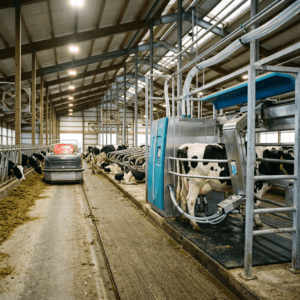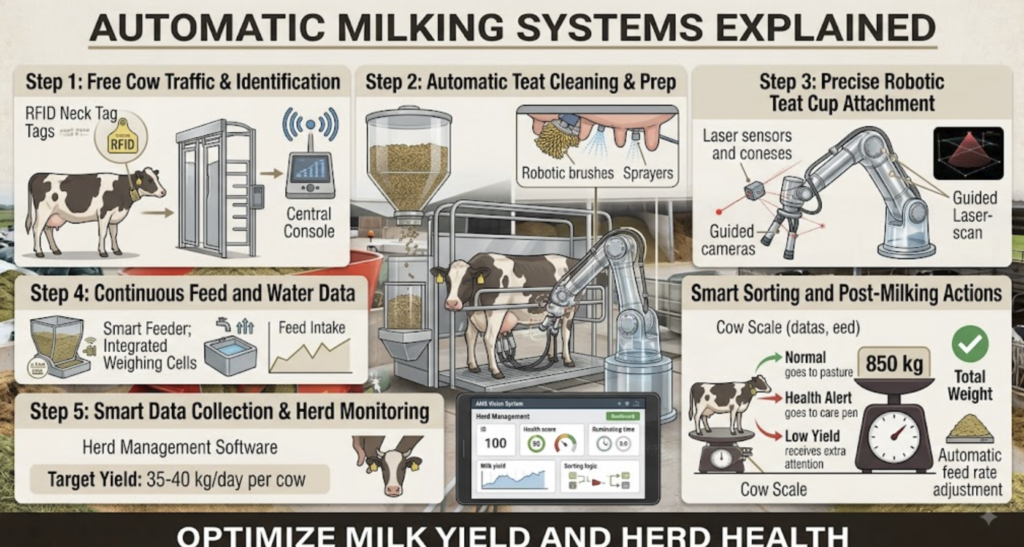
An automatic milking system uses robotic equipment to identify cows, prepare teats, attach milking cups, monitor milk flow, remove the cups, and record cow-level data with limited direct operator involvement. Unlike a conventional milking parlour, box-type robotic systems generally allow cows to visit the milking unit individually throughout the day rather than moving the whole group through fixed milking sessions.
Robotic milking is no longer a niche technology. USDA Economic Research Service (ERS) reported that robotic systems produced 6% of U.S. milk in 2021, up from 4% in 2016. Adoption was highest among midsized dairies: 13% of farms with 150–499 cows used robotic milking in 2021. These figures describe U.S. adoption; they do not mean that 150–499 cows is automatically the ideal herd size for robots. (Economic Research Service)
For beginners, the most important point is simple: automatic does not mean unattended. The robot reduces repetitive milking work, but people are still needed to manage cows, clean equipment, respond to alarms, maintain the system, and make herd-management decisions.
| Quick Question | Automatic Milking | Conventional Milking Parlour |
|---|---|---|
| Automatic cow identification | Yes | System-dependent |
| Robotic cup attachment | Yes | Usually no |
| Individual cow visits | Common | Usually group-based |
| Fixed milking sessions required | Usually no | Common |
| Cow-level digital data | Extensive | System-dependent |
| Human supervision required | Yes | Yes |
| Software dependence | High | Varies |
| 24/7 operation possible | Yes | System-dependent |
USDA ERS — Robotic Milking Gains Ground
1. How Does an Automatic Milking System Work?
An automatic milking system combines electronic cow identification, robotic teat preparation and attachment, milk sensors, automatic detachment, cleaning equipment, and herd-management software. The goal is to complete routine milking without requiring an operator to attach every cow manually.
Core Milking Workflow
The process is easier to understand as one continuous line:
Cow enters → Electronic ID → Milking permission checked → Teats prepared → Cups attached → Milk monitored → Cups removed → Data recorded → Cow exits
When a cow enters, her electronic identification is read. The software checks whether she meets the system’s programmed milking criteria. If she does, the robot prepares the teats, locates them, and attaches the cups.
During milking, sensors collect system-dependent information such as milk flow and yield. Cups are removed according to the system’s settings, information is stored, and the cow leaves the unit.
Main AMS Components
| Component | Main Function |
|---|---|
| Electronic ID | Identifies individual cow |
| Entry/selection gate | Controls access |
| Teat-detection system | Locates teats |
| Robotic arm | Positions and attaches cups |
| Teat-preparation unit | Prepares teats |
| Milking unit | Extracts milk |
| Milk sensors | Collect milking data |
| Automatic detachment | Removes cups |
| Cleaning system | Cleans relevant equipment |
| Management software | Stores data and alerts |
This is why robotic milking is more than advanced dairy milking equipment. The physical equipment performs the milking, while identification, sensors, software, and automation create a digital record for each cow.
The relationship is straightforward:
Cow → Robot → Milking event → Data recorded
The next question is how this workflow differs from a traditional parlour.
2. Automatic Milking System vs. Milking Parlour: What Really Changes?
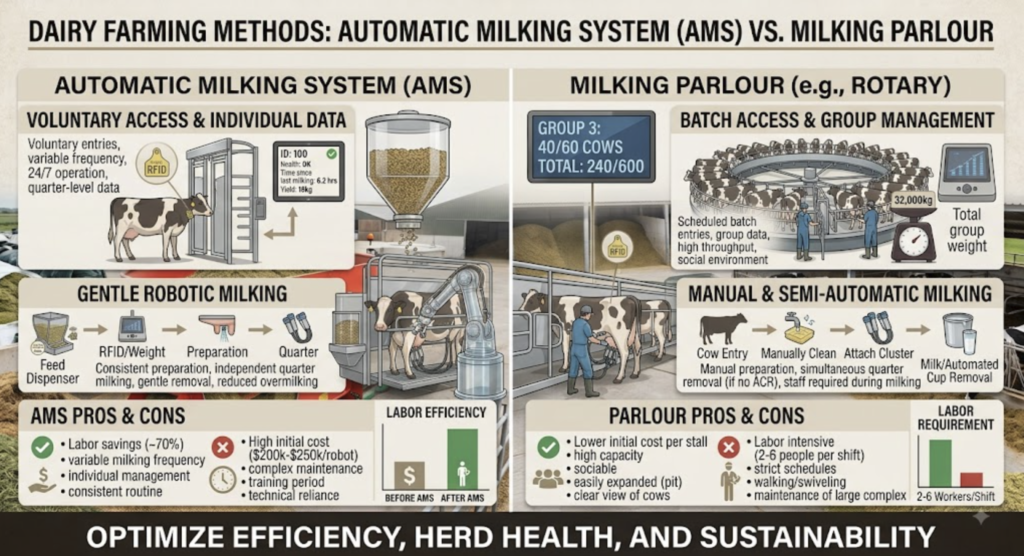
The main difference is workflow. A conventional milking parlour normally brings groups of cows to scheduled milking sessions. Box-type robotic milking allows individual cows to visit stationary robots at different times throughout the day.
That changes cow movement and the way employees organize their work.
Robotic Milking Comparison
| Comparison | Automatic Milking | Conventional Parlour |
|---|---|---|
| Cow movement | Mainly individual | Mainly group |
| Milking timing | Distributed through day | Scheduled sessions common |
| Cup attachment | Robotic | Operator/automation |
| Operator at each attachment | No | Common |
| Cow identification | Automatic | System-dependent |
| Individual-cow data | Extensive | System-dependent |
| Cow-traffic importance | Very high | Moderate–high |
| Software dependence | High | Varies |
| Some cows need fetching | Yes | Different workflow |
| Expansion method | Add/reconfigure units | Increase parlour capacity |
This robotic milking comparison does not mean one approach is universally better. A well-designed parlour can provide efficient group throughput, while robotic milking emphasizes individual visits, automation, and exception-based management.
What Changes for Cows and Workers?
Cow behavior changes because animals are no longer necessarily leaving a milking session together.
Penn State Extension explains that cows in conventional parlour systems typically return to their pen as a group, often creating a strong feeding peak. In AMS barns, individual robot visits spread feeding activity more widely across the day. However, crowding can still occur after fresh feed is delivered. (Penn State Extension)
Labor changes too.
Instead of spending much of the milking shift repeatedly attaching units, workers may spend more time on:
- fetching cows that are overdue;
- cleaning robots and surrounding areas;
- checking alerts;
- inspecting individual cows;
- maintaining equipment;
- managing exceptions.
So the change is better described as:
Scheduled group milking → Individual automated milking + exception management
The actual economic effect of this change belongs in the ROI calculation later in the article.
3. What Does a Dairy Farm Need Before Installing Robotic Milking?
A dairy needs more than enough floor space for a robot. Successful installation depends on cow traffic, feeding access, flooring, utilities, separation areas, monitoring, backup power, and technical service.
Barn and Cow Traffic
Cows need to reach the robot easily and willingly.
Two common concepts are:
Free-flow traffic: cows have relatively free access among resting, feeding, and milking areas.
Guided traffic: gates and layout influence how cows move through different areas.
Neither approach is automatically better. The correct design depends on the barn, herd, feeding program, stocking strategy, and management goals.
| Requirement | Why It Matters |
|---|---|
| Robot position | Easy cow access |
| Cow traffic | Supports regular visits |
| Fetch area | Handles overdue cows |
| Separation pen | Health and treatment work |
| Non-slip flooring | Supports safe movement |
| Feed access | Supports intake |
| Water access | Supports intake |
| Ventilation | Supports cow comfort |
| Backup power | Protects continuity |
| Service access | Simplifies repairs |
Mobility is particularly important. Penn State cites research showing that lame cows were more than twice as likely to require fetching for milking. (Penn State Extension)
That is a useful reminder that robot performance is connected to the cow’s ability and willingness to move—not only to the specifications of the machine.
Feeding and Robot Visits
Feeding should be planned together with robotic milking.
A simple relationship is:
Feed availability + ration design + robot feed + cow comfort → Feeding behavior and robot traffic
Penn State notes that even though eating is distributed more widely through the day in AMS barns, activity at the bunk still increases after fresh-feed delivery. (Penn State Extension)
Space matters as well. Dairy housing guidance commonly recommends around 24 inches (61 cm) of bunk space per cow, while research summarized by Penn State found that around 25–28 inches (64–71 cm) per cow on average in AMS herds was associated with higher milk production. This is an association rather than a guarantee that increasing bunk space alone will increase milk production. (Penn State Extension)
Feed push-up helps keep ration within reach, but Penn State specifically notes that frequent push-up does not eliminate competition caused by insufficient bunk space. (Penn State Extension)
A useful one-line calculation is:
Bunk space/cow = Total usable bunk length ÷ Cows = 120 ft × 12 in/ft ÷ 60 cows = 24 in/cow
This calculation helps a farmer check an existing barn before planning robotic milking. (Penn State Extension)
Penn State Extension — Feed Bunk Space in Automated Milking Systems
Cow Monitoring and Data
The robot also becomes an important data source.
Depending on the system, information can include visits, milk yield, milking intervals, milk flow, and other cow- or milk-level measurements.
The management flow is:
Cow ID → Milking data → Cow monitoring system → Alert → Farmer checks cow → Management decision
This relationship is important for smart dairy farming.
The objective is not simply to generate more alerts. The farm needs to decide which information deserves attention, who reviews it, and what action follows.
A cow monitoring system supports management; it does not replace direct observation, professional herd management, or veterinary diagnosis.
4. How Do You Calculate AMS Costs, Labor Savings, and ROI?
AMS profitability depends on labor changes, milk-production changes, operating expenses, installation costs, financing, and equipment life—not the robot’s purchase price alone.
This is also where farm size can make a significant difference.
USDA ERS found that U.S. robotic-milking farms with 150–499 cows had paid-labor expenses of $1.17/cwt in 2021, compared with $2.10/cwt for nonadopters in the same size group. Among farms with 50–149 cows, unpaid labor expenses averaged $5.30/cwt for adopters versus $9.22/cwt for nonadopters. USDA cautions that the labor effect varies with herd size. (Economic Research Service)
USDA ERS — Robotic Milking and Labor Costs
Labor Savings
Use your farm’s actual labor hours and wage:
Annual labor saving = Hours saved/day × Labor cost/hour × 365 = 4 hr × $22 × 365 = $32,120/year
Milk-Value Change
Do not automatically assume milk production will increase. Run the calculation using conservative, expected, and optimistic scenarios.
Annual added milk = Cows × Milk change/cow/day × 365 = 120 × 1.5 kg × 365 = 65,700 kg/year
Annual added milk value = Added milk × Milk price = 65,700 kg × $0.45/kg = $29,565/year
Total Ownership Cost
Purchase price alone does not represent the true investment.
Total ownership cost = Equipment + Installation + Barn modification + Utilities + Financing + Service + Maintenance + Consumables + Energy + Downtime − Residual value
This formula is especially important when comparing a robot installation with continued use or expansion of an existing parlour.
ROI and Payback
Calculate the annual net benefit first:
Annual net benefit = Labor saving + Added milk value + Other savings − Added OPEX = $32,120 + $29,565 + $8,000 − $25,000 = $44,685/year
Then calculate simple payback:
Simple payback = Net installed investment ÷ Annual net benefit = $300,000 ÷ $44,685 = 6.71 years
For a longer investment view:
5-year simple ROI = [(5-year benefits − 5-year costs) ÷ 5-year costs] × 100
The hypothetical example can be summarized more clearly in one table:
| Planning Item | Illustrative Example |
|---|---|
| Net installed investment | $300,000 |
| Annual labor saving | $32,120 |
| Annual added milk value | $29,565 |
| Other annual savings | $8,000 |
| Added annual OPEX | −$25,000 |
| Annual net benefit | $44,685 |
| Simple payback | 6.71 years |
These are illustrative planning inputs, not industry-average AMS costs or expected results. Replace every number with farm records, current milk prices, labor costs, and supplier quotations before making an investment decision.
What Does Independent Research Say?
USDA ERS provides useful independent evidence. Its 2026 analysis found that, after accounting for farm and operator characteristics, robotic milking was associated with $3.15/cwt higher dairy net returns on average than nonadoption. (Economic Research Service)
A broader USDA ERS report found that robotic milking—or adoption of two or more precision technologies among those studied—was associated with approximately 13% higher dairy net returns on average. (Economic Research Service)
These are statistical estimates across U.S. farms, not a promise that buying a robot will raise an individual farm’s profit by $3.15/cwt or 13%.
USDA ERS — Precision Dairy Farming, Robotic Milking, and Profitability
That distinction is important when building an honest ROI model:
Independent research → Establish realistic context
Farm records + supplier quotations → Calculate your own investment case
5. Is an Automatic Milking System Right for Your Dairy Farm?
An automatic milking system is worth considering when the farm has suitable herd management, workable cow traffic, a compatible feeding program, reliable technical support, and enough economic value from labor flexibility, production, or cow-level data to justify the total investment.
Herd size alone should not make the decision.
USDA reported that robotic adoption in 2021 was highest among farms with 150–499 cows, at 13%. The agency notes that smaller farms may rely more heavily on unpaid family labor, reducing the opportunity for cash labor savings, while very large dairies may already have relatively low labor costs per hundredweight and could require substantial changes to integrate box robots. (Economic Research Service)
10-Point Buyer Checklist
| Question | What It Determines |
|---|---|
| How many cows need milking? | Required system capacity |
| What milking frequency is expected? | Robot workload |
| What is the total installed cost? | Investment requirement |
| How much labor can realistically change? | Potential savings |
| Is reliable local service available? | Downtime risk |
| Is backup power available? | Operating continuity |
| What is the maintenance plan? | Long-term OPEX |
| Who responds to alarms? | Management workload |
| Can data integrate with farm software? | Monitoring value |
| What is the calculated payback? | Investment feasibility |
The buying process should therefore follow:
Herd → Barn → Feeding → Robot capacity → Service → Data → Economics
Five Common Buying Mistakes
1. Buying the robot before planning the complete farm system. Milking, feeding, cow traffic, utilities, separation, and management must work together.
2. Assuming all milking labor disappears. Cup attachment can become automated, but fetching, cleaning, maintenance, cow checks, and alarm management remain.
3. Underestimating technical support. A system expected to operate throughout the day needs dependable service, spare parts, backup procedures, and trained staff.
4. Building ROI around optimistic assumptions. Use conservative, expected, and higher-performance scenarios rather than one ideal forecast.
5. Collecting data without a response process. Decide who reviews alerts, which alerts deserve action, and how quickly staff should respond.
Frequently Asked Questions
How many cows can one milking robot handle?
There is no universal number. Capacity depends on manufacturer design, milking frequency, milking duration, attachment performance, cleaning cycles, cow traffic, and management. Use the manufacturer’s validated capacity and test it against the farm’s expected workload rather than relying on a generic cows-per-robot figure.
Does robotic milking eliminate milking labor?
No. It changes labor. Repetitive cup attachment may decline, but cleaning, fetching cows, maintenance, health checks, alarm response, and data review remain important.
Can an existing dairy barn be converted to robotic milking?
Often yes, but feasibility depends on robot location, cow traffic, utilities, feeding access, milk routing, separation areas, structural changes, and conversion cost. Evaluate the barn before purchasing equipment.
What happens if the milking robot stops?
The farm needs a documented contingency plan covering alarms, technical support, backup power, critical spare parts, and how cows will be managed if normal robot capacity is temporarily unavailable.
Conclusion
An automatic milking system is more than advanced dairy milking equipment. It changes cow movement, labor, feeding, data management, and daily farm routines.
Compared with a conventional milking parlour, robotic milking provides greater automation and more individual-cow information, but successful adoption still depends on good management and system integration.
The final decision is best made in this order:
Herd → Barn → Feeding → Capacity → Service → Data → ROI
When robotic milking, feeding, facilities, staff responsibilities, and the cow monitoring system work together, the technology becomes a practical part of smart dairy farming rather than simply an expensive replacement for a milking machine.
Recommended Resources: