
Define the Sample-to-Loading Handoff
Forage dry matter testing becomes useful at the mixer when the result can be traced to the forage sampled and the loading instruction approved for use. Keep those links together: source and sample identity, test method, result, advisor decision and effective feed sheet.
Dairy rations are formulated on a dry-matter basis, while the feeder weighs ingredients as fed, including their water. A changing forage dry matter percentage therefore changes the wet quantity needed to supply a fixed amount of ingredient dry matter. Penn State Extension explains this distinction through its Batch Mix workflow.
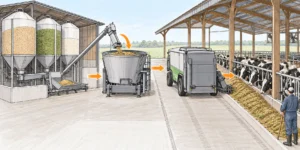
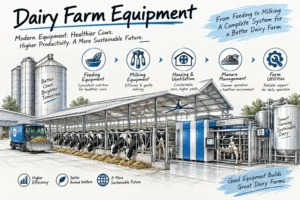
This proposed worksheet is for technical staff, feeders and their advisors. It is an editorial record design, not a validated sampling plan or a ration prescription. For the wider storage-to-feeding interfaces, use the dairy farm equipment guide.
Document the Forage Source and Sampling Conditions
Keep forage lots identifiable and use sampling appropriate to the stored material. UMN Extension notes that storage and fermentation can change forage quality and that feedout sampling captures the material being fed, including its dry matter. An earlier inventory sample and a current feedout sample should remain separately dated records.
| Proposed field | What the record should identify |
|---|---|
| Forage and source | Ingredient name; lot or field identity where known; silo, bag or other storage location. |
| Sample identity | Unique sample ID; collection date and time; collector; material and location represented. |
| Collection method | Applicable sampling plan; how subsamples were combined; deviations or suspected bias. |
| Test destination | On-farm method or laboratory; associated report or worksheet ID. |
Fine particles matter to sample composition. K-State describes using scoops from mixed, removed silage and retaining the fines rather than relying on a few handfuls. That is silage-specific guidance; agree the collection plan for the actual forage and testing purpose.
Keep sampling away from the silage face
Penn State Extension warns that silage faces can collapse without warning. Arrange sampling from removed material moved away from the face under the site safety plan. Trained personnel must manage removal and equipment access; this worksheet provides no loader operating procedure.
Use the silage storage systems guide for storage and feedout-interface context. It does not replace a forage-specific sampling plan.
Identify the Test Method and Its Limits
Record the device model or laboratory method, applicable instruction version, operator and result basis. If the instruction or sample applicability is unclear, flag the result for review before using it to issue a loading instruction. Obtain the current device instructions or laboratory submission requirements for the actual test.
Direct drying methods depend on an appropriate endpoint and net sample masses, excluding the container. UF/IFAS Extension describes constant-weight drying and container-mass subtraction. This article supplies no heating schedule, appliance settings or endpoint tolerance. Those details belong to the applicable method and equipment instructions.
The same UF/IFAS Extension guidance cautions against using microwave-dried material for nutrient analysis because heating can change its composition. It also describes electronic moisture readings as dependent on material conditions. Preserve the method identity; do not treat results from different methods as interchangeable without review.
Dry matter measures the water-versus-dry-material mass relationship. The separate TMR particle size testing guide addresses physical retained fractions. Keep the two records distinct; neither one alone establishes a complete ration.
Set the checking schedule with the responsible farm advisor and record it. Published guidance varies: the Penn State Extension Batch Mix manual, the UMN Extension TMR overview and its UMN Extension on-farm tools article give different schedules for their contexts. This worksheet adopts no universal interval or numerical moisture-change trigger.
Keep Dry Matter Results and Units Traceable

For the same sample on its original wet-mass basis, dry matter percentage is 100 minus moisture percentage, as defined by UMN Extension. Label the result explicitly: “35% dry matter” and “35% moisture” describe different material compositions.
The following invented example shows the calculation for a direct drying-based measurement. Assume the applicable method has been followed and the final mass meets its endpoint. These are not measured farm data or recommended forage values.
| Illustrative entry | Value and basis |
|---|---|
| Initial net wet sample mass | 100 g, container excluded |
| Final net dry sample mass | 35 g, container excluded |
| Dry matter | 35 g ÷ 100 g × 100 = 35% |
| Moisture | (100 g − 35 g) ÷ 100 g × 100 = 65% |
The mass relationship follows the direct-method calculation described by UF/IFAS Extension and the initial/final-weight workflow in Penn State Extension. Keep both masses next to the percentages so the arithmetic can be checked. For a laboratory or electronic result, retain its report and basis instead of inventing wet and dry masses.
Use the dry matter fraction
As-fed ingredient mass = approved ingredient dry matter mass ÷ dry matter fraction. For an illustrative, already-approved 7 kg of ingredient dry matter at 35% DM: 7 kg ÷ 0.35 = 20 kg as fed. The 7 kg input is hypothetical; this calculation does not approve a ration. Penn State Extension
Use the same mass unit throughout the conversion and enter 35% as 0.35. This converts an existing ingredient instruction between mass bases; it does not calculate the animal’s nutrient requirement or determine whether the full ration is suitable.
Record Approval Before Issuing a Loading Instruction
The Penn State Extension Batch Mix workflow links a formulated ration, forage dry matter entries and feeding-group numbers to a feed sheet. The proposed approval record below adds a way to identify who accepted an instruction and when it applies. It is a suggested farm control, not an approval requirement imposed by that source.
| Proposed handoff field | Record before the instruction is used |
|---|---|
| Reviewed result | Sample/report ID; forage identity; result and basis; unresolved limitations. |
| Decision and owner | Responsible nutritionist or authorized advisor; accepted, recheck or hold; dated decision. |
| Issued instruction | Recipe/feed-sheet version; ingredient quantities and units; group or batch; effective time. |
| Feeder receipt | Person receiving the instruction; acknowledgement; location of the current version. |
| Superseded instruction | Previous version identified so the feeder can distinguish it from the current one. |
Carry the approved instruction into the loading record. The TMR mixer guide covers equipment configuration, weighing and commissioning context; a moisture result does not itself verify the mixer scale.
Review Exceptions and Retain the Record
Use a short exception log when the sample source is unclear, a method deviation is recorded, a result has no stated basis or a feed sheet cannot be traced to its review decision. Preserve the original result, name the person resolving the issue and record the disposition rather than silently overwriting the entry.
- Keep repeat measurements as separately identified results, with the reason for repeating them.
- Document which result and instruction were accepted, who decided and the first batch or time covered.
- Retain the method/report reference alongside the calculation and approval record.
- Agree unresolved sampling or result questions with the farm advisor or testing laboratory before revising the loading instruction.
The completed record should let a reviewer follow one chain: this forage, this sample, this method, this result and this authorized instruction. A missing link is a question to resolve, not a reason to infer a ration correction.
References
- AIG Machinery (aigmachinery.com) — Dairy industry solutions provider supplying the linked whole-farm equipment, storage and mixer context used to place the proposed forage-result handoff within feeding operations.
- The Pennsylvania State University Extension (Penn State Extension) — Supports the dry-matter-to-as-fed distinction and feed-sheet workflow, and supplies the silage-face safety boundary used when planning access to removed sampling material.
- University of Minnesota Extension (UMN Extension) — Supports the dry matter and moisture distinction, forage lot and feedout sampling context, and the comparison showing why this worksheet adopts no universal testing schedule.
- University of Florida Institute of Food and Agricultural Sciences Extension (UF/IFAS Extension) — Explains direct drying measurements, exclusion of container mass, method-dependent limitations and why microwave-dried samples should not be reused for nutrient analysis.
- Kansas State University (K-State) — Provides the silage-specific sampling discussion used to explain scoop collection, mixing and retention of fine particles, without adopting a universal sample count or feedout specification.