Silage storage systems should be chosen as part of the farm’s feeding system, not as a stand-alone structure. The best fit depends on how much forage must be stored, how quickly it will be fed out, what machinery is available, how the site handles traffic and access, and how the storage area connects to loading and TMR feeding.
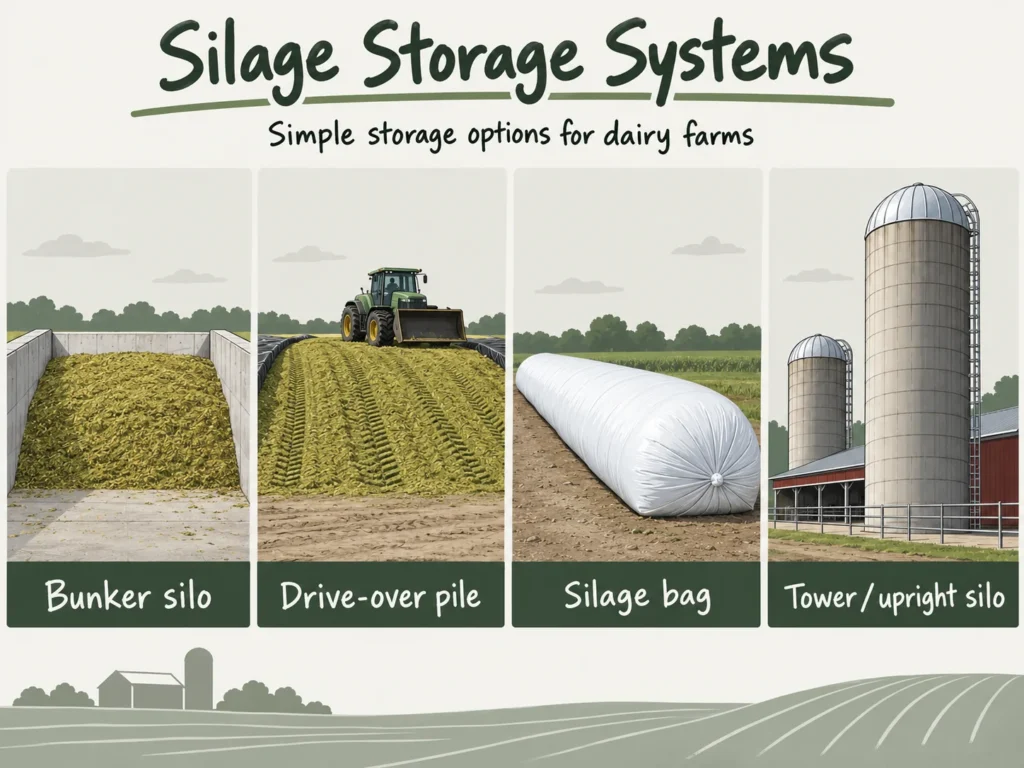
For most dairy farms, the main choices are bunker silos, drive-over piles, silage bags, and tower or upright silos. Each can work when it is matched to the farm’s inventory, feedout pattern, equipment, labor, maintenance, and safety requirements. Agricultural extension sources consistently treat these systems as alternatives with different operating tradeoffs rather than a single universal winner.
A useful planning sequence is:
Feed inventory → daily feedout → storage type → machinery access → loading/TMR interface → future expansion
This article focuses only on storage-system selection and operating fit. It does not replace a broader guide to silage production, fermentation, harvest timing, or ration formulation.
1. What Are the Main Silage Storage Systems?
Common dairy-farm silage storage systems include bunker silos, drive-over piles, silage bags, and tower or upright silos. The University of Florida IFAS also identifies related forms such as ground stacks and wrapped or bagged bale systems, but the four systems below represent the main comparison for a dairy operation planning a high-volume feed-storage workflow.
Bunker silos
A bunker silo is a horizontal structure with retaining walls. Forage is placed into the bunker, spread, packed, covered, and later removed from the exposed face.
Its main operational advantage is that it can fit a high-throughput feeding system with direct loader access. Its main design requirement is that the bunker geometry, filling process, packing capacity, and feedout face all have to match the farm’s actual operating conditions.
A bunker should therefore be evaluated together with:
- forage delivery and filling traffic;
- packing tractors or other packing capacity;
- loader access;
- daily feedout;
- covering and maintenance;
- movement from storage to the mixer.
Drive-over piles
A drive-over pile is a horizontal storage system without the retaining walls of a bunker. It gives the farm more flexibility in pile dimensions and storage volume, but it still depends on disciplined filling, packing, covering, and feedout.
The absence of permanent bunker walls does not remove the need for layout planning. The site still needs enough working area for harvest traffic, packing equipment, safe loader movement, and daily removal.
For farms where forage inventory changes from one season to another, this flexibility can be useful. The tradeoff is that the pile footprint and traffic pattern must be controlled so flexibility does not become inefficient material handling.
Silage bags
Silage bags provide modular storage. A farm can use separate bags for different feed inventories, crop groups, or temporary storage needs without building another permanent bunker.
They can be useful where flexibility is more important than a single large fixed structure. However, the farm needs suitable bagging equipment, enough space for the bags, protection of the plastic, and practical feedout access.
A bag is therefore not simply “storage without construction.” It creates its own equipment, site, maintenance, and daily handling requirements.
Tower or upright silos
Tower silos use vertical space and therefore have a different site footprint from horizontal systems. They normally rely on more specialized filling and unloading equipment.
According to University of Florida IFAS, storage-system choice has implications for equipment and capital requirements. For a tower system, those implications include the filling method, unloading system, maintenance access, and structure-specific safety considerations.
The correct comparison is not “which structure is best?” but “which structure can this farm fill, maintain, unload, and integrate into feeding reliably?”
2. How Do Bunkers, Piles, Bags, and Tower Silos Compare?
The practical differences between silage storage systems become clearer when they are compared by operating function rather than by appearance.
| System | Main Planning Strength | Main Operational Constraint | Equipment / Site Interface |
|---|---|---|---|
| Bunker silo | Organized high-volume horizontal storage | Permanent structure and exposed-face management | Filling traffic, packing equipment, loader access |
| Drive-over pile | Flexible storage volume and geometry | Requires substantial working area and disciplined pile management | Packing traffic, pad area, loader access |
| Silage bag | Modular separation of feed inventories | Plastic integrity and bagging/feedout workflow | Bagger, bag placement area, loader/feedout access |
| Tower silo | Uses vertical rather than broad horizontal footprint | Specialized filling, unloading, maintenance, and safety requirements | Filling system, unloader, service access |
No row in this table should be interpreted as a universal ranking. The USDA Agricultural Research Service notes that forage storage systems involve different equipment, energy, handling, and investment requirements, and no single system is universally superior.
That means a farm should avoid choosing on one variable alone.
For example:
- choosing only by theoretical storage capacity ignores daily feedout;
- choosing only by construction simplicity ignores machinery access;
- choosing only by footprint ignores unloading requirements;
- choosing only by flexibility ignores labor and traffic flow.
A better comparison asks whether the storage system remains workable during both the busiest filling period and the ordinary daily feeding routine.
3. Size Storage Around Inventory and Daily Feedout
Silage storage systems need to satisfy two different planning questions:
- How much forage must be stored?
- How quickly will forage be removed once the storage is opened?
These questions are related but not identical.
The UW–Madison Extension Dairy Feed Inventory Calculator treats feed inventory as a combination of feed needs and storage capacity across systems including bags, bunkers, piles, and tower silos. This supports a basic planning principle: storage volume should be linked to the farm’s actual feed inventory rather than selected as an isolated structural capacity.
Daily feedout matters because once silage is exposed to oxygen, deterioration can increase. UW–Madison Extension identifies oxygen exposure and feedout management as important causes of loss across forage storage systems and emphasizes maintaining a firm face and an appropriate removal rate.
The practical implication is simple:
A storage structure that holds enough forage can still be poorly matched if its exposed feedout area is too large for the farm’s normal daily use.
This is why inventory and feedout should be planned together.
Inventory questions
Before selecting a structure, determine:
- how many forage inventories must remain separate;
- how much of each forage must be stored;
- how long each inventory is expected to last;
- whether future herd growth will materially change storage needs.
Feedout questions
Then determine:
- how much forage is normally removed each day;
- how much face or bag length is exposed during feeding;
- whether the loader can remove feed cleanly and consistently;
- whether the storage arrangement keeps the feeding route practical.
The purpose is not to force one universal face-removal number. The Searching evidence does not support a single rate for every climate, storage type, and farm. The correct design principle is to match storage geometry and feedout management to real daily use.
4. Match the Storage System to Equipment and Site Flow
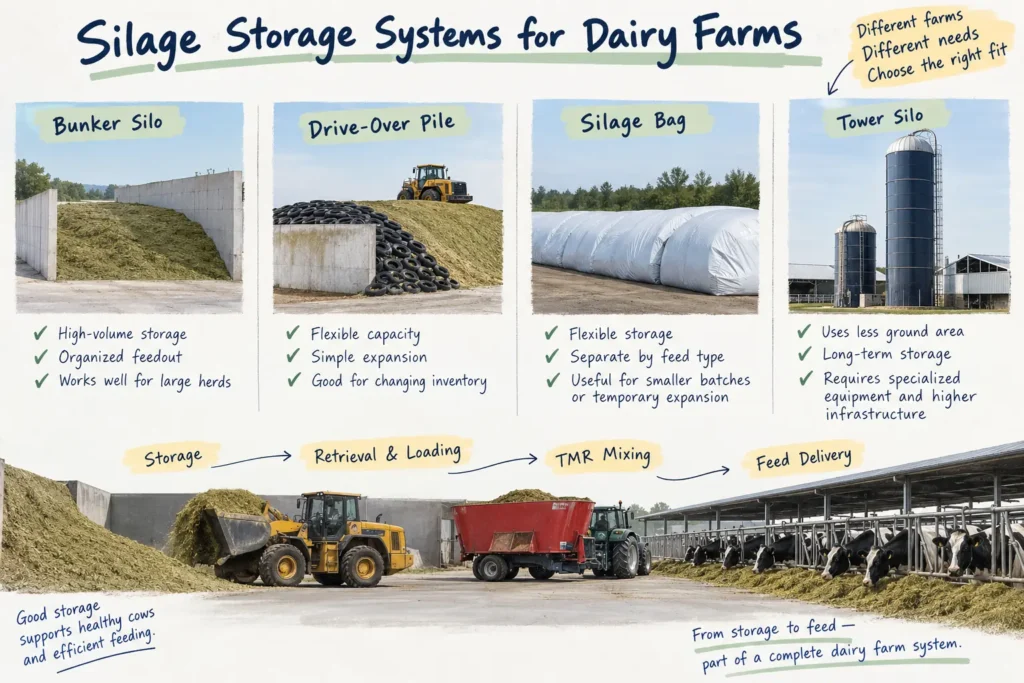
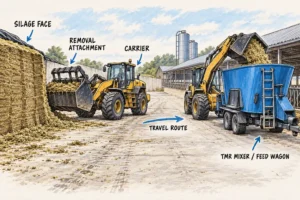
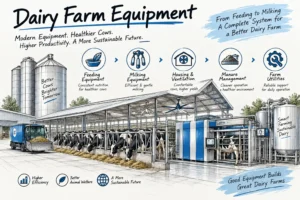
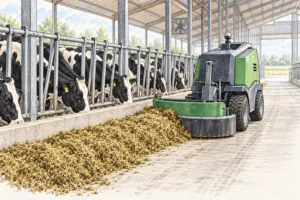
A dairy farm does not operate storage independently from the rest of the feeding chain. The current dairy farm equipment pillar treats feeding as a connected sequence that includes storage interfaces, loading, TMR mixing, delivery, and feed push-up.
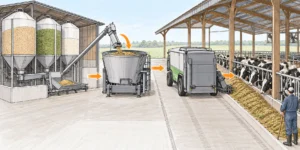
For that reason, silage storage systems should be checked against the complete material-flow path:
Storage → removal → loader or transfer equipment → TMR mixer → feed delivery
The USDA Agricultural Research Service supports this connection by noting that chopped silage is compatible with mechanized handling and TMR feeding.
Check the filling side
During harvest, storage may need to receive forage quickly. University of Florida IFAS notes that chopped-silage systems can require harvesting, hauling, and power equipment.
The storage choice should therefore be checked against:
- incoming vehicle flow;
- unloading points;
- spreading or filling method;
- packing capacity where required;
- safe equipment movement;
- ability to finish filling and covering without creating an operational bottleneck.
Check the daily feedout side
Daily operation has a different traffic pattern.
The farm should confirm:
- the loader or unloading system can reach the stored feed;
- travel distance to the mixer is practical;
- the surface remains usable in normal weather and operating conditions;
- reversing and cross-traffic are minimized where possible;
- the storage face or bag can be managed without disrupting mixer loading.
Mixer capacity and mixer-type selection require a separate assessment. For storage selection, ensure the upstream feed-storage interface can serve the mixer consistently.
Check maintenance and safety
Maintenance and safety requirements differ by storage structure. UW–Madison Extension discusses different hazards and maintenance needs for upright silos and flat storage structures.
The decision should therefore include:
- safe access;
- structure and surface condition;
- maintenance capability;
- machinery clearance;
- unloading-system condition where applicable.
This is not a complete safety standard. Site-specific procedures and requirements need to follow the actual equipment, structure, and local operating conditions.
5. A Practical Framework for Choosing a System
Instead of asking which silage storage system is “best,” use a sequence of farm-specific checks.
Step 1 — Define the feed inventory
List each forage inventory that needs storage and determine whether it must remain separate from other feeds.
This establishes the storage task before structure type is discussed.
Step 2 — Estimate normal daily feedout
Determine how much of each stored forage is actually removed during routine feeding.
This helps prevent a mismatch between total capacity and the amount of exposed feed the farm can manage effectively.
Step 3 — Compare storage formats
Evaluate bunker, drive-over pile, bag, and tower options against:
- required inventory;
- number of separate feed groups;
- site space;
- fixed versus flexible storage needs;
- machinery already available;
- maintenance capacity.
Do not assign a universal winner. The appropriate choice depends on the operating inputs.
Step 4 — Verify the machinery interface
Check whether the farm can reliably:
- fill the system;
- pack it where required;
- cover or seal it;
- maintain it;
- remove feed;
- transfer feed to the TMR mixer.
A structure that cannot be served efficiently by available machinery is not a complete storage solution.
Step 5 — Verify the site flow
Full-site layout planning requires a separate assessment. For storage selection, confirm that harvest traffic, storage access, loader movement, and the route to the feeding system can operate without obvious conflicts.
Step 6 — Allow for future change
Future herd growth or changes in forage strategy can affect:
- total inventory;
- daily feedout;
- number of storage units;
- loader cycles;
- mixer-loading demand.
A good storage decision leaves a realistic path for expansion instead of maximizing today’s capacity with no room for a different operating pattern.
The central decision rule is:
Choose the storage system that best matches the farm’s inventory, daily feedout, machinery, site flow, maintenance capability, and downstream feeding workflow.
That approach keeps the article’s focus where it belongs: not on making silage, but on selecting and integrating the storage system that supports daily dairy-farm feeding.
Recommendation
- aigmachinery.com
- aigmachinery.com/dairy-farm-solutions
- aigmachinery.com/blog
- Dairy Farm Equipment: A Practical Guide to Essential Systems
- University of Florida IFAS — Silage Harvesting, Storing, and Feeding
- UW–Madison Extension — Feedout Losses from Forage Storage Systems
- USDA Agricultural Research Service — Forage Storage Systems