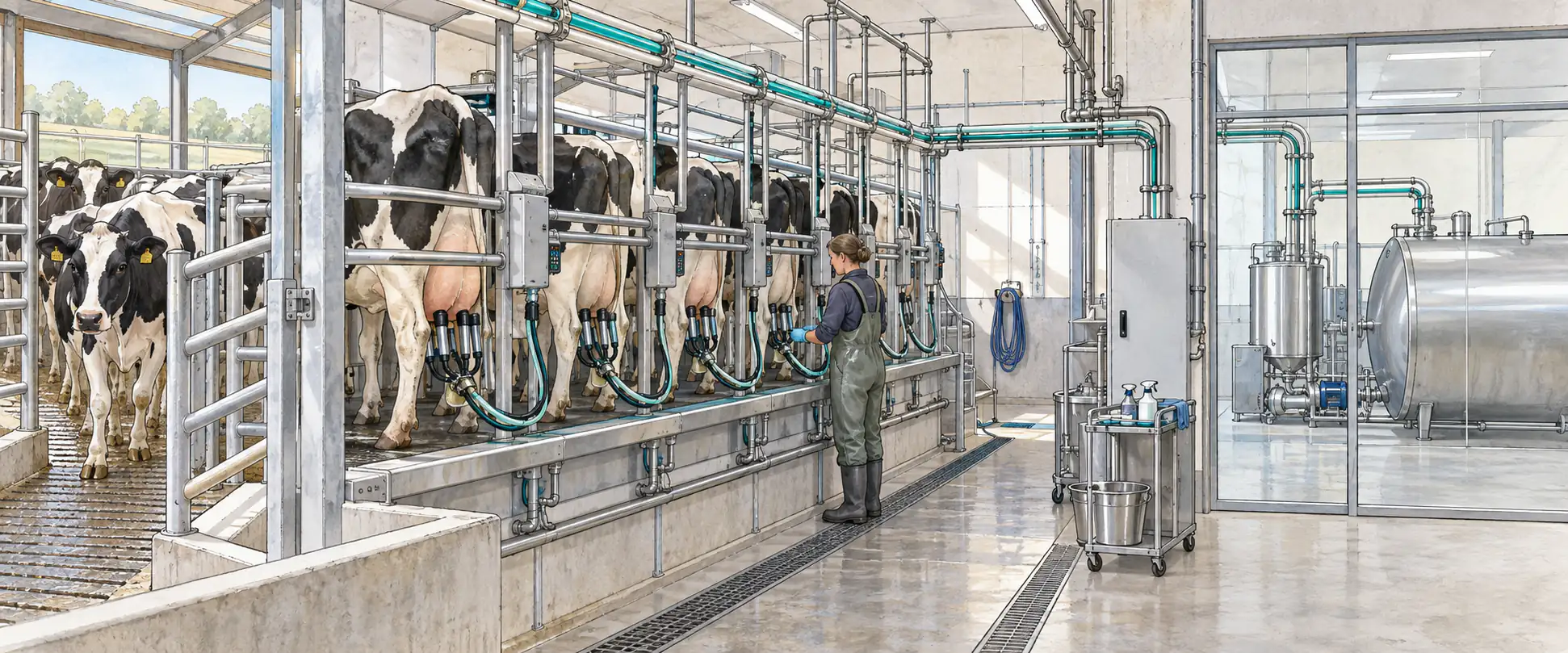
The right dairy milking equipment is the system that fits the farm’s cows, milking routine, building, milk destination, utilities, staff, maintenance capability, and service support as one connected job. Start by defining that job. Comparing machine names or stall counts before the interfaces are known can hide the real bottleneck.
Map the whole route: cow entry, teat preparation, unit attachment, milk removal, milk transfer, filtration, cooling, storage, cleaning, cow exit, data capture, and fault recovery. The selection is not complete until each handoff has an owner, an input, an output, and a way to verify performance after installation.
This guide provides a procurement framework, not a site design or veterinary procedure. Final settings, dimensions, capacities, sanitation controls, and acceptance limits must come from the applicable standards, local regulator, milk buyer, qualified designer, and exact equipment documentation.
1. Define the Complete Milking Job Before Selecting Hardware
A dairy milking equipment brief should begin with the operating day, not a catalogue. Record the cows that will actually use the system, expected changes in the milking group, milking frequency, operating windows, labor available for each shift, current preparation routine, special-cow handling, and the route cows take into and out of the milking area.
Then document the milk side. Define the destination of saleable milk, the route for diverted milk, the collection schedule, the milk room, existing cooling and storage assets, water source, drainage, electrical supply, backup arrangements, and any interfaces that must remain. Mark which facts were measured, which came from current records, and which are still assumptions.
Use an interface evidence matrix so every supplier receives the same job:
| Interface | Farm information to provide | Evidence required from the proposal |
|---|---|---|
| Cows and routine | Milking groups, routine sequence, staffing, cow route, exception handling | System type, operating sequence, access, expected constraints |
| Milking machine | Existing layout, retained components, available space and utilities | Complete component schedule, compatibility basis, drawings, applicable design standard |
| Milk handling | Milk route, diversion needs, cooling/storage interfaces, collection pattern | Flow path, filtration, receiver/pump, cooling and tank integration, control logic |
| Cleaning | Water, heating, drainage, chemical program, wash destination | Defined circuit, cycle logic, cleanability, required utilities, verification method |
| Service and data | Technician access, spare parts, records, connectivity and ownership needs | Maintenance plan, consumables, support scope, data export, commissioning records |
Do not turn herd size into a universal machine category. A conventional parlour, pipeline arrangement, portable system, or automatic milking system changes the work, cow traffic, service dependency, and failure response in different ways. Ask which option fits the documented routine and site, then require evidence for that answer.
The output of this step is a frozen requirement sheet. If suppliers are quoting against different cow groups, retained assets, cleaning assumptions, or milk-room boundaries, their prices and claimed performance are not yet comparable. For dairy milking equipment, the matrix also exposes which contractor owns each interface so responsibility is not lost between machine, building, refrigeration, electrical, plumbing, and software scopes.
2. Specify the Milking Machine as One Performance System
The cluster, liners, short tubes, milk hoses, pulsators, vacuum pump and control, sanitary lines, receiver, milk pump, filter, and wash circuit interact. Selecting dairy milking equipment component by component can create a system that connects physically but lacks a coherent performance or cleaning basis.
ISO identifies system-level construction and performance requirements for machine milking and cleaning. Ask the supplier to state the standard and test method that apply in the destination market, the system boundary covered by its design, and the conditions used for each performance claim. A standard reference on a quotation is not enough if the offered configuration, installation, or commissioning test is undefined.
Require a complete system schedule showing:
- cluster, liner, shell, tube, and hose compatibility;
- vacuum generation, regulation, reserve, filtration, exhaust, and monitoring;
- pulsation equipment and the method used to verify it;
- milk-line geometry, receiver, pump, filtration, and diversion path;
- automatic take-off or other controls, including sensor and fail-safe behavior;
- clean-in-place circuit, wash fittings, drains, and return path; and
- components retained from the old installation, with written compatibility responsibility.
Do not copy settings from another farm or an unrelated model. The qualified designer should establish the required duty using the actual layout, milk flow, air use, equipment combination, cleaning circuit, and governing requirements. The installer should then test the installed system during representative milking and cleaning conditions and provide the measurements, instruments, test method, results, and exceptions.
Maintainability belongs in the original design. Penn State Extension describes how blocked air vents, damaged pulsation tubes, twisted liners, and restricted hoses can disrupt normal equipment function. The quotation should therefore identify inspection points, wear items, replacement instructions, service clearances, consumable specifications, and the training needed for workers to recognize a defect before it becomes routine. That makes accessible inspection and supported replacement parts a dairy milking equipment selection requirement, not a post-installation convenience.
3. Match Equipment to Cows, People, and Facility Flow
Milking performance begins before the unit is attached. University of Minnesota Extension treats cow preparation, milk letdown, and machine attachment as a coordinated routine. The equipment layout must allow workers or automation to perform the intended sequence consistently without forcing shortcuts, awkward reaches, or conflicting tasks.
Walk the proposed dairy milking equipment layout in both directions. Check cow approach, holding area, entry, positioning, release, exit, drafting, and the route for a cow that cannot follow the normal sequence. Check the worker route for preparation supplies, unit attachment, observation, intervention, cleaning, and safe exit. Confirm sight lines, footing, lighting, ventilation, splash control, hose management, guard placement, and isolation access with qualified facility and safety advisers.
Teagasc emphasizes coordinating parlour location, cow flow, worker position, water, bulk storage, electrical, plumbing, and building work when upgrading a facility. That coordination matters because a fast milking machine cannot compensate for a restricted entrance, difficult exit, unsuitable operator position, or milk room that cannot support the process.
Automation changes responsibilities rather than removing them. Define how animals are admitted, identified, milked, diverted, released, and fetched when necessary; how alarms are prioritized; what happens during power, network, sensor, or equipment failure; and who can restore service. If conventional and automatic systems will operate together, document the separate cow groups, milk routes, cleaning programs, records, staff skills, and backup plans.
Review future changes without inventing a growth percentage. Ask what physical, utility, software, cooling, and storage interfaces can be expanded, which components would become stranded, and what work would interrupt milking. “Expandable” should mean a documented path with defined limits, not an unpriced promise.
4. Close the Milk Cooling and Cleaning Interfaces
The equipment boundary does not end at the claw. Milk must move through a defined product path to filtration, cooling, and storage while the cleaning system must reach the intended milk-contact circuit and drain as designed. Include these interfaces when comparing dairy milking equipment, even when different contractors supply them.
For the product path, document every receiver, pump, filter, valve, diversion point, cooler, tank connection, sensor, sample point, and control handoff. Require the responsible supplier to confirm compatibility with the most demanding expected operating condition and the receiving equipment. Avoid accepting a nominal component rating as proof that the complete installed path will work.
For cleaning, require a circuit drawing and a written program tied to the exact installation, water supply, heating equipment, drainage, approved chemicals, and component manuals. The proposal should state who determines and verifies the cycle, how all intended surfaces are reached, how solution is separated from saleable milk, how the circuit drains, how failures are detected, and what records are retained. Do not invent wash temperatures, chemical concentrations, volumes, or cycle times in the purchasing brief.
Sanitation and cooling limits depend on the destination market. The FDA lists the 2025 Grade “A” Pasteurized Milk Ordinance as the current U.S. model document, issued in June 2026. A U.S. Grade “A” project should use the current adopted requirements and regulatory interpretation; a farm elsewhere must use its own regulator and milk buyer requirements. One country’s rule is not a global equipment specification.
Ask the cooling and storage provider to size and document its system from verified milk inflow, starting conditions, collection pattern, ambient conditions, utilities, cleaning needs, and required reserve. Those project calculations belong to the qualified provider and must be checked against the real installation. This article does not supply substitute capacity or refrigeration calculations.
5. Compare Quotations and Commission the Installed System
Normalize each dairy milking equipment proposal before comparing price. The same table should show included components, retained assets, installation labor, building work, utilities, controls, software, licenses, consumables, spare parts, training, warranty, service response, exclusions, and the exact commissioning evidence. Blank cells are unresolved scope, not zero cost.
If milk meters or automated recording are included, define what the data will be used for and who owns, exports, corrects, and backs it up. ICAR states that devices used for official milk recording must be certified under its applicable guidelines. Verify the exact device, configuration, species, software or sampler combination, and intended use; do not assume approval transfers automatically to another model or version.
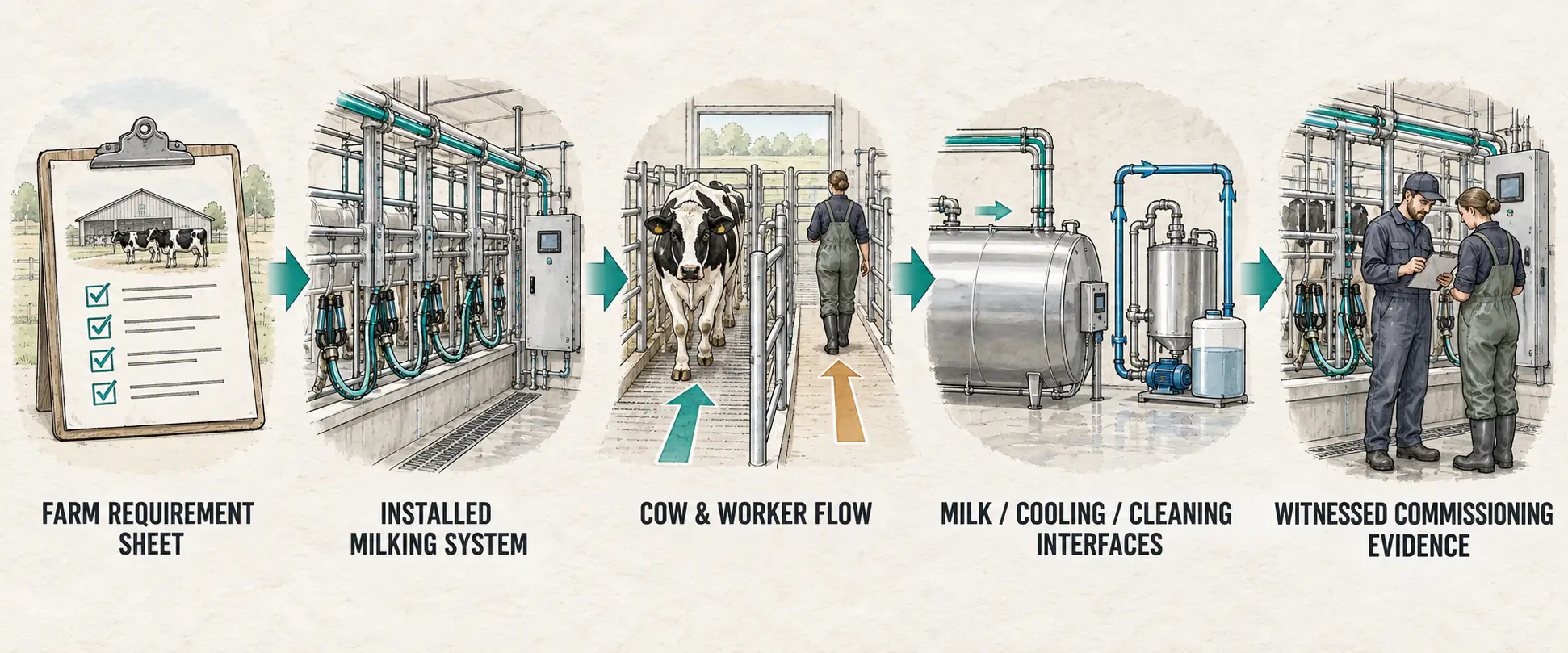
Before final acceptance, require a witnessed commissioning record for the connected installation:
- Confirm the as-installed drawings, component list, model/serial records, utilities, guards, isolation points, and declared standards.
- Run the normal cow-entry, preparation, attachment, milking, detachment, diversion, and exit sequence under representative operating conditions.
- Measure and record the machine parameters required by the applicable standard and test method during milking and cleaning.
- Verify milk transfer, filtration, cooling, storage, alarms, and control handoffs with the responsible providers present where needed.
- Run the complete cleaning program and document circuit coverage, drainage, fault detection, and the agreed verification records.
- Test safe shutdown, loss of a critical utility, alarm escalation, recovery, restart, and the practical backup plan without creating an unsafe demonstration.
- Verify meters, identification, reports, data export, user permissions, backups, and offline behavior against the contracted functions.
- Close exceptions in writing and deliver operating, cleaning, maintenance, parts, warranty, training, and service documents.
Acceptance is not a promise that every future milking will be identical. It is evidence that the installed configuration performed the agreed functions under recorded conditions and that unresolved deviations have an owner and disposition.
The best dairy milking equipment proposal is the one with the fewest hidden interfaces: it matches the verified routine, cows, building, milk path, cleaning system, utilities, staff, data purpose, and service model, and it defines how the farm will prove those claims after installation. Use the broader dairy farm equipment framework to check how the milking project interacts with feeding, manure, housing, utilities, and whole-farm planning.