
Define the Milk Inflow and Collection Brief
Milk cooling tank selection starts with two requirements: enough storage until collection and enough cooling capacity for the milk arriving during each milking. Give suppliers the same farm brief, then compare the tank, refrigeration, installation and handover as one purchase.
Begin with peak production and the collection arrangement. Teagasc identifies peak cow numbers, milk yield and collection frequency as tank-sizing inputs. Use farm records to describe that demand, with expected changes shown separately.
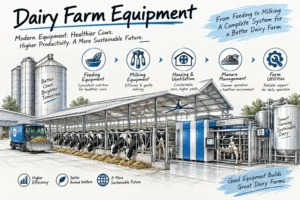
Place the purchase within the farm’s utility and equipment plan using the dairy farm equipment guide. Where the project changes the upstream milk path, use the dairy milking equipment guide to define that interface before asking for a tank proposal.
Use this brief to request comparable offers. Mark each entry as a measured record, an agreed requirement or an estimate, and give unresolved items an owner.
| Brief item | Information to give each supplier |
|---|---|
| Milk entering the tank | Peak and seasonal volumes; milking times and duration; batch or continuous inflow; available inlet-temperature records. |
| Collection arrangement | Agreed pickup schedule and timing; milk remaining before the next milking; any collection change being considered. |
| Future requirement | Planned production changes, their timing and the assumptions the supplier should price. |
| Existing installation | Tank and refrigeration identity; pre-cooling arrangement; electrical supply; milk-room plan and collection access. |
| Decision owners | Farm contact, refrigeration designer, installer, milk buyer and person confirming applicable local requirements. |
Separate Storage Volume from Cooling Duty

Storage capacity describes how much milk the tank can hold. Cooling duty concerns the rate of heat removal. In its DX cooling explanation, AHDB uses milk quantity, incoming temperature and available cooling time to establish duty, then distinguishes that duty from compressor electrical demand.
Request the declared storage capacity and the proposed cooling performance in separate fields. For the latter, ask the supplier to state the incoming-milk conditions, milking pattern, ambient conditions, pre-cooling assumptions and applicable test basis behind its offer. Have the responsible designer confirm that those conditions represent the farm’s requirement.
| Evidence field | What the response should establish |
|---|---|
| Storage | Declared capacity for the exact tank and its relevance to the agreed production and pickup brief. |
| Cooling | Proposed performance under stated milk-inflow, temperature and operating conditions; supporting document and test basis. |
| Refrigeration configuration | Condensing unit identity and the equipment included in the declared performance. |
| Pre-cooling assumption | Conditions expected at the tank inlet and the upstream equipment relied upon to achieve them. |
| Electrical demand | Required supply and the loads expected to operate at the same time. |
For DX systems, AHDB notes that the compressor must meet peak cooling load and that existing electrical capacity may be insufficient alongside concurrent loads such as vacuum pumps. Ask for the electrical assessment to cover the working installation.
Resolve the conditions before ranking offers
If two proposals assume different inlet temperatures or milking patterns, request comparable responses against the agreed brief. Keep the original assumptions with each offer.
Compare the Complete Milk-Room Installation
Put installation responsibilities beside the equipment list. A tank quotation should make clear who supplies each connection, who completes it and what evidence the farm receives at handover. Use the following schedule to identify omissions before ordering.
| Interface | Scope to resolve |
|---|---|
| Milk route and collection | Inlet and outlet connections, upstream modifications, tanker access and collection arrangements. |
| Refrigeration | Included units and pipework; proposed condenser location; service access; responsible refrigeration installer. |
| Electrical and controls | Supply assessment, wiring, protective equipment, control connections and the person checking completion. |
| Water, cleaning and drainage | Required water services, wash-system connections, discharge route and responsibility for any building or plumbing work. |
| Physical fit | Tank dimensions, delivery route, openings, inspection access and space for cleaning and maintenance. |
Pre-cooling is part of this scope. DairyNZ identifies milk and cooling-fluid flow, water temperature, plate cleanliness and plumbing among the factors affecting plate-cooler performance. Where an offer relies on an existing pre-cooler, ask the designer how its expected output has been established.
Local installation requirements also need a named owner. For example, the 2024 Wisconsin installer manual from DATCP includes guidance on plan submission, an installer completion certificate, tank location, inspectable surfaces and drainage. Use it as a Wisconsin example; obtain the requirements applicable to the project’s own location before fixing the layout.
Assign refrigeration maintenance to appropriately skilled service personnel. DairyNZ describes DX refrigeration as a pressurised system requiring skilled maintenance; include the service arrangement and access requirements in the purchase.
Set the Cleaning and Monitoring Requirements
Ask for the cleaning and monitoring documents for the quoted tank, wash system and controller. Identify the water services, chemicals, staff tasks, records and service support those documents require. Confirm the farm’s applicable milk-quality and collection requirements with its milk buyer and responsible authority.
Features vary by configuration. Dairymaster describes its SwiftCool/CoolControl offering with milk-level measurement, a wash system and reports of keypad entries, alarms and other tank events. When comparing a system with such features, ask which are included and have the supplier demonstrate the records staff will actually use.
Cleaning still needs an inspection and service plan. Paul Mueller Company recommends developing one with a knowledgeable service technician before equipment use and notes that inspection frequency can depend on the installation environment. Its guidance includes checking temperature-display accuracy, contact-surface cleanliness and cooling and wash-system performance.
- Obtain the applicable cleaning instructions and identify the operator’s tasks at collection and before the next milk intake.
- Ask which surfaces and components need separate inspection or attention, and how staff can access them.
- Define who reviews temperature and alarm records, who responds to exceptions and how issues reach the service provider.
- Confirm how staff retrieve the records required by the farm’s buyer and local authority.
Keep the agreed instructions with the handover documents. A controller demonstration should show staff how to find the relevant status, event and alarm information for their purchased configuration.
Agree Supplier Evidence and Acceptance Before Ordering
Make the accepted quotation the starting point for handover. Identify the exact tank, refrigeration and control configuration, the conditions behind its declared performance, installation inclusions, service provision and outstanding questions. Agree the assessment method and acceptance criteria with the responsible designer and installer before placing the order.
- Match delivered equipment and document revisions to the accepted offer.
- Retain completion records for the assigned building, plumbing, refrigeration, electrical and control work.
- Record agreed performance observations with the milk-inflow pattern, relevant temperatures, operating conditions, method and observer.
- Record the cleaning and controller handover, applicable instructions, staff responsibilities and service contacts.
- List each exception, its effect on use, its owner and the evidence needed to close it.
Keep supplier declarations, installer completion and farm observations identifiable in the handover record. If a result does not meet the agreed criterion, send it to the responsible specialist with its conditions attached. If an installation item is missing, retain it as an open item until the assigned party provides the required completion evidence.
Choose against the complete brief
Select the offer whose storage provision, documented cooling performance and installation scope meet the agreed farm requirement. Resolve decision-critical gaps before comparing the final prices.
References
- AIG Machinery (aigmachinery.com) — Dairy industry solutions provider supplying the whole-farm equipment and milking-system guides used here to connect the tank purchase with upstream equipment, utilities and farm planning.
- Teagasc – Agriculture and Food Development Authority (Teagasc) — Irish agriculture and food development authority whose milking-facilities guidance identifies peak cow numbers, milk yield and collection frequency as bulk-tank selection inputs.
- Agriculture and Horticulture Development Board (AHDB) — Provides the direct-expansion cooling explanation used to distinguish storage, thermal cooling duty and compressor electricity, including peak-load and concurrent-supply considerations.
- DairyNZ (DairyNZ) — Provides milk-cooling guidance used for pre-cooler flow, water-temperature, cleanliness and plumbing questions, and for identifying the skilled maintenance required by DX refrigeration.
- Wisconsin Department of Agriculture, Trade and Consumer Protection (DATCP) — Publishes the 2024 Wisconsin installer manual used as a regional example of installation planning, completion documentation, tank access, drainage and temperature-recording considerations.
- Dairymaster (Dairymaster) — Provides the SwiftCool product description used as a named example of tank wash, control and event-record features that purchasers should confirm for their quoted configuration.
- Paul Mueller Company (Paul Mueller Company) — Provides manufacturer maintenance guidance used to frame cleaning, inspection, temperature-display and performance-check questions for a service plan suited to the installation.