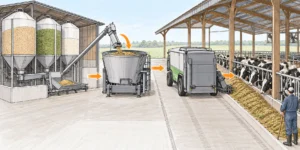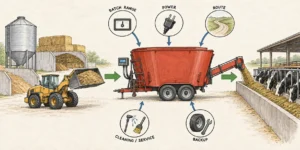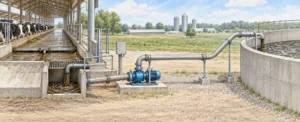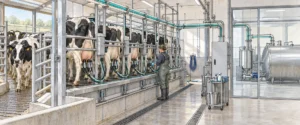

Feed distribution equipment moves a prepared ration from its loading point to the correct feeding group and places that feed along the bunk or feeding table. The selection problem is therefore not simply “Which wagon is largest?” A useful specification starts with the amount that must be delivered, the number of delivery events, the physical route, the required discharge arrangement, the records the farm needs, and the fallback method if the machine is unavailable.
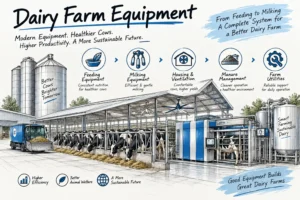
This function sits between mixing and feed push-up. A TMR mixer prepares the ration; distribution equipment transports and places prepared feed; a feed pusher moves feed that is already at the bunk back within reach. Some machines combine two or more of those functions, but the quotation should state exactly what enters the machine, what task it performs, and what condition the feed is in when that task ends. The current dairy farm equipment guide uses the same process-first approach.
A practical planning sequence is:
feeding groups → amount per delivery → deliveries per day → usable payload → trips → route and discharge → weighing/records → backup method → acceptance test
1. What Does Feed Distribution Equipment Actually Do?
The defining job is to carry prepared feed and distribute it to a specified destination. That sounds simple, but equipment names are not consistent enough to use as the specification.
A “feed wagon,” for example, may be a dedicated transport/distribution unit with no mixing function, or it may be a mixer wagon that mixes and then travels to the bunk. A self-propelled delivery vehicle may only transport and discharge feed, while an automatic system may combine transport with recipe control, destination selection, scheduling, and other functions. The buyer should compare functions, not labels.
| Functional arrangement | Prepared-feed input | Main job | What must be confirmed |
|---|---|---|---|
| Dedicated distribution wagon or spreader | Feed prepared elsewhere | Transport and distribute | Usable payload, loading method, discharge arrangement, tractor/power needs, route fit |
| Mixer-delivery wagon | Ingredients or prepared material, depending on the system | Mix and/or transport and distribute | Exact mixing boundary, usable batch/load, discharge, route, power and operating sequence |
| Self-propelled or truck-mounted distributor | Feed prepared elsewhere | Transport and distribute without a separate towing tractor | Payload, route access, maneuvering, refueling/charging, discharge and service access |
| Automated transport/distribution unit | Prepared ration from a defined upstream system | Scheduled transport and distribution | System boundary, destination logic, route, controls, data, fallback and interface ownership |
These categories describe operating arrangements, not universal product classes. One machine may cross categories. Mixer selection and the wider automation architecture require separate assessments.
The boundary with push-up is also important. A feed pusher moves feed already placed at the bunk. Feed distribution equipment, by contrast, owns the delivery of new prepared feed to that feeding area.
This distinction prevents a common procurement error: buying a machine whose category name sounds correct but whose actual function leaves another step of the feeding process unresolved.
2. Build the Delivery Specification From Feeding Groups
Feed distribution equipment should be sized around the delivery job, not herd size alone. Two dairies with the same number of cows can have different requirements because they use different feeding groups, ration amounts, delivery frequencies, routes, loading methods, and time windows.
University of Minnesota Extension, reviewed in 2026, identifies group cow count, actual feed intake, and feeding schedule as daily TMR management inputs. That does not provide a universal machine size, but it supports a group-based planning method.
Create one row for every feeding group:
| Group | Prepared ration | Target as-fed amount per delivery | Deliveries/day | Loading source | Delivery window | Required record |
|---|---|---|---|---|---|---|
| Group A | ||||||
| Group B | ||||||
| Group C |
Use actual farm values rather than a generic “cows per wagon” rule. Two calculations are useful: first determine the number of trips; then test whether those trips fit inside the required delivery window.
1. How many trips are required?
Concept: This calculation converts the farm’s delivery requirement into a minimum number of complete loads. It is useful because a distributor that looks large enough by nominal volume can still require too many trips when its verified usable payload is lower under the intended feed and operating conditions.
Required trips = feed to deliver in the time window ÷ verified usable payload per trip
Illustrative Example — teaching assumptions only, not a real farm or equipment specification
- Feed to deliver = 12,000 kg
- Verified usable payload = 5,000 kg/trip
12,000 kg ÷ 5,000 kg/trip = 2.4 trips → round up → 3 trips
Result: Under these illustrative inputs, the candidate would need 3 trips to move the required 12,000 kg. For feed distribution equipment, this result converts the farm’s required delivery amount into a minimum trip count that can be compared against route time and the available feeding window. The result does not mean that 5,000 kg is a recommended payload; the real denominator must come from the actual machine configuration, intended feed, current documentation, and applicable operating limits.
2. Can those trips be completed inside the delivery window?
Concept: Trip count alone is not enough. The farm also needs to know whether loading, travel, discharge, return, and turnaround can be completed before the feeding window closes.
Trip time = loading + outbound travel + discharge + return travel + normal turnaround
Continue the same Illustrative Example and assume:
- Loading = 12 minutes/trip
- Outbound travel = 6 minutes/trip
- Discharge = 8 minutes/trip
- Return travel = 6 minutes/trip
- Normal turnaround = 3 minutes/trip
12 + 6 + 8 + 6 + 3 = 35 minutes/trip
3 trips × 35 minutes/trip = 105 minutes
120-minute delivery window − 105 minutes = 15 minutes theoretical margin
Result: In this example, the planned work fits inside the two-hour window on paper, with 15 minutes of theoretical margin. The practical purpose is to test whether the proposed feed distribution equipment can complete the required delivery job within the farm’s actual time window, not merely whether it can carry one load. That margin is not a recommended buffer or operating guarantee. Shared routes, waiting, ration changeover, cleaning, traffic conflicts, operator procedures, site conditions, faults, or other delays can consume it.
If several groups share the same route, include the actual sequence. If the farm uses multiple rations, include the changeover and cleanout actions that are genuinely required by the operating plan.
These are planning calculations, not substitutes for current model documentation or site measurements. Rated load, axle limits, material limitations, tractor requirements, road legality, machine dimensions, route restrictions, and other model- or jurisdiction-specific limits still need to be confirmed for the actual equipment.
Delivery timing also matters. Penn State Extension, updated December 1, 2025, identifies fresh-feed delivery and milking as major events that drive cows to the feed bunk and recommends coordinating feed-management schedules with milking. For equipment selection, the relevant conclusion is narrow: the feed distribution equipment must be able to complete the defined routes within the farm’s required feeding windows. The article does not need to prescribe one universal feeding frequency.
A useful specification therefore states the job in one sentence, for example:
“Receive prepared ration at the feed center, deliver the specified amount to each listed group within its delivery window, discharge from the required side, and retain the agreed delivery record.”
That sentence is much more useful to a supplier than “quote a feed wagon for 800 cows.”
3. Match Payload to Route, Discharge, and Site Constraints
A machine that carries enough feed can still be the wrong choice if it cannot move through the real route or place feed where the farm needs it. Feed distribution equipment should therefore be checked against a dimensioned route, not only a capacity table.
Walk every route from the loading point to the feeding area and back. Record at least:
| Route / interface input | Farm measurement or requirement | Candidate-machine check |
|---|---|---|
| Narrowest passage | ||
| Lowest clearance | ||
| Door or gate opening | ||
| Tightest turning area | ||
| Maximum operating slope | ||
| Floor/drain/threshold condition | ||
| Cross traffic or blocked periods | ||
| Required discharge side | ||
| Required discharge height/reach | ||
| Loading-point clearance | ||
| Refueling/charging/service access |
Do not turn this table into a universal barn-dimension guide. The relevant values come from the actual site and the actual machine drawing.
The feed center matters as well. A Cornell PRO-DAIRY on-farm process example described a dairy where delivery trucks blocked access to feed-bin augers and delayed the feeder. Reconfiguring access removed that recurring conflict. The result is a useful process-design lesson, not a guarantee that a similar layout change will create the same savings elsewhere: loading and delivery traffic must be checked together.
Discharge is another interface that deserves a written requirement. Confirm:
- left, right, front, rear, or bilateral discharge as actually required;
- whether the discharge point reaches the intended feeding surface;
- whether the machine can place feed along the required portion of the bunk;
- whether gates, posts, curbs, headlocks, parked equipment, or animals create conflicts;
- whether the operator can see or verify the discharge process where manual control is used;
- what happens if a partial load remains after a route.
Usable payload also depends on material handling. UW–Madison Extension notes that overfilling a feed wagon or TMR mixer can contribute to forage spillage during transport. That supports a simple buying rule: do not treat nominal box volume as automatically usable under every feed condition. Verify the intended feed, fill level, containment, and rated load under current model documentation.
When feed distribution equipment is evaluated this way, payload, route and discharge become one connected question: Can this machine carry the required amount through this route and place it correctly without relying on an unverified assumption?

4. Verify Weighing, Cleaning, and Failure Recovery
Feed distribution equipment may include weighing, counters, group records, route logs, or software, but the presence of a screen or load cell does not prove what is measured or how the record is created. The quotation should define the data function in operational terms.
Ask:
- Is weight measured while loading, while unloading, or both?
- Is the displayed value gross weight, remaining weight, target weight, or delivered weight?
- Can delivered amount be recorded by feeding group?
- Can the operator correct a wrong group or interrupted delivery?
- What calibration or verification procedure does the supplier require?
- Is the record stored locally, exported, or dependent on a remote service?
- What happens to the record after power, sensor, or network interruption?
- Which values are operator-entered and which are measured automatically?
Do not assume a universal accuracy percentage. If accuracy is commercially important, require the supplier to state the exact model, measuring system, test method, operating conditions, tolerance, calibration process, and acceptance criterion.
Cleaning should also be treated as part of the daily workflow. The buyer should be able to inspect areas where feed can remain, reach routine cleanout points, and understand how the machine is emptied after a normal route or an interruption. The article should not invent a sanitation interval or chemical procedure; the final method depends on the feed handled, machine design, supplier instructions and farm hygiene plan.
Failure recovery is the other side of the same decision. A dairy still needs a way to distribute feed when the primary machine is unavailable. Define the fallback before purchase:
| Failure / interruption | Required temporary response |
|---|---|
| Distributor cannot move | Alternative vehicle or distribution method |
| Discharge system cannot operate | Safe unload / transfer method defined by supplier and farm |
| Scale or delivery record fails | Approved temporary recording method |
| Route is blocked | Alternate route or manual operating plan, if available |
| Power / fuel / charging is unavailable | Defined energy/fueling contingency |
| Repair cannot be completed promptly | Access to replacement equipment, service or critical parts |
This is a procurement and continuity framework, not a statement that one redundancy design is legally required everywhere.
A candidate becomes easier to compare when feed distribution equipment is specified as a complete operating job: move the required feed, fit the route, discharge correctly, provide the agreed records, allow normal inspection/cleaning, and have a credible fallback.
5. Compare Quotes and Commission the Distribution Job
A quotation should be evaluated against the frozen farm inputs rather than against a generic product brochure. For feed distribution equipment, require enough detail to prove that the offered configuration performs the defined job.
Before comparing prices
Ask each supplier to state:
- exact model and configuration;
- supplied function boundary — transport only, transport + distribution, or another combination;
- usable payload or working range for the intended material and the conditions attached to that value;
- overall and operating dimensions;
- required tractor, engine, electrical supply, battery/charging, hydraulics, or other utilities;
- loading interface;
- discharge type, side, reach and control method;
- weighing and data functions;
- cleaning and inspection access;
- route assumptions used in the proposal;
- included guards, controls, documentation and training;
- excluded site work or farm-supplied equipment;
- critical spare parts and service arrangement;
- backup / emergency unloading or feeding assumptions.
Do not compare a machine-only price with a package that includes delivery, installation, commissioning, training, spares, or controls without separating those scopes.
Convert promises into acceptance tests
Commissioning should prove the distribution job under representative operating conditions. The test plan can include:
- load the intended prepared ration using the agreed loading method;
- confirm the machine can travel every route in scope;
- confirm clearances and turning under normal operating conditions;
- deliver to every required feeding group;
- verify discharge side, placement and operator/control response;
- compare requested, indicated and independently checked delivered quantities where weighing is in scope;
- inspect residual material and normal cleanout access;
- test the agreed response to an interrupted route or representative fault where safe and appropriate;
- verify manuals, training, spare-parts list and service contacts are handed over.
Define the method, conditions, acceptance criterion and responsible witness before the test. A statement such as “distribution is accurate” is not an acceptance criterion until the parties define what quantity is measured, how it is checked, and what tolerance applies.
The final selection should therefore be based on a traceable chain:
farm feeding requirement → delivery specification → candidate capability → route/site verification → quotation scope → acceptance test
That chain is the main reason to treat feed distribution equipment as its own support topic. The machine is not merely a box that carries feed; it is the link that converts a prepared ration into a completed delivery to the correct group.
Recommendation
- aigmachinery.com
- aigmachinery.com/dairy-farm-solutions
- aigmachinery.com/blog
- Dairy Farm Equipment: A Practical Guide to Essential Systems
- University of Minnesota Extension — Feeding Total Mixed Rations
- Penn State Extension — Feed Bunk Management
- Cornell PRO-DAIRY — Lean Management: Practical Applications and Challenges on Dairy Farms
- UW–Madison Extension — Feedout Losses from Forage Storage Systems