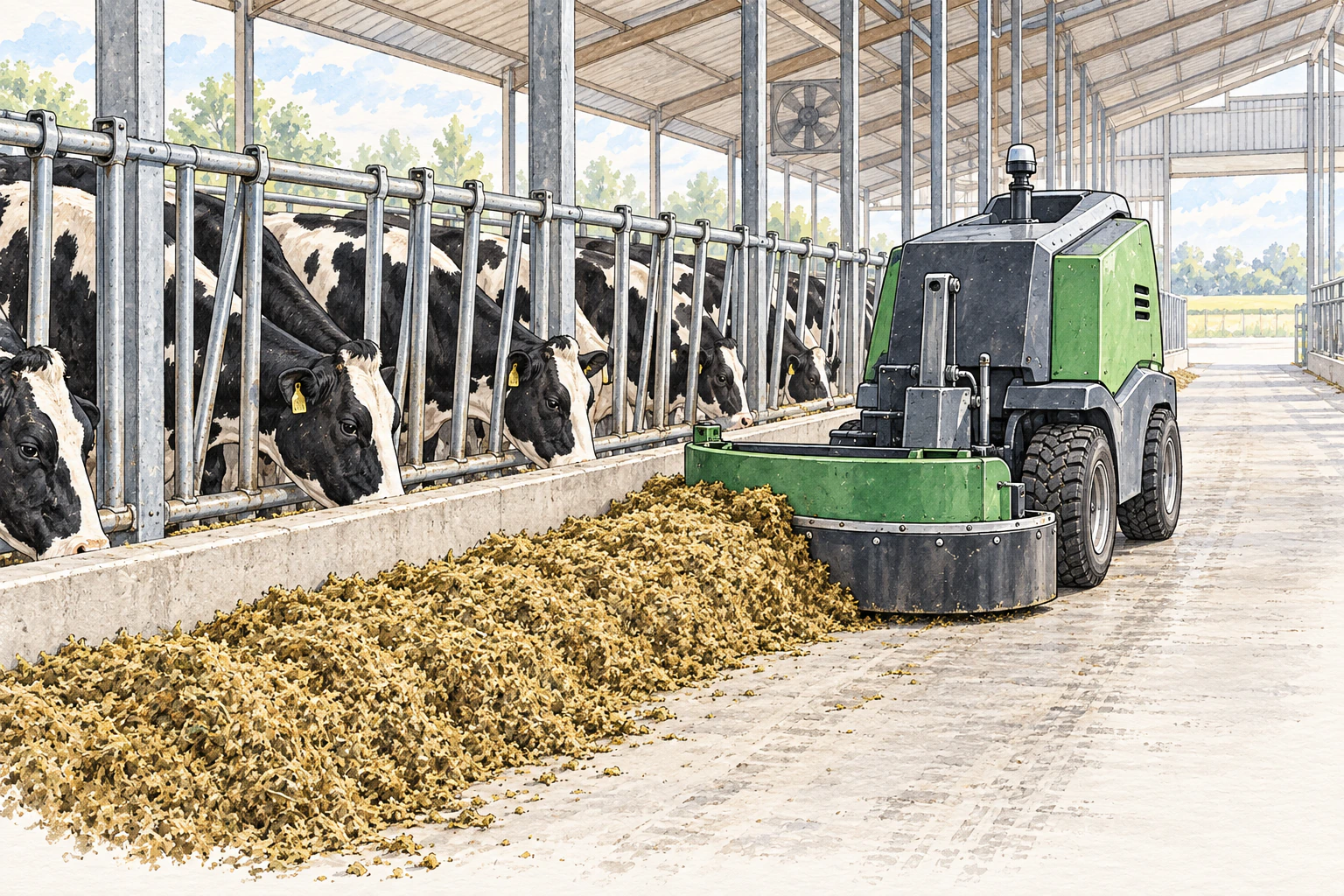
Feed pushing equipment moves ration that has already been delivered back toward the feed barrier so cows can reach it. It does not automatically mix ingredients, carry a fresh batch from storage, or distribute that batch along the bunk. That distinction is the starting point for choosing the right machine.
A useful selection process connects one defined job to the barn route, bunk geometry, ration condition, operating schedule, safety response, service plan, and acceptance test. It also keeps production expectations realistic. Feed access matters, but equipment alone does not prove a milk, intake, labor, or payback result.
Define the Pushing Job and Its Boundaries
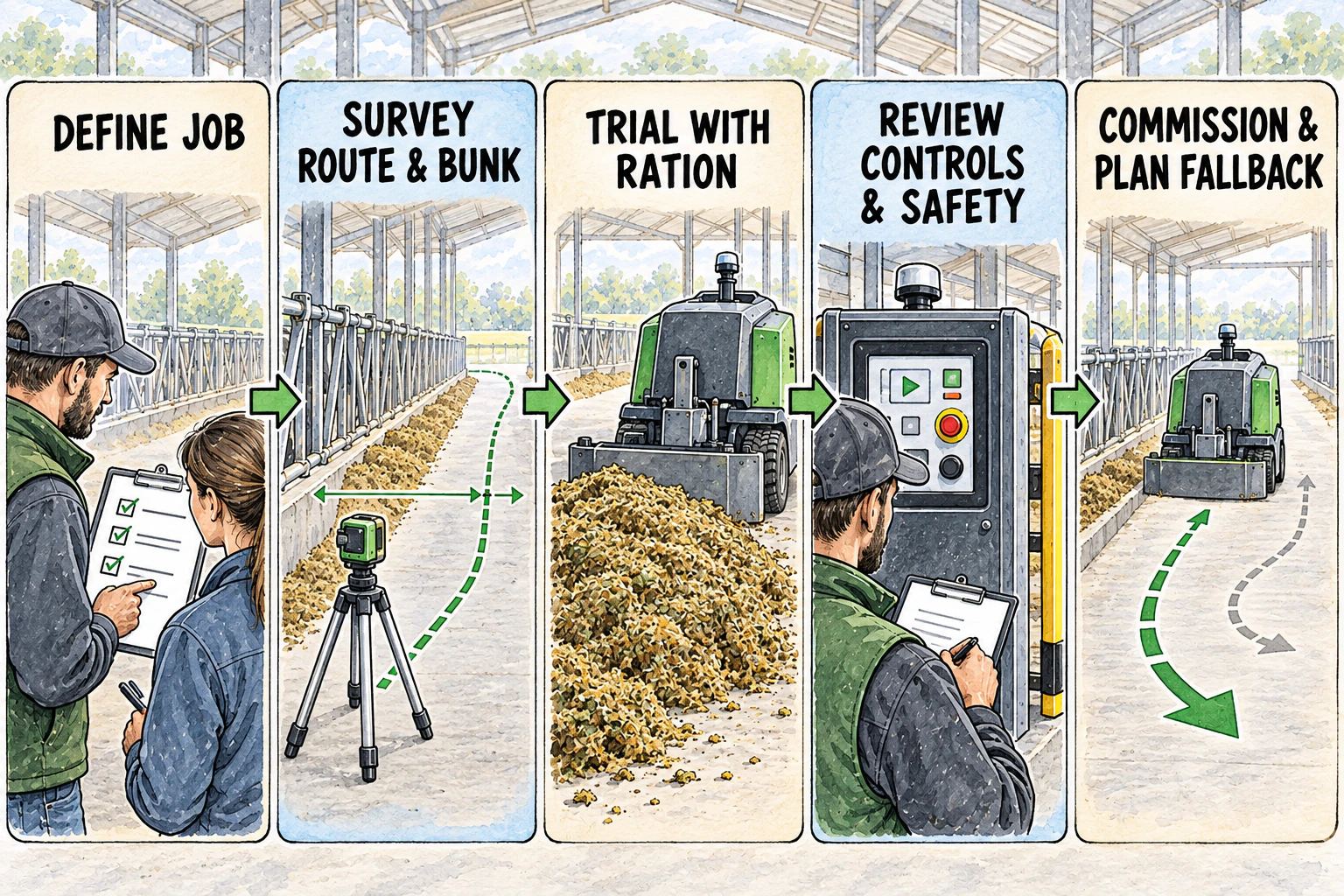
Write the required job in one sentence before comparing machines. For example: “Return the existing TMR along each lactating-cow bunk to the farm’s marked feed line on scheduled passes, without entering unapproved areas.” A statement like “automate feeding” is too broad to identify what the equipment must actually do.
Keep the interfaces clear:
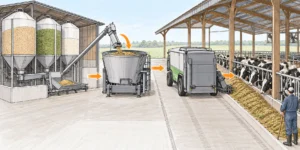
- A TMR mixer prepares the ration.
- Feed distribution equipment transports and places prepared feed along a route.
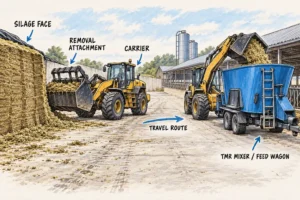
- A feed pusher repositions that placed feed after delivery.
Some systems combine tasks, but the quotation should identify the input material, the included function, and the required condition at handoff. A purchase specification for feed pushing equipment should also state which pens and feed lines are included, who can change schedules, and which tasks remain manual.
Define a successful pass in observable terms. Record the starting feed position, target line, allowed spill or carryover, permitted contact points, and whether manual correction is acceptable. Do not use “pushes well” as an acceptance criterion.
Match the Machine to the Route, Bunk, and Ration
Survey every planned route while normal work is taking place. A machine that fits the straight section of one alley may still fail at a narrow gate, cross-traffic point, drain, slope, sharp turn, or charger approach. Measure the route instead of relying on nominal barn width.
| Site input | What to record | What the supplier must verify |
|---|---|---|
| Feed line | Total route, number of bunks, start and finish points | Every route can be mapped, completed, paused, and resumed |
| Clearances | Narrowest passage, lowest overhead point, tightest turn | Machine and required safety clearance fit the limiting point |
| Floor | Surface, slope, steps, drains, gratings, wet or loose areas | Traction, guidance, and recovery suit actual conditions |
| Bunk edge | Curb profile, barrier position, required reach | Pushing mechanism returns feed without harmful contact |
| Ration | Typical and difficult moisture, depth, stickiness, long material | Representative feed can be moved without unacceptable wrapping or buildup |
| Shared work | Feed delivery, scraping, bedding, people, cattle, doors, vehicles | Routes and schedules avoid or safely manage conflicts |
| Docking | Charger location, approach, power, weather exposure | The machine can dock reliably and the installation meets documented requirements |
Feed condition belongs in the equipment trial. Test both routine material and the difficult conditions the farm reasonably expects. Clean, shallow feed in an empty demonstration alley cannot establish performance with the farm’s wetter, deeper, or more fibrous ration.
The University of Wisconsin–Madison Division of Extension treats push-up as part of feed-bunk management and maintaining access between fresh-feed deliveries. That supports the management objective, but the required route and ration performance still need a site test. Choose feed pushing equipment only after those conditions are documented.
Compare Manual, Fixed, and Mobile Configurations
The main equipment categories solve the same pushing task with different infrastructure and operating demands. Cornell PRO-DAIRY material describes fixed hydraulic or cable arrangements and mobile battery-powered pushers; it also highlights barn location, route distance, charging, and bunk-management needs as selection factors. Use Cornell PRO-DAIRY for the category overview, then confirm current model details in the supplier’s documentation.
| Configuration | Often fits when | Verify before selection | Main dependency |
|---|---|---|---|
| Operator-driven blade or attachment | The farm can combine push-up with an existing staffed route | Reach, visibility, maneuvering room, attachment compatibility, and safe access | Operator and carrier availability |
| Fixed cable, rail, or hydraulic pusher | One consistent bunk line justifies installed infrastructure | Return path, mounting, obstruction of delivery or cleaning, and isolation for service | Fixed route and installed components |
| Mobile autonomous pusher | Multiple scheduled passes or routes require independent operation | Navigation method, route changes, obstacle response, charging, logs, and manual recovery | Reliable route, controls, charger, and support |
Do not rank the categories by automation level alone. A fixed system may suit a simple repeatable line; a mobile unit may suit several accessible routes; an operator-driven method may remain the practical fallback. Feed pushing equipment should be compared against the farm’s complete operating requirement, not against a different category performing a different job.
Ask the supplier to identify every required component: pushing mechanism, machine or carrier, navigation infrastructure, charger or hydraulic installation, doors and interfaces, control access, commissioning, training, manuals, spares, software or connectivity, and exclusions. This makes quotations comparable and exposes site work that a machine-only price can hide.
Specify Controls, Safety Response, and Support
For autonomous feed pushing equipment, “runs by itself” is not an adequate control description. Document how routes are created and approved, who may change a schedule, what happens when localization is lost, and how the unit responds to people, animals, vehicles, blocked paths, open gates, power loss, interrupted charging, or lost communications.
Obtain the exact model’s operating and safety documentation before commissioning. The farm’s site risk assessment should cover crossings, blind areas, animal access, shared vehicle routes, unexpected starts, isolation, cleaning, towing or manual movement, and maintenance access. Detection and stopping behavior must be demonstrated through the supplier’s approved procedure and site controls; workers should not improvise an obstacle test.
Controls should leave usable evidence. Confirm that authorized staff can view route completion, interruptions, alarms, manual recoveries, charge status, and configuration changes. If remote access or a subscription is involved, record which functions depend on the network, who can access the system, how updates are managed, and what remains available during an outage.
Service fit can decide whether automation is dependable. Request preventive-maintenance tasks and intervals from the current manual, the local parts route, technician coverage, escalation contacts, expected training, configuration backup method, and recovery instructions. Include the pushing element, wheels and drive, sensors, guards, bumpers, emergency devices, battery and charger, and feed-buildup points where applicable.
Commission the Whole Feed-Access Process
Commission feed pushing equipment with representative feed, normal cross traffic, and every approved route. A single pass in a cleared alley proves only that one condition. Test the smallest and most demanding planned jobs, docking from each route, schedule conflicts, pause and resume, documented fault responses, cleaning access, and the manual fallback.
Use a signed acceptance record:
- Confirm the installed machine, route infrastructure, charger, controls, and documents match the approved scope.
- Record the feed condition and starting position for each test.
- Run every route and inspect the final feed line, spill, buildup, contact, and need for correction.
- Demonstrate authorized schedule changes, stop and restart, alarms, recovery, isolation, and data access.
- Verify that delivery, scraping, bedding, gates, people, cattle, and vehicles can follow the agreed operating plan.
- Perform cleaning and routine service tasks with the supplied tools and instructions.
- Run the fallback method and confirm staff know when to use it.
- Record deviations, corrective actions, responsibility, and retest results before acceptance.
Set the push-up schedule from feed availability, feeding and milking routines, ration condition, pen behavior, and observed results. Penn State Extension places push-up timing within the wider feeding environment. However, a 2017 crossover study in the Journal of Dairy Science found no difference in intake, milk yield, composition, sorting, or standing and lying patterns when 28 tie-stall Holsteins received five rather than three daily push-ups. That defined study does not set a universal schedule, but it does show why more passes should not be sold as a guaranteed production response.
After startup, review missed routes, alarms, manual interventions, feed left out of reach, cleaning time, and schedule conflicts. Adjust only within the approved operating process and keep changes traceable. A successful feed pushing equipment project is one that performs the defined pushing job reliably in the farm’s real route and feed conditions while preserving a workable fallback—not one justified by an unverified brochure claim.