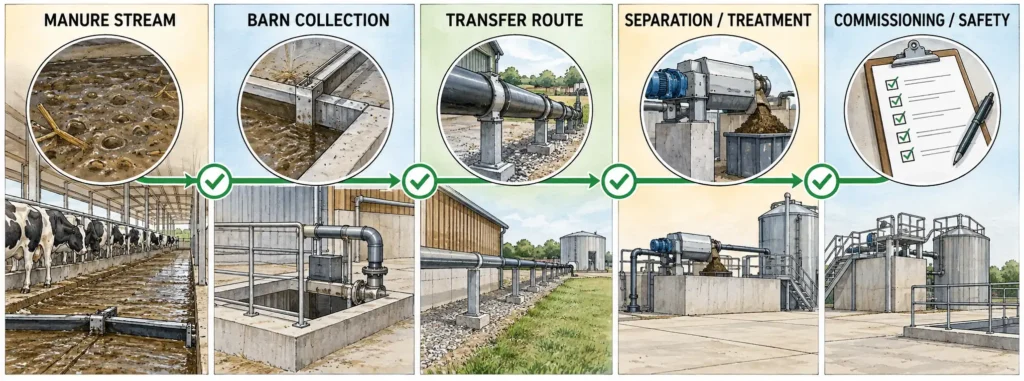
The right dairy manure handling equipment moves the farm’s actual manure stream from its source to storage or treatment without creating a blockage, unsafe intervention, or incompatible handoff. Start with the material and the complete route—not a preferred machine name.
A useful selection brief defines what enters the system, how it changes as it moves, where each transfer occurs, what the receiver can accept, how the line is cleaned and serviced, and what happens when a component stops. This article covers the barn-to-storage-or-treatment interface. Land application, permitting, complete nutrient planning, and treatment-process design require separate qualified work.
1. Freeze the Manure Stream Before Comparing Equipment
Start every dairy manure handling equipment decision with a source-by-source inventory. “Dairy manure” is not one consistent material. Scraped freestall manure with sand bedding presents a different job from flushed manure, a bedded pack, parlour wastewater, or a stream containing waste feed and foreign objects.
For each source, record:
- housing area and collection point;
- bedding material and expected carryover;
- whether wash water, rainfall, or process water joins the stream;
- observed solids, fibers, grit, stones, twine, and other foreign material;
- whether the material is expected to be stackable, semi-solid, slurry, or dilute liquid;
- seasonal temperature and freezing exposure;
- collection frequency and peak operating condition; and
- the exact destination and its allowable inflow condition.
This is not a substitute for sampling or engineering characterization. It is the minimum fact set needed to ask the right questions. Cornell PRO-DAIRY identifies site topography, building layout, bedding type, climate, and management style as factors that affect conveyance. Those variables belong in the purchasing brief because they can change the suitable collection and transfer approach.
Map every addition and subtraction along the route. Water added for cleaning or flushing can change flow behavior and total volume. Bedding, wasted feed, or grit can settle, abrade components, bridge openings, or interfere with downstream processing. A separation step produces more than a “cleaner liquid”; it creates two material streams, each needing a defined destination.
The output of this step should be a manure-stream schedule, not an assumed average. If the supplier has not received representative material information and the most demanding operating condition, a confident equipment recommendation is not yet evidence.
2. Match Collection Equipment to the Barn and Transfer Point
Collection equipment has one job: move manure from animal and work areas to a controlled transfer point while fitting the barn, cleaning routine, cow movement, worker route, and bedding system. Common approaches include manual or vehicle scraping, automatic alley scrapers, gravity channels, flush collection, underfloor collection, and mechanical conveyors. These are functional categories, not a universal ranking.
Compare each candidate against the real barn:
- Floor and route: Check alley width, floor profile, slopes, turns, cross alleys, doors, kerbs, drains, and obstructions.
- Animals and people: Define when the system operates, how cows and staff are separated from moving components, and how unexpected access is controlled.
- Material capture: Confirm that the blade, flight, chain, channel, or flush arrangement can manage the actual bedding and foreign-material load.
- Discharge: Verify that material leaves the collector cleanly and enters the reception point without an uncontrolled drop, splash, pile, or bridge.
- Cleaning and recovery: Provide safe access to inspect, isolate, clean, release, and restart the equipment after a fault.
A dairy manure handling equipment proposal is incomplete if it specifies only the collector. The handoff into a reception pit, hopper, cross channel, conveyor, or pump intake is often where mismatched geometry and material assumptions become downtime. Request drawings or measured dimensions for both sides of that interface. This makes dairy manure handling equipment selection an interface check as much as a machine comparison.
Automatic equipment also needs a safe operating concept. Ask how the system detects an obstruction or overload, where emergency stops and isolation points are located, how an alarm is communicated, and what the farm does until service is restored. A backup method does not need to duplicate the normal system, but it must be physically possible and documented.
3. Design the Transfer Route, Pump, and Pipe as One System
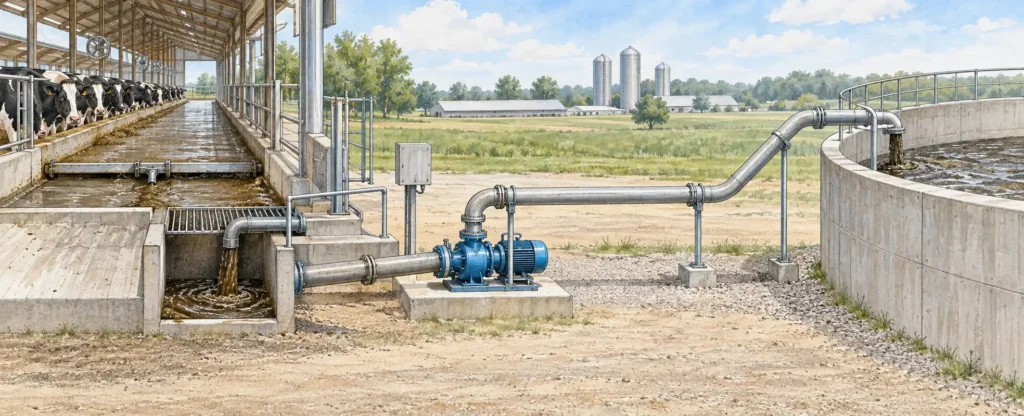
The transfer section begins at the collection discharge and ends at the defined storage or treatment inlet. It may use gravity, a pump, an auger or conveyor, a reception pit, and open or closed conduits. Evaluate the route as one connected duty rather than treating each component as a separate purchase.
For dairy manure handling equipment that pumps or conveys material, require the supplier or qualified designer to document:
- the material characteristics used for selection;
- the required duty at the most demanding operating condition;
- vertical elevation change and complete route length;
- pipe, channel, valve, fitting, and transition arrangement;
- foreign-material protection and the response to blockage;
- cleanout, drain-down, flushing, and freeze-protection method;
- backflow, air-lock, vacuum, and pressure-control provisions where relevant;
- motor, power, control, alarm, and isolation requirements; and
- the exact receiving level, connection, inflow limit, and shutdown condition.
The NRCS Waste Transfer standard supports this system view: transfer design must consider waste properties, management operation, capacity, pressure, cleanout, environmental exposure, structural loads, and operation and maintenance. Use the current local Field Office Technical Guide and qualified professional input where the practice applies; the national document is not a ready-to-install site design.
Do not select a pump from a nominal flow statement alone. Pump behavior depends on the material, solids and fibers, grit, required pressure, intake condition, wear, and the complete piping system. Ask for the performance basis for the exact configuration and verify that the stated duty is for manure under the defined conditions—not water under an unrelated test.
Design for external intervention wherever practical. Cleanouts, accessible isolation, removable guards, lifting provisions, and service clearances can turn a blockage into a controlled maintenance task rather than a reason to approach a hazardous pit or improvise around moving machinery.
4. Add Separation or Treatment Only for a Defined Interface Need
Separation is not automatically an upgrade. Add it when a downstream requirement justifies changing the stream—for example, when the receiving process needs lower-solids liquid, when bedding or grit must be removed to protect equipment, or when separated solids have a defined handling destination.
The University of Wisconsin–Madison Division of Extension explains that a screw press receives liquid or slurry manure and produces both separated solids and a lower-solids liquid stream. It also notes that performance varies with manure type, consistency, solids content, flow, and equipment design. A brochure value therefore cannot replace testing or documentation for the farm’s actual influent and objective.
For any separator or pretreatment step, specify four interfaces:
- influent condition and delivery method;
- machine duty and control response;
- liquid-output route and receiving capacity; and
- solid-output collection, movement, storage, or approved next process.
Adding separation to dairy manure handling equipment also adds wear parts, cleaning, service access, controls, and failure modes. Ask where material goes during a shutdown, whether the upstream system can pause or bypass safely, how both outputs are contained, and how the operator recognizes deteriorating performance.
Keep treatment claims within evidence. Separation changes physical streams, but it does not by itself prove nutrient removal, pathogen control, odor elimination, universal storage savings, or payback. Those outcomes depend on the selected technology, measured inputs and outputs, management, and the wider system.
5. Specify Safety, Commissioning, and Acceptance Evidence
Safety is a system requirement, not a warning label added after selection. Separate normal operation from maintenance, blockage clearing, agitation, pump-out, and any confined-space work. Identify energy-isolation points, guards, access controls, traffic conflicts, fall and drowning exposures, ventilation needs, gas hazards, and rescue dependencies during design review.
Penn State Extension explains that many below-ground storages, tanks, and enclosed transfer structures meet confined-space characteristics and may involve oxygen deficiency, toxic or flammable gases, and drowning. NIOSH warns against manure-pit entry unless it is necessary and proper safeguards are used. This article is not an entry procedure: keep inspection, clearing, sampling, and retrieval points outside hazardous spaces where feasible, and obtain a site-specific confined-space program from qualified safety professionals.
Before acceptance, test the installed dairy manure handling equipment as a connected system under representative conditions. The commissioning record should show:
- the material and operating condition used in the test;
- collection across the intended barn route;
- clean discharge into the reception point;
- stable transfer to the defined receiver;
- control, alarm, stop, and isolation functions;
- blockage-response and safe cleanout method;
- normal shutdown, drain-down, and restart; and
- the backup procedure when a critical component is unavailable.
Record exceptions instead of accepting verbal assurances. The quotation and handover package should identify the exact equipment configuration, drawings, limits, utilities, controls, guards, operation and maintenance documents, training, wear parts, warranty conditions, service responsibility, and acceptance method.
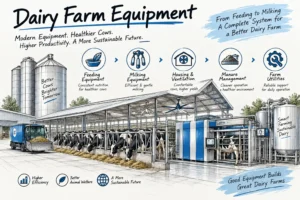
The final dairy manure handling equipment choice should be the system that fits the verified manure stream, barn, route, receiver, maintenance capability, and safety plan with the fewest unresolved assumptions. Return to the broader dairy farm equipment framework when checking how this manure workflow interacts with the rest of the dairy operation.
Recommendation
- AIG Machinery Blog
- Cornell PRO-DAIRY Manure Collection & Conveyance
- NRCS Waste Transfer Conservation Practice Standard
- University of Wisconsin–Madison Division of Extension Screw Press Separation of Manure
- Penn State Extension Confined Space Manure Storage Hazards
- NIOSH Preventing Deaths of Farm Workers in Manure Pits