Automatic feeding system dairy farm technology can reduce repetitive feeding work, improve feed-delivery consistency, and give farmers more control over when and how different cow groups are fed. But full automation is not automatically the right investment for every dairy farm.
This article will start with the questions farmers usually care about most: How much labor can I save? Will the system fit my existing barn? How much feed must it handle? What will it cost? And what happens if the system stops?
The article will follow the complete decision path from identifying the farm’s feeding problem to calculating capacity, estimating costs, comparing system types, and choosing the right level of automation.
Opening decision table:
| Main Farm Problem | First Solution to Evaluate |
|---|---|
| Too much time spent delivering feed | Automatic feed distribution |
| Frequent manual feed push-up | Feed pusher robot |
| Ingredient weighing varies between batches | Automatic weighing/dosing |
| Several ration groups | Automated scheduling and distribution |
| Multiple nearby barns | Central feeding kitchen |
| Existing TMR equipment works well | Partial automation |
| New dairy being designed | Integrated automatic feeding system |
The introduction will also make one distinction clear: automatic feeding is not the same as automatic milking. Numerical evidence used in the article will come specifically from feeding-system research, university sources, or clearly identified manufacturer specifications rather than using automatic-milking data as a substitute.
Is an Automatic Feeding System Right for Your Dairy Farm?
This section will help the reader decide whether automation solves a real feeding problem before discussing specific equipment.
It will explain that herd size alone should not determine the decision. Daily feed volume, feeding labor, number of ration groups, barn layout, travel distance, existing equipment, feeding frequency, local service support, and future expansion can be equally important.
Problems Automation Can Solve
Focus on practical operating problems:
- excessive labor spent loading and distributing feed;
- difficulty maintaining consistent feeding times;
- several cow groups requiring different rations;
- repetitive feed push-up work;
- long tractor operating hours;
- inaccurate or inconsistent ingredient loading;
- expansion making the existing feeding system inefficient.
The section will explain the difference between automating one bottleneck and replacing the whole feeding process.
For example, a farm with a reliable TMR mixer but high push-up labor may only need a feed pusher robot. Another farm operating several barns and ration groups may benefit from a more integrated system.
When Full Automation May Not Be Necessary
This section will provide balance and improve trust.
A farm may not need full automation when its existing feeding system is reliable, labor requirements are manageable, barn layout is unsuitable for robots, only a small number of rations are prepared, or the cost of rebuilding feed alleys and infrastructure is too high.
A short table will compare:
| Farm Situation | Direction to Consider |
|---|---|
| Existing system works well | Keep it and automate bottlenecks |
| Push-up is the main labor problem | Feed pusher robot |
| Mixing works but distribution is slow | Automate delivery |
| Many ration groups | Automated dosing/distribution |
| Multiple barns near one feed center | Central feeding kitchen |
| New dairy construction | Full-system evaluation |
The key message will be simple: start with the problem, not the robot.
How Does an Automatic Feeding System Work?
This section will explain the technology in beginner-friendly language by following the feed rather than presenting a list of machines.
The basic workflow will be:
Feed storage → dosing → weighing → mixing → transport → distribution → push-up → feeding records
From Feed Storage to Mixing and Delivery
Each step will be explained briefly:
| Feeding Stage | Typical Equipment | Automation Potential |
|---|---|---|
| Feed storage | Silage/storage bins | Partial |
| Ingredient dosing | Dosing units | High |
| Weighing | Load cells/scales | High |
| Mixing | Stationary or mobile TMR mixer | High |
| Transport | Conveyor/rail/mobile robot | High |
| Distribution | Feeding robot/dispenser | High |
| Push-up | Feed pusher robot | High |
| Recording | Feeding software | High |
The article will explain how the TMR mixer fits into the automated process and why an existing mixer does not always need to be replaced.
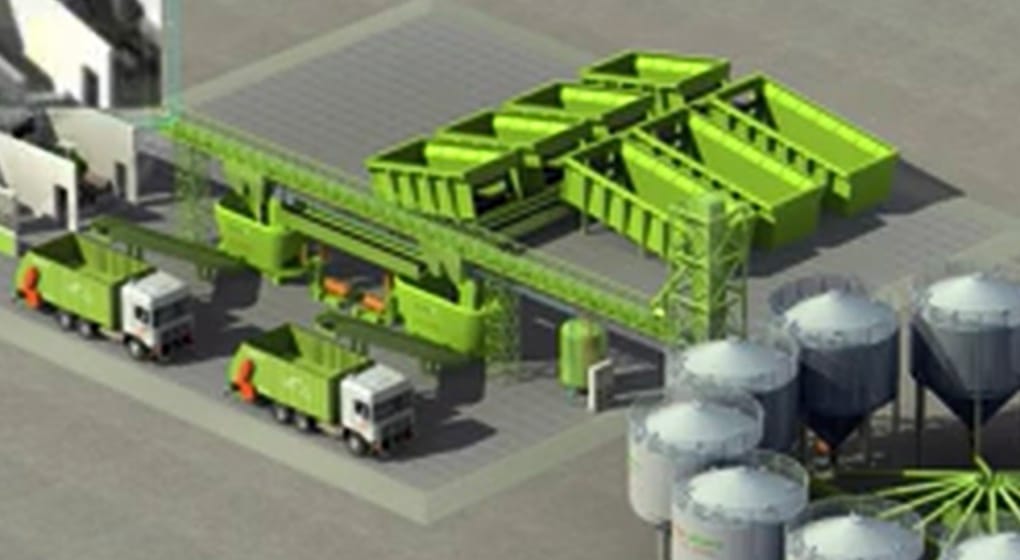
It will also explain how a central feeding kitchen can centralize ingredient storage, weighing, and mixing before finished rations are transported to individual barns or cow groups.
Main Types of Automatic Feeding Systems
Instead of ranking technologies as “best” or “worst,” this section will compare systems by how they move and prepare feed.
Main configurations will include:
- stationary mixing with automated distribution;
- rail-guided feeding systems;
- autonomous mobile feeding robots;
- conveyor-based distribution;
- centralized feeding systems serving multiple barns.
Comparison criteria will include infrastructure requirement, flexibility, feeding route, mixing location, expansion potential, and maintenance requirements.
Manufacturer specifications will be clearly labeled as machine-specific rather than presented as universal industry standards.
Automatic Feeding System vs Feed Pusher Robot
This distinction deserves a short dedicated subsection because beginners frequently confuse the two.
A feed pusher robot mainly pushes already-delivered feed back toward the cows.
A complete automatic feeding system can potentially handle several additional steps, including weighing ingredients, mixing, transporting, distributing, scheduling, and recording feed deliveries.
A comparison table will show function, investment level, infrastructure requirement, and suitable use case without repeating the full system explanation.
What Changes After Installing an Automatic Feeding System?
This section will evaluate measurable operational changes rather than presenting automation as a guaranteed productivity improvement.
The focus will be labor, feeding frequency, consistency, management flexibility, data, maintenance, and operating risk.
Research data will be distinguished from illustrative calculations. The article will avoid using evidence from automatic milking systems as proof of automatic-feeding performance; those technologies have different workflows and outcomes. Research on dairy automation also shows that technology outcomes depend heavily on management and system design, supporting this cautious approach. (ScienceDirect)
Labor, Feeding Frequency and Consistency
The article will compare conventional and automated feeding using evidence specifically related to feeding systems.
The main table will use this structure:
| Metric | Conventional Feeding | Automated Feeding | Why It Matters |
|---|---|---|---|
| Feeding labor | Verified data | Verified data | Labor requirement |
| Deliveries/day | Verified data | Verified data | Feed availability |
| Feeding schedule | Operator dependent | Programmable | Timing consistency |
| Ingredient weighing | Operator controlled | Can be automated | Batch repeatability |
| Feed push-up | Manual/mechanical | Automated option | Less repetitive work |
| Feeding records | Manual/limited | Digital | Easier monitoring |
Only research-supported numbers will be inserted into the final table. Manufacturer performance data will be identified separately.
The article will avoid claiming that automation itself guarantees higher milk yield. Cow response also depends on ration formulation, dry matter intake, feed quality, stocking density, cow comfort, health, and overall management.
Limitations, Maintenance and Backup Feeding
This is an essential part of the article because automation creates new dependencies.
Discuss:
- electricity supply;
- sensors and load cells;
- software and communications;
- robot or conveyor failures;
- wear parts;
- cleaning requirements;
- local technician availability;
- spare parts availability;
- emergency feeding procedures.
The practical question will be:
If the automatic feeding system stops at 5:00 a.m., how will the cows be fed?
Every farm considering automation should have a backup method before installation.
This section will therefore balance the benefits with operational risk rather than presenting automation as a one-way upgrade.
How Much Does an Automatic Feeding System Cost?
This section will explain why a single “automatic feeding system price” can be misleading.
Total investment may include:
Feed storage + dosing + weighing + mixing + transportation + distribution + electrical infrastructure + building modifications + software + installation + commissioning
The article will distinguish initial investment from ongoing operating expenses such as electricity, maintenance, replacement parts, software/service contracts, and remaining labor.
What Determines Total Investment?
Main cost drivers will include:
- number of cows;
- daily as-fed volume;
- ration groups;
- feeding frequency;
- number and length of feed alleys;
- distance between barns;
- existing equipment that can be retained;
- required building modifications;
- level of automation;
- local installation and service costs.
Where reliable public price data are unavailable, the article will state quotation required instead of creating unsupported price ranges.
Labor Savings and Payback
A consistent hypothetical farm example will make the calculations easier to understand.
For example, a 500-cow dairy can be used throughout this section, with every assumed number clearly labeled as an illustrative example rather than research data.
All calculations will remain on one line:
Daily feed requirement = Number of cows × average as-fed intake/cow/day = 500 cows × 50 kg/cow/day = 25,000 kg/day
Feed per delivery = Daily feed requirement ÷ deliveries/day = 25,000 kg ÷ 4 = 6,250 kg/delivery
Annual feeding labor cost = Feeding labor hours/day × labor cost/hour × 365 = 6 h × $20 × 365 = $43,800/year
Illustrative annual labor saving = (6 h − 2 h) × $20 × 365 = $29,200/year
Simple payback period = Net investment ÷ annual net operating savings
The article will explain that labor savings alone should not determine ROI. Electricity, maintenance, financing, remaining labor, downtime, and infrastructure changes also affect the result.
Central Feeding Kitchen vs Individual Barn Systems
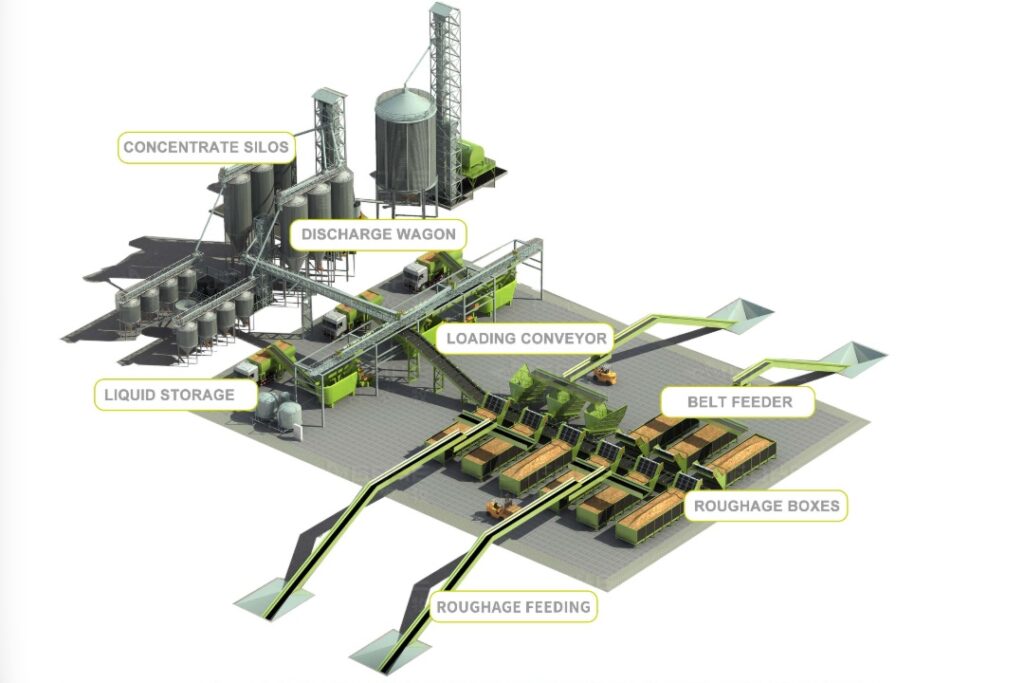
This subsection will explain when centralized feeding deserves consideration rather than simply defining a central feeding kitchen.
| Farm Condition | Central Kitchen Potential |
|---|---|
| Single small barn | Usually limited |
| Several nearby barns | Worth evaluating |
| Many ration groups | More attractive |
| High daily feed volume | More attractive |
| Long barn-to-barn distances | Transport cost matters |
| Existing distributed mixers | Compare conversion cost |
| New large dairy | Easier to integrate |
The discussion will focus on total feed movement, equipment utilization, travel distance, redundancy, and expansion—not simply herd size.
How to Choose the Right Automatic Feeding System
The final section will turn the article into a practical buyer’s guide.
Instead of recommending equipment only according to herd size, the selection method will consider:
Cows + daily feed volume + ration groups + deliveries/day + barn layout + travel distance + existing equipment + future expansion + service support
Calculate Daily Feed and Required Capacity
Beginners will first calculate how much material the feeding system actually needs to handle.
Daily feed requirement = Number of cows × average as-fed intake per cow per day
Feed required per delivery = Daily feed requirement ÷ number of deliveries per day
Required hourly delivery capacity = Daily feed requirement ÷ available feeding operating hours per day
The article will explain that TMR mixer or feeding-robot capacity cannot be selected from weight alone. Ration density, forage moisture, usable mixer volume, filling level, and manufacturer specifications also matter.
Match Automation to Farm Layout
The article will then connect capacity to physical layout.
Important factors include:
- feed-alley width;
- turning space;
- slopes and floor condition;
- door dimensions;
- travel distance;
- charging or power locations;
- number of barns;
- feed-center position;
- vehicle and cow traffic;
- future barn expansion.
A high-capacity system can still be a poor investment if it does not fit the existing farm.
10 Questions to Ask Before Buying
The article will finish the equipment-selection process with ten practical questions:
- How many cows must the system feed today?
- What herd size is expected in 5–10 years?
- How many kilograms of as-fed ration are delivered daily?
- How many ration groups must be handled?
- How many feed deliveries are required?
- Can the system operate in the existing feed alleys?
- Which existing equipment can be retained?
- Who provides local parts and technical service?
- How will cows be fed during a system failure?
- What is the expected total ownership cost rather than only purchase price?
This checklist will prevent repetition of the earlier benefits and cost sections by focusing specifically on the final purchasing decision.
From Automatic Feeding to Precision Dairy Farming
The article will end by putting feeding automation into a broader management context.
An automated feeding system can generate information such as:
Ingredient weights → batch records → delivery times → feeding frequency → group feeding data
When these records are used to improve feeding decisions, they become part of precision dairy farming. When feeding systems are connected with cow monitoring, milking, environmental controls, and farm-management software, they can contribute to broader smart dairy farming.
The conclusion will avoid claiming that more technology automatically means better farming.
The central takeaway will be:
Choose an automatic feeding system when it solves a measurable feeding problem and the farm can support its capacity, maintenance, service, backup, and operating costs.
That keeps the article focused on the farmer’s decision rather than the technology itself.