
Choosing a TMR Mixer
What does a TMR mixer do?
A TMR mixer blends a dairy herd’s feed ingredients into a total mixed ration (TMR). The aim is to deliver a ration with the intended ingredient proportions along the feed bunk. UMN Extension explains how the ration is formulated and mixed.
What size TMR mixer should we buy?
Check the smallest and largest batches you actually make against the working range of the model you are considering. Include the smallest pen’s batch and any partial loads. Give the supplier each batch weight and the ration it represents, since feed density affects the volume a batch takes up. Ask for the model’s working range with your ration. Overfilling or underfilling can affect mix quality. The Western Canadian Dairy Seminar describes overfilling in a four-auger mixer and discusses underfilling in vertical mixers.
Use the farm’s regular batches to compare candidates in the TMR mixer selection guide.
Can my mixer handle long hay or whole bales?
Confirm whether the exact model can process your forage in the form you load it. Whole bales, loose long hay and chopped forage can require different handling. When comparing models, ask whether the machine takes the bale as loaded or requires a separate chopping step. KUHN gives examples by mixer design.
Loading and Mixing
What order should ingredients go into the mixer?
Follow the loading order on the farm’s feed sheet and confirm that it matches the procedure for your mixer. If the ration or forage form changes, ask the feed lead whether the sequence needs updating. A forage that needs cutting in the mixer adds a processing step, and the correct loading sequence depends on the machine and the feed, as outlined by UMN Extension.
When do I start the mixing timer?
Start timing the final mix after the last ingredient is in. Use the procedure for your model and batch. In the batch log, record any forage processing time separately, then record the final mix time. When a ration looks different, those two entries let you see whether the forage processing step or the final mix changed. UMN Extension describes the timing of the final mix.
Did the scale drift, or did the forage get wetter?
Check the scale and the forage separately. With the farm’s approved scale-check procedure, use a known load and compare the expected and displayed weight change. Record any discrepancy for follow-up. Then compare a current dry matter test from the forage being loaded with the value on the feed sheet. Wetter forage takes more as-fed weight to deliver the same amount of dry matter, even when the scale is accurate. UMN Extension covers both checks.
Record the forage lot and test date so the feed lead can review the loading target. Use the forage dry matter testing guide to document the result and any approved update to the loading target.
Checking the Feed at the Bunk
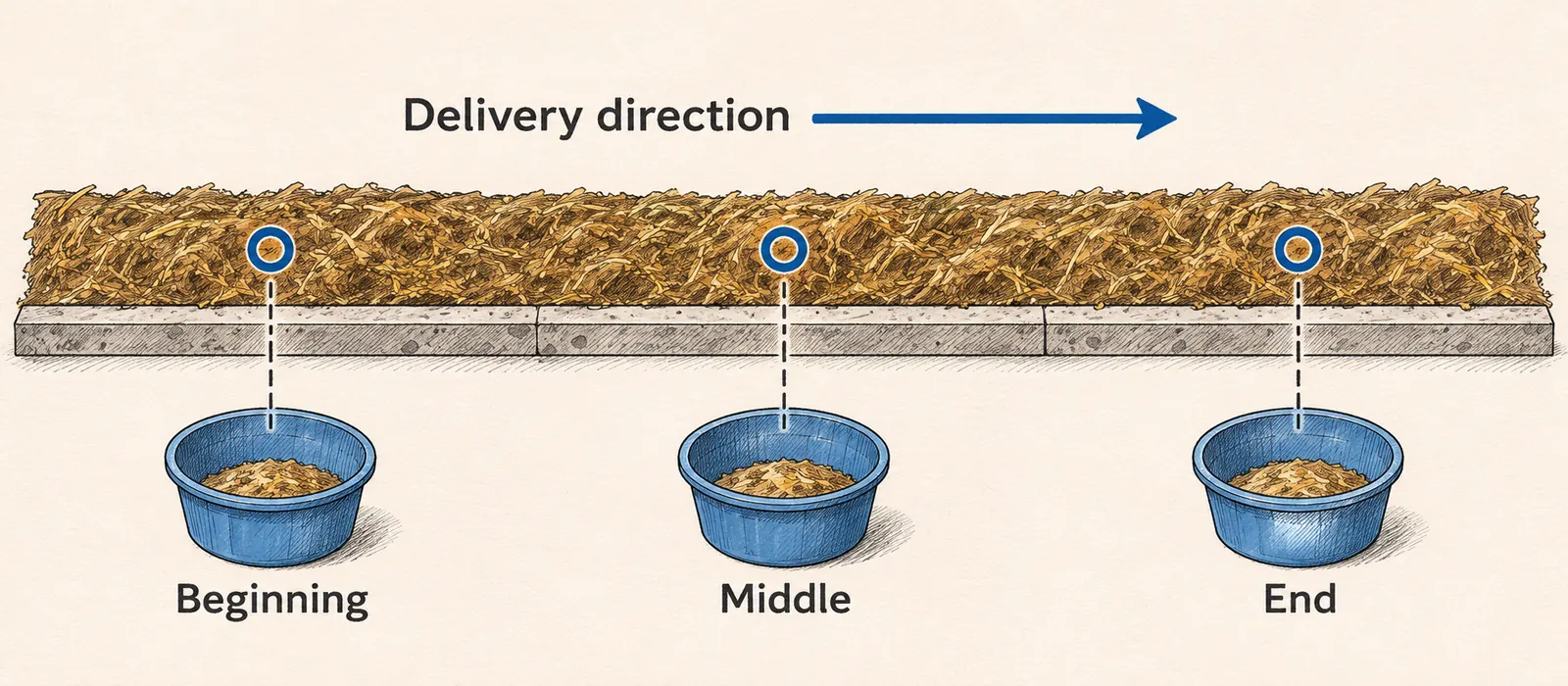
Where should I sample the ration to check for an uneven mix?
Keep separate samples from the beginning, middle and end of the same feed delivery. Collect fresh feed before cows can sort it. Label each sample with its batch and delivery position, then use the same particle-size method at each position. Compare the mass proportions retained on each screen and in the pan by location. The comparison shows how particle fractions vary across the delivery. Determining how nutrients are distributed would require separate evidence. See the feed delivery comparisons from the Western Canadian Dairy Seminar.
The TMR particle size testing guide explains how to collect and compare the samples.
What should I check if the feed differs along the bunk?
Use the pattern to pick the first record or setting to check. Repeat the same fresh-feed comparison after changing one approved variable so you can see whether the pattern changes.
| What you see | First check |
|---|---|
| A difference keeps appearing at the beginning or end of delivery. | Check whether the mixer was level while loading and mixing, and where ingredients landed in the tub. Both are possible contributors in audits from the Western Canadian Dairy Seminar. |
| Differences show up mainly in the smallest batch. | Verify that batch against the model’s working range with the current ration. Check the small load first when the regular batch looks consistent. See the vertical mixer observations from the Western Canadian Dairy Seminar. |
| The batch looks different after a change in the loading routine. | Compare the actual loading sequence and the time after the last ingredient with the farm’s procedure. Check where mixing time was counted using guidance from UMN Extension. |
When should I ask maintenance to check for wear?
Flag wear for a service check if forage takes progressively longer to process or its cut changes across comparable batches with the same forage form, load size and procedure. Worn knives can change cutting performance, and worn auger flighting can change how feed moves through the mixer. Give maintenance the batch records and ask them to check the applicable parts against the model’s service limits. KUHN describes the wear points on several mixer designs.
References
- AIG Machinery (AIG Machinery) — Dairy industry solutions provider with guides on matching a TMR mixer to farm batches, recording forage dry matter and comparing feed particle size.
- University of Minnesota Extension (UMN Extension) — Dairy feeding guidance for choosing a loading sequence, timing the final mix, checking scale response and accounting for changes in forage dry matter.
- Western Canadian Dairy Seminar (Western Canadian Dairy Seminar) — University of Alberta seminar proceedings that document feed delivery audits and variables to review when fresh ration particle fractions vary along a bunk.
- KUHN North America (KUHN) — Manufacturer guidance on forage handling and capacity by mixer design, with examples of knife and auger wear points for a model-specific service review.