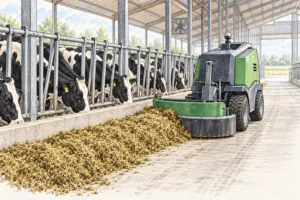
The right TMR mixer is the machine that can repeatedly weigh, process, blend, and discharge the farm’s actual ingredient set within the available loading and feeding window. Nominal tub volume matters, but it cannot prove that the smallest group will mix correctly, the largest batch will stay within operating limits, or the loaded machine will fit the route.
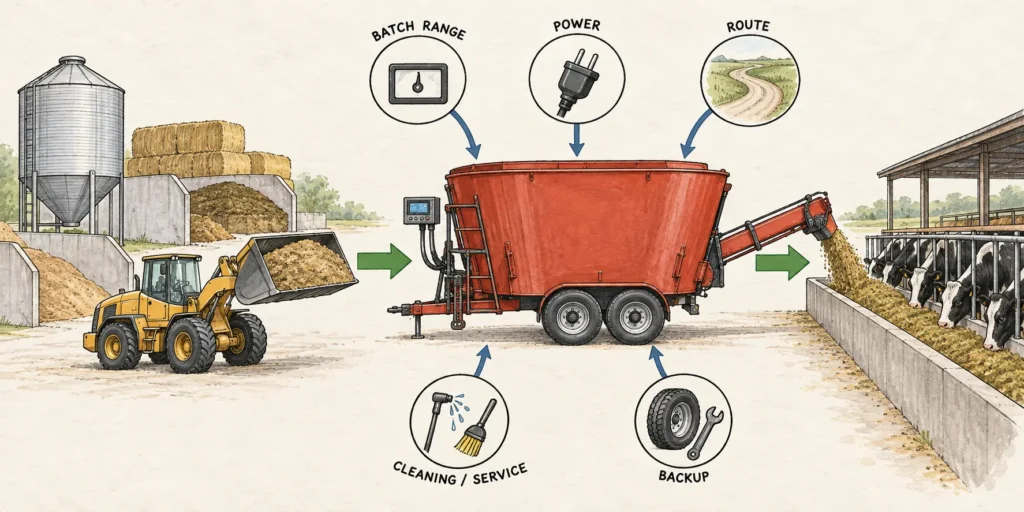
Choose the complete mixing job, not a type label. Freeze the ingredients and their physical form, required batch range, loading equipment, power source, mixer location, route, discharge receiver, scale and record needs, cleaning method, service access, and backup plan before comparing quotations. This is the mixing step in the wider dairy farm equipment system; ration formulation still belongs to a qualified dairy nutrition professional.
1. Define the Mixing Job Before Comparing Machines
Begin with every ration group the machine must serve, but specify the equipment task rather than creating a recipe. For each group, record the target batch provided by the farm’s nutrition and feed-management process, the number of batches, the operating window, and the smallest and largest loads the machine must handle. Also identify what happens when group size, intake, or forage dry matter changes. Those inputs may alter the as-fed quantity even when the formulated ration remains outside this article’s scope.
A useful TMR mixer job sheet keeps those group requirements separate. It prevents one convenient average batch from hiding a small-load problem, an overloaded peak batch, or a feeding window that the proposed machine cannot meet.
Next, inventory every ingredient in the form that reaches the mixer:
- long or preprocessed dry forage;
- silage and other wet forage;
- grains, premixes, minerals, and other small-inclusion dry materials;
- approved liquid ingredients;
- bales, blocks, clumps, foreign-material risks, and expected seasonal variation.
Ingredient form changes the mixing duty. UCCE Dairy Programs explains that particle size, shape, density, moisture behavior, static electricity, and adhesiveness affect how ingredients combine. Its guidance also notes that mixer type and forage preparation influence loading order: vertical machines can accept unprocessed hay in some arrangements, while horizontal auger machines may need preprocessed hay for better mixing. These are comparison questions, not a universal ranking.
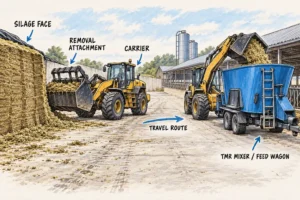
Map the two adjacent handoffs. Upstream, silage handling equipment must reach the actual loading opening without collision, unstable travel, or an improvised drop. Downstream, feed distribution equipment must accept the discharged ration at the required side, height, rate, and location. A machine that mixes acceptably but cannot be loaded or emptied into the real receiver is not a complete solution.
2. Match Mixer Architecture to Ingredients and Workflow
Use architecture to narrow the shortlist, then demand proof from the exact configuration. A TMR mixer may be a mobile wagon powered by a tractor or truck, or a stationary machine feeding conveyors or mobile delivery equipment. Penn State Extension describes both arrangements and warns that some buildings, feed alleys, and mangers may not suit a TMR system.
| Architecture question | What it may solve | What must be verified before selection |
|---|---|---|
| Vertical auger or screw | May combine forage processing and mixing when long or baled material is part of the job | Accepted forage form, knife and auger configuration, smallest effective load, loading height, processing time, total height, power demand, discharge consistency, and risk of excessive particle reduction |
| Horizontal or auger-based mixer | May suit ingredients that arrive at a controlled or preprocessed length | Maximum accepted forage length, required preprocessing, auger/reel/paddle arrangement, wear condition, effective load range, loading order, discharge behavior, and service access |
| Mobile mixer wagon | Can move between storage, loading, and feeding locations | Tractor or truck compatibility, PTO/hydraulic/electrical needs, loaded dimensions and mass, turning space, gradients, surface condition, traffic, visibility, and receiver access |
| Stationary mixer | Can centralize mixing while separate equipment loads and distributes feed | Foundation, power, controls, overhead and side access, conveyor or feeder interfaces, weather protection, emergency emptying, and a backup distribution route |
Do not select by the row with the most apparent advantages. If long forage is expected, ask whether it must be processed before loading or inside the machine and how the exact setup prevents under-processing without damaging the rest of the ration. If several small groups must be fed, demand evidence that the lowest working load reaches the mixing elements and can be discharged without unacceptable carryover.
The published vessel volume is not the accepted working range of a TMR mixer. Obtain the exact model’s documented minimum and maximum batch conditions, allowable ingredient forms, fill guidance, and operating restrictions. Then test the smallest demanding batch and the largest demanding batch with representative ingredients. A universal capacity calculation is not provided here because ingredient density, model geometry, minimum fill, configuration, and operating limits are machine- and ration-specific.
3. Prove Loading, Power, Route, and Discharge Interfaces
Treat every physical handoff as a rejection gate. For each candidate TMR mixer, verify these four interfaces in order:
- Loading gate: Can every approved loader, conveyor, or ingredient source reach the intended opening while the loading machine remains within its documented operating conditions? Confirm approach, reach, clearance, visibility, drop point, and a safe loading sequence.
- Power gate: Can the named tractor, truck, motor, hydraulic supply, or electrical service operate the exact mixer configuration under the supplier’s stated conditions? Record PTO speed where applicable, hydraulic flow and pressure, electrical supply, control requirements, and who supplies each connection.
- Route gate: Can the loaded unit use every turn, door, alley, slope, surface, and traffic crossing in normal and adverse site conditions? Check total height and width, wheel and axle arrangement, drawbar geometry, turning envelope, ground clearance, and stopping or parking points.
- Discharge gate: Can the selected door, conveyor, auger, or belt place feed into the real receiver without contact, uncontrolled spillage, inaccessible residue, or manual transfer? Verify discharge side, reach, height, rate control, visibility, cleanout, and the condition of feed at the handoff.
Loading order is part of the interface test. University of Minnesota Extension gives different reference sequences for auger and vertical machines and states that mixer type, amount of feed, tractor size, and machine condition can affect mixing time. Penn State Extension says to follow the manufacturer’s mixing recommendation and perform standing mixing on a flat, even surface before delivery.
Use those sources to challenge the proposal, not to override the current manual. Require the supplier to document when the mixer starts, where each ingredient is placed, the sequence, processing and final-mixing controls, and the conditions for liquids or small-inclusion materials. Validate that protocol with the farm’s approved ingredients. If a supplier cannot state the tested order and operating condition for the offered setup, the interface remains unresolved.
The same rule applies to site fit: a TMR mixer should be judged in its working configuration, with the specified power unit, extensions, discharge components, scale hardware, and loading equipment—not from a bare-machine drawing.
4. Specify Weighing, Cleaning, Maintenance, and Safety
The weighing system converts the ration plan into operator actions. Specify load-cell arrangement, display location, readability from each loading position, units, zero/tare procedure, ingredient prompts, over-target handling, batch records, data export, user permissions, environmental protection, and the method for identifying a failed or drifting component. Do not accept “scales included” as a complete specification.
The TMR mixer scale also needs a clear failure response. The operator should know how a suspect reading is flagged, which batches or ingredients may be affected, who can authorize continued use, and how verification is recorded before normal loading resumes.
Both University of Minnesota Extension and Penn State Extension emphasize scale accuracy and maintenance. The Minnesota source offers a reference check at several load levels using a known weight, but the purchase document should require the exact manufacturer’s approved calibration and verification method, necessary test equipment, service responsibility, record format, and acceptance limits. Legal-for-trade or local metrology requirements, if applicable, need separate confirmation.
Plan cleaning and maintenance from the safe working position. Request daily inspection points, cleanout access, residual-feed handling, knife/auger/reel/paddle inspection, wear limits, lubrication points, load-cell and wiring protection, conveyor or door service, spare parts, special tools, service intervals, and the procedure for safely emptying a disabled machine. The machine’s condition can change mixing performance, so maintenance access is a process-control requirement as well as a service issue.
Feeder wagons contain serious mechanical hazards. HSE identifies rotating mixing components, discharge mechanisms, transmissions, PTO shafts, maneuvering hazards, and ladder falls. Require guards, safe stops, isolation points, blocked-energy procedures, access restrictions, warnings, and operator training that match the exact machine and local rules. Never plan routine entry into a mixing chamber; inspection, blockage recovery, and repair must follow the current manual and site safety procedure.
Finally, define degraded operation. The backup may be another mixer, a service agreement, a temporary feeding method, critical spares, or a documented recovery arrangement. It must name available equipment, responsible people, safe procedures, and the groups that can be served. “Dealer support” is not a backup plan until response coverage, parts, and the farm’s interim method are documented.
5. Compare Suppliers and Run an Acceptance Test
Send every supplier the same job sheet. It should list ingredients and physical forms, required working batch range, loading machines and openings, power source, route measurements, discharge receiver, scale and data needs, cleaning and service conditions, safety requirements, documentation, training, and backup expectations. Ask each supplier to mark assumptions, exclusions, farm-supplied items, and the exact boundary of responsibility.
Compare complete offers rather than headline capacity. A TMR mixer quotation should identify the exact model, mixer architecture, knives and mixing components, extensions, discharge equipment, scales and controls, power requirements, dimensions, tyres or undercarriage, guards, documentation revision, installation, commissioning, training, warranty conditions, parts support, and acceptance method. Keep every claim tied to that configuration and its stated operating conditions.
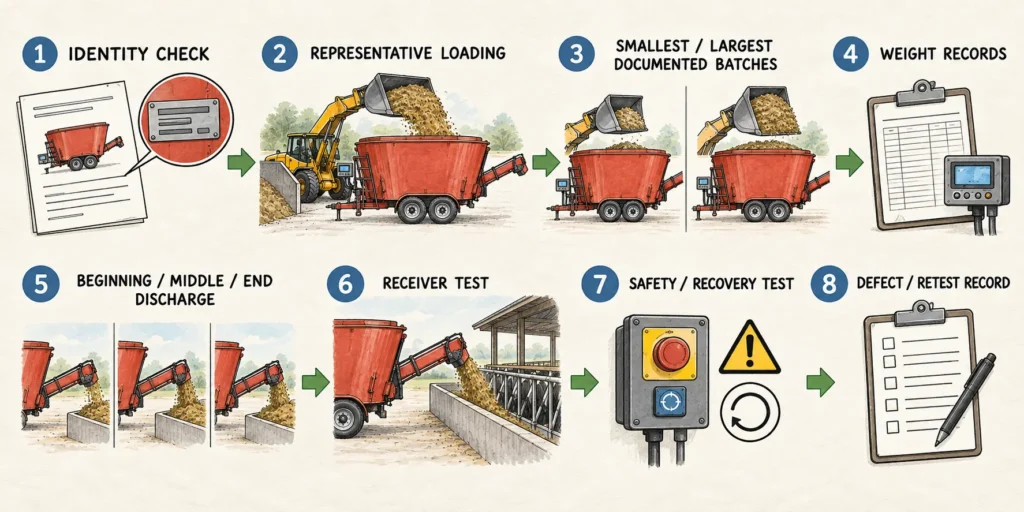
Before final acceptance, test the installed TMR mixer against the frozen job:
- Verify model identity, options, manuals, guards, labels, scales, controls, and software or display versions.
- Demonstrate each loading source and the documented loading sequence using representative approved ingredients.
- Run the smallest demanding batch and largest demanding batch within the supplier’s documented operating range.
- Record ingredient target and actual weights, start and finish events, interruptions, manual corrections, and residual material for the test only.
- Observe the ration at multiple discharge points and compare the beginning, middle, and end for visible clumps, separation, excessive processing, or carryover. Any laboratory or particle-separator assessment must follow its own qualified protocol.
- Demonstrate normal discharge into the actual receiver, including visibility, rate control, stopping, restart, and cleanout.
- Demonstrate scale verification, alarms, interlocks, safe stop, isolation, blockage recovery, and the agreed disabled-machine emptying method without creating a hazard.
- Record defects, responsible parties, corrective work, retest conditions, training completion, and the documents delivered.
Acceptance results apply only to the ingredients, batch sizes, machine configuration, power unit, route, operator, maintenance condition, and test method observed. They do not prove every future ration, universal uniformity, milk response, labor saving, or payback. The strongest TMR mixer purchase decision is the proposal that passes the farm’s mixing, interface, maintenance, safety, and recovery tests with the fewest unresolved assumptions.
For upstream planning, use silage storage systems to define how forage reaches feedout. Then keep the mixer decision focused: verify what enters, how it is weighed and mixed, how it leaves, and how the farm continues feeding when the normal machine is unavailable.