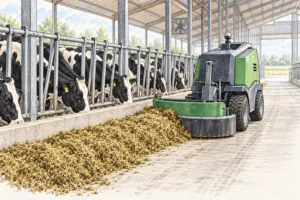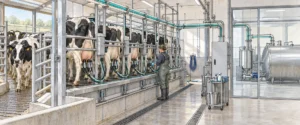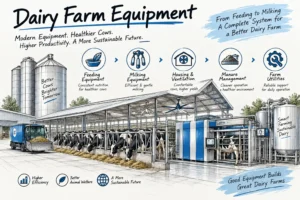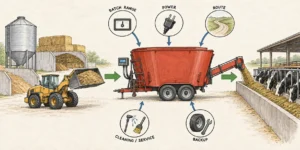
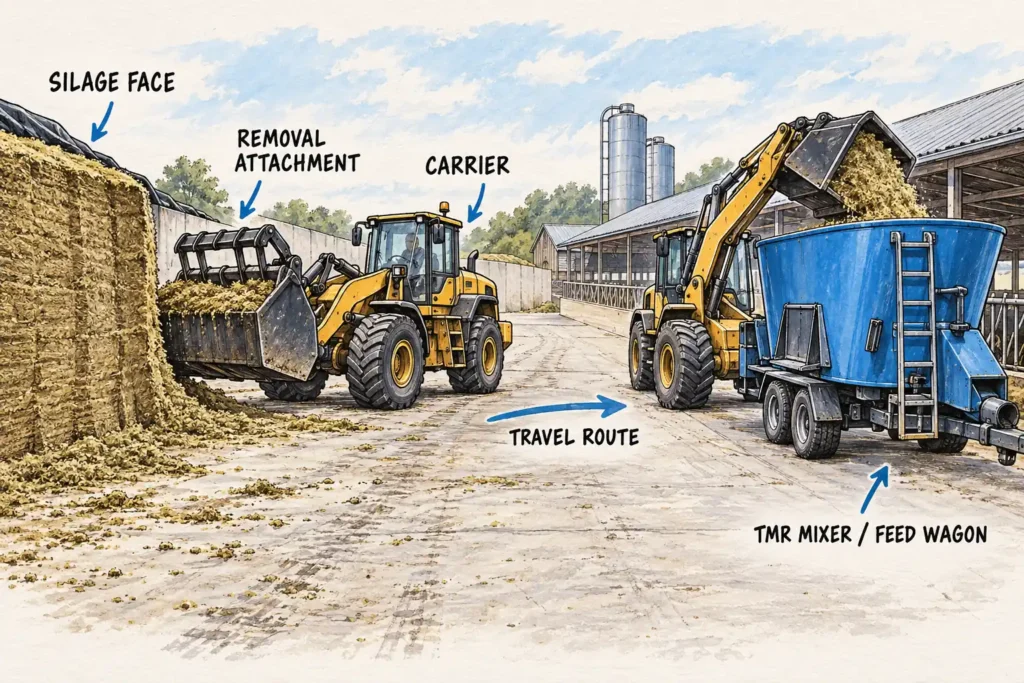
The right silage handling equipment does more than fit a loader. It must remove forage from the open face without creating an unsafe overhang, carry or release the material as intended, travel through the real yard, and reach the receiving machine while the carrier remains within its documented limits.
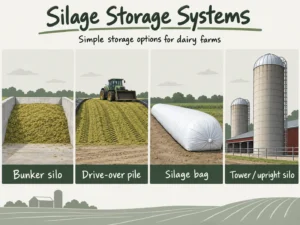
That makes selection a system-design task. Start with the farm’s feedout job, then reject any option that cannot be verified at one of five interfaces: the silage face, the attachment, the carrier, the route, or the receiver. This guide covers that face-to-receiver job only. Storage construction belongs in silage storage systems, while ration delivery after mixing belongs in feed distribution equipment.
1. Define the Feedout Job Before Comparing Equipment
A product name is not a work specification. A bucket may remove, hold, carry, and dump material in one cycle. A facer may loosen material that another pass must collect. A shear grab or block cutter may retain a section, but the farm still has to prove carrier stability, travel clearance, and receiver access.
Write the job as five connected actions:
- Remove: What face height, width, condition, and removal pattern must the tool handle?
- Retain or collect: Does the attachment carry the removed material, or is a second pickup step required?
- Travel: What surface, slope, turning radius, doorway, crossing, and traffic conflict lie between storage and the loading point?
- Load: What height, reach, approach side, opening, and discharge action does the receiver require?
- Recover: What happens when the attachment, carrier, or primary route is unavailable?
Record daily as-fed demand and the available feedout window, but do not convert a nominal bucket volume into a guaranteed work rate. Moisture, density, fill factor, retained load, travel distance, operator method, and interruptions all change the result. A defensible target is the amount the complete system must move during an agreed test, under stated site and forage conditions.
A useful request for quotation therefore describes the job rather than asking for “a suitable attachment.” For silage handling equipment, that distinction helps suppliers identify missing data early and gives the farm a common basis for comparison.
2. Match the Removal Action to the Face and Next Step
Different tools act on the face in different ways. When comparing silage handling equipment, treat the categories below as functional descriptions rather than universal rankings; actual designs vary by manufacturer and model.
| Equipment function | What it may do | What must be verified next | Reject when |
|---|---|---|---|
| Loader bucket | Shave, scoop, retain, carry, and dump | Top reach, bucket geometry, retained load, carrier limits, and operator method | The operating method undercuts the face or the loaded carrier cannot complete the route safely |
| Facer or defacer | Remove or rake material down across the face | Working reach, cutting/raking action, hydraulic requirements, guarding, and pickup step | It cannot cover the required face safely or leaves an undefined collection task |
| Shear grab or silage cutter | Cut and hold a section | Opening, depth, implement mass, coupler, load position, hydraulics, and release action | Attachment fit is treated as proof of carrier capacity or receiver compatibility |
| Block cutter | Cut and remove a defined block | Block geometry, pickup height, retained mass, stability, and unloading method | The block cannot enter or be released into the receiving system as planned |
Face condition matters for both safety and feed preservation. UW–Madison Extension identifies uneven faces, slow feedout, early plastic removal, and silage left exposed after removal as practices that can reduce aerobic stability. It also describes a facer as one way to produce a smoother face and reduce air pockets and overhangs. This supports a practical requirement—define the face condition and removal pattern you expect—but it does not prove that every facer outperforms every bucket in every storage system.
The selection question is therefore: which removal action completes the farm’s job with the fewest unverified follow-up steps? A tool that leaves material on the apron may be appropriate if the collection pass is planned, safe, and included in the time test. It is not a one-pass solution merely because it removes material from the face.
3. Prove Attachment, Carrier, Route, and Receiver Compatibility
Coupler fit is only the first compatibility check. Before accepting silage handling equipment, obtain current documents for the exact attachment and carrier configuration, then verify:
- attachment mass and the position of the retained load;
- carrier model, coupler, tyres or tracks, ballast, and installed options;
- rated operating limits at the required height and reach;
- hydraulic flow, pressure, circuits, controls, hoses, and connectors;
- visibility, guarding, transport position, parking, and maintenance isolation;
- clearance at doors, walls, overhead services, corners, crossings, and the receiver;
- surface condition, drainage, grade, pedestrian separation, and other vehicle movements.
Do not combine a capacity value from one attachment, a reach value from another carrier configuration, and a receiver dimension measured at a different point. Keep every value tied to its model, revision, options, units, and stated conditions. If the supplier cannot document a critical interface, mark it unresolved rather than filling the gap with an estimate.
Every silage handling equipment proposal also needs a receiver field measurement. Identify the exact TMR mixer, feed wagon, hopper, or intermediate collection point. Measure the relevant opening and approach—not just overall machine height—and note extensions, guards, tyres, obstructions, and the intended discharge path. Then confirm that the loaded carrier can approach, reach, release, reverse, and leave without contact or an improvised correction maneuver.
Use three rejection gates:
- Documentation gate: reject the proposal if exact manuals, dimensions, operating limits, or configuration details are missing.
- Route gate: reject it if the loaded combination cannot use the real route with safe clearance and traffic control.
- Receiver gate: reject it if the material cannot be placed as intended without exceeding documented limits or creating an unplanned second handling step.
These gates prevent an apparently compatible attachment from becoming an incompatible farm system.

4. Protect the Silage Face and Control Machine Hazards
Equipment choice cannot separate face management from worker protection. Penn State Extension explains that loading machines unable to reach the top can undercut the face and create an overhang that may collapse. It also warns that apparently smooth faces can collapse and recommends moving material away with a loader before sampling rather than standing at the face.
For silage handling equipment, safe reach means more than maximum lift height. The farm must confirm that the attachment-and-carrier combination can perform the intended top-down removal action at the actual face while remaining within the carrier manufacturer’s conditions. If it cannot, redesign the storage/feedout method or select a suitable system; do not normalize working beneath an overhang.
Dedicated removal tools introduce their own hazards. Penn State notes that a hydraulic defacer’s exposed blades can create cutting and entanglement hazards. A CDC/NIOSH incident record reinforces why guarding, stopping, isolation, and maintenance procedures must be explicit rather than assumed.
At minimum, the site-specific silage handling equipment plan should define:
- an exclusion zone at the face and control of access above it;
- the approved removal direction and a prohibition on undercutting;
- separation of people from moving carriers and attachments;
- safe stop, pressure release, blocking, and lockout steps before inspection or service;
- rules for clearing jams without entering the hazard zone;
- sampling from material moved to a safe location;
- the current equipment manuals, trained operators, and applicable local requirements.
No attachment makes a collapsing face safe to approach, and no productivity target justifies bypassing guards or isolation. If the required method conflicts with the current manual, carrier limits, or site risk assessment, the method fails the selection gate.
5. Compare Suppliers With One Acceptance Test
Send every shortlisted supplier the same job sheet. Include storage type and face dimensions; forage conditions and daily demand; removal schedule; exact carrier configuration; hydraulic data; route constraints; receiver identity and opening; cleaning and service access; safety requirements; and the fallback method.
Require a written response that identifies the exact model and options, included adapters and hoses, implement mass, hydraulic needs, working geometry, carrier requirements, guards, wear items, inspection intervals, warranty limits, and current manuals. Marketing terms such as “high capacity,” “clean face,” or “labor saving” are not acceptance criteria until they are converted into observable test conditions.
Before purchase or final acceptance, test the proposed silage handling equipment on the real job:
- Confirm the delivered identity, options, coupler, hoses, guards, labels, and document revisions.
- Review the carrier-and-attachment check for the required load position, height, and reach.
- Demonstrate connection, disconnection, transport, parking, safe stop, pressure release, and service isolation.
- Remove an agreed amount from an agreed face zone using the approved method.
- Inspect the face for the agreed observable condition and any undercutting or overhang.
- Complete the real travel route with the agreed traffic controls.
- Load the actual receiver without contact, unplanned repositioning, or undocumented operating conditions.
- Record time, amount moved, spills, residual material, interruptions, and operator actions as results for that test only.
- Demonstrate the fallback process and confirm critical wear-part and service support.
The farm and supplier should set tolerances before the test. Results apply only to the tested forage, operator, site, carrier, attachment, receiver, and conditions; they are not universal capacity, loss-reduction, labor, or payback claims.