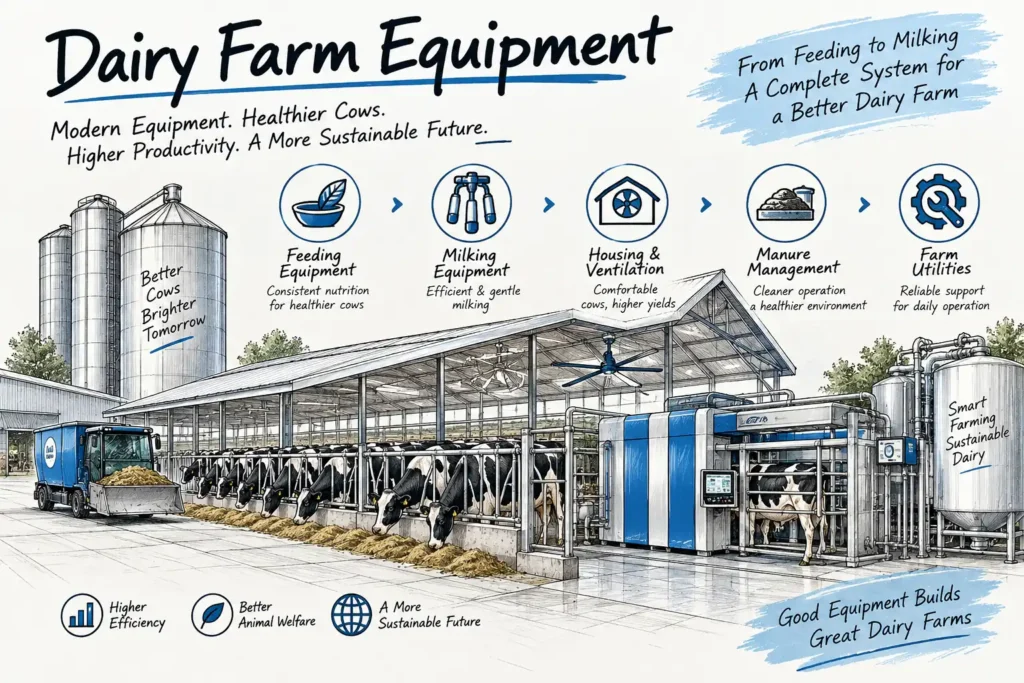
Dairy farm equipment is not one machine or one purchase list. It is the operating infrastructure that connects milking, feed delivery, water, cow comfort, manure handling, calf care, animal handling, and farm data. A useful equipment plan therefore starts with the work the dairy must perform every day, then matches machines and facilities to herd flow, labor, hygiene, utilities, climate, and future expansion.
As a planning rule—not a universal requirement—a new dairy should establish reliable process fit before adding automation. For an established dairy, a practical first question is where the current system creates a bottleneck: milking throughput, ration consistency, feed access, heat stress, manure movement, calf hygiene, treatment handling, or downtime. Penn State Extension similarly frames dairy facility and equipment decisions around operational needs, climate, costs, maintenance, cow comfort, health, and technology rather than a single universal equipment package.
1. What Equipment Does a Dairy Farm Need?
A complete dairy farm equipment plan normally covers several functional systems. Not every farm needs the same level of automation, but every farm needs a dependable way to complete the underlying task.
| System | Typical equipment | Main operating question |
|---|---|---|
| Milking and milk handling | Milking units or parlor/automatic milking system, vacuum and pulsation components, milk lines, receiver, milk cooling/storage | Can milk be harvested consistently, hygienically, and at the required throughput? |
| Feeding | Feed storage interfaces, loaders, TMR mixer, feed delivery equipment, feed push-up equipment | Can the correct ration be mixed and delivered consistently to each group? |
| Water | Troughs, bowls, valves, piping, pumps where required | Can cows access clean water reliably at peak demand? |
| Housing and cow comfort | Stalls or bedded areas, gates, lighting, bedding-handling tools | Does the facility support resting, movement, observation, and safe daily work? |
| Ventilation and cooling | Natural-ventilation openings, exhaust or circulation fans, controls, sprinklers where appropriate | Can the barn manage heat, moisture, air quality, and cow-level air movement? |
| Manure handling | Scrapers or flush components, pumps, conveyors/augers, storage interfaces, separators where justified | Can manure move from animal areas to storage or processing without creating a recurring bottleneck? |
| Calf care | Bottles/buckets or group feeders, mixing tools, pasteurization equipment where used, cleaning/drying equipment | Can feed be prepared and delivered hygienically and consistently? |
| Handling and treatment | Sorting gates, treatment pens, headlocks/stanchions, chutes or restraint points | Can one animal or a group be separated and handled safely? |
| Monitoring and automation | Activity sensors, sort gates, identification, milk or feed data systems, alarms | Does the data lead to a defined management action? |
| Maintenance and sanitation | Wash systems, brushes/tools, spare critical parts, lubrication/service tools, records | Can critical systems be cleaned, inspected, repaired, and returned to service quickly? |
The most useful way to read this list is as a dependency map. A high-capacity milking system still depends on cow flow, clean water, electrical supply, milk cooling, cleaning, and staff response. A TMR mixer still depends on ingredient storage, loading sequence, scales or measurement discipline, delivery access, and feed-bunk management. Manure equipment depends on the physical characteristics of the manure stream, barn layout, storage, and the destination of separated solids or liquids.
That is why dairy machinery should be specified by task, throughput, compatibility, and failure consequence, not by catalogue category alone.
2. Core Dairy Farm Equipment by Operating Function
Milking and milk handling
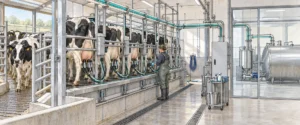
Milking equipment is the most obvious dairy-specific system, but the correct configuration depends on herd size, milking schedule, labor model, cow traffic, building layout, and the level of automation the farm can support. Conventional parlors and automatic milking systems solve the same basic task in different ways: move cows through a repeatable milking process, harvest milk, protect milk quality, and move milk into cooling/storage.
The machine is only part of the system. Penn State Extension notes that blocked air vents, damaged pulsation tubing, twisted liners, and restricted hoses can affect milking function and udder-health risk. That makes routine visual inspection, cleaning, service access, and spare-part planning part of equipment selection—not an afterthought.
Automatic milking requires even more system integration. Penn State Extension’s AMS guidance describes automatic milking as a coordinated system that affects housing, feeding, cow flow, special-needs handling, monitoring, and response to malfunctions. The purchase decision should therefore include staffing, technical support, data workflow, sort/treatment space, and backup procedures.
For U.S. Grade “A” operations, equipment choices also sit inside a regulatory framework. FDA notes that milk-safety requirements address the design of farm milking areas, milk heating/cooling/transport/storage, and the design and control of milking and processing equipment. Other countries and regions use their own rules, so local regulatory review belongs in the project specification.
Feeding and water systems
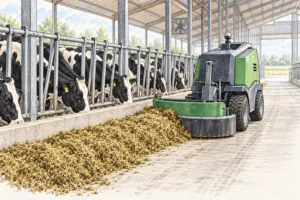
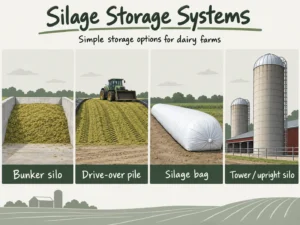
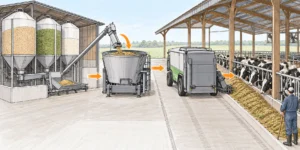
Feeding equipment should protect ration consistency from storage to the feed bunk. A typical mechanized workflow may include ingredient storage, loading equipment, a TMR mixer, a delivery vehicle or self-propelled unit, and feed push-up equipment. The exact combination depends on feed form, group strategy, building access, daily volume, labor, and whether the mixer must also process long forage.
Mixer configuration changes the operating procedure. University of Minnesota Extension gives different ingredient-loading sequences for auger and vertical mixers, illustrating why a “mixer is a mixer” approach is inadequate. The farm needs equipment that matches the ration and an SOP that matches the equipment.
Water equipment deserves the same planning attention. Troughs, bowls, piping, valves, pumps, and freeze protection where needed must maintain reliable access and be easy to clean. Penn State Extension emphasizes fresh, clean water across animal groups and regular waterer inspection and cleaning. When designing or upgrading a dairy, water capacity should be evaluated at the points where cows actually drink—not only at the source.
Housing, ventilation, cooling, and handling
Dairy barn equipment determines whether cows and people can move through daily routines without unnecessary conflict. Stalls or bedded areas, gates, feed barriers, headlocks, treatment pens, lighting, alley surfaces, bedding handling, and ventilation all interact with the building.
Ventilation equipment must be designed around the barn, not added as a collection of fans. Penn State Extension shows that tunnel systems depend on fan capacity, inlet sizing, barn cross-section, controls, and placement. UW–Madison Extension likewise explains that naturally ventilated barns may still need cow-level circulation fans and, in hotter conditions, evaporative cooling such as appropriately managed sprinklers. The engineering target is airflow where cows are located, with a design appropriate to climate and building geometry.
Handling equipment should make routine treatment possible without improvisation. Penn State Extension describes treatment pens, gates, stanchions/headlocks, chutes, and loading arrangements as parts of the handling system. The practical selection test is whether animals can be observed, separated, restrained, treated, and released with minimal risk to both cattle and workers.
3. How the Main Equipment Systems Work Together
The biggest equipment mistakes often occur at the interfaces between systems.
Milking ↔ cow flow. A parlor or automatic milking unit cannot deliver its theoretical capacity if holding areas, return lanes, sort gates, or treatment areas create congestion. Equipment layout should be checked against the actual path of lactating cows, fresh cows, lame cows, and animals needing treatment.
Feeding ↔ barn access. Mixer and delivery equipment must physically reach storage and feeding areas, turn safely, discharge where intended, and operate without blocking cow or worker movement. Feed push-up equipment must also fit the bunk and alley geometry.
Cooling ↔ water and power. Fans and sprinklers add electrical and water demand. Their controls, service access, drainage effects, and backup response should be designed with the utility system rather than treated as separate accessories.
Manure ↔ bedding and storage. Scrapers, pumps, channels, conveyors, and separators must match the material they receive and the next process step. UW–Madison Extension explains that screw-press separation creates solid and liquid output streams that then require separate management. A separator therefore does not eliminate manure handling; it changes the process train.
Calf feeding ↔ sanitation. Bottles, buckets, nipples, mixing tanks, hoses, pasteurizers, and automated feeders should be evaluated for cleanability as carefully as for feeding capacity. Penn State Extension notes that residues on feeding, mixing, and health equipment can support bacterial growth and emphasizes cleaning after use and following manufacturer directions.
Automation ↔ management response. Sensors and herd-management software create value only when alerts or measurements lead to a defined action. Before buying a monitoring system, decide who reviews the data, what thresholds trigger attention, what happens after an alert, and how the process works during connectivity or equipment failure.
A pillar equipment plan should therefore include an interface review: animal flow, material flow, water, power, drainage, data, cleaning access, service access, and backup procedures. That review often reveals more risk than comparing machine specifications in isolation.
4. How to Choose Dairy Farm Equipment
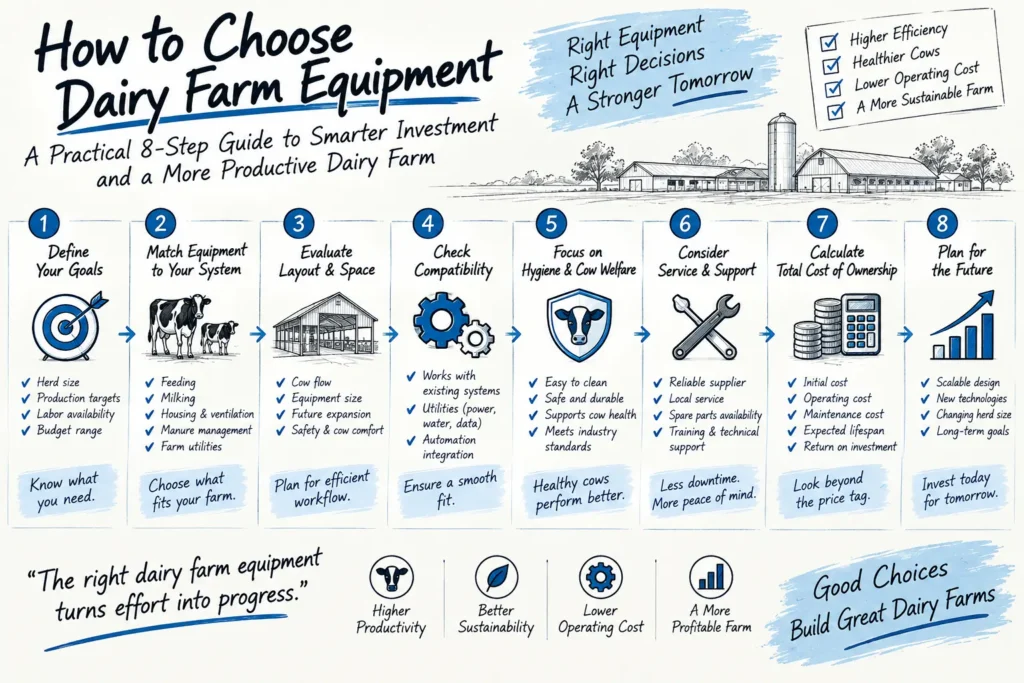
A structured dairy farm equipment selection process makes comparisons more useful and reduces the chance of overbuying automation while underfunding basic infrastructure.
Step 1 — Define the job and required throughput
Write down the task first: cows milked per shift, feed mixed and delivered per day, manure moved per day, groups served, treatment events, or the area requiring ventilation. Use the farm’s own operating data where available. Avoid choosing equipment solely from a herd-size label because two herds of the same size can have very different layouts, labor models, feeding programs, and milking schedules.
Step 2 — Map the physical workflow
Check equipment dimensions, turning space, door and alley clearances, floor loading, slopes, drainage, cow routes, feed routes, manure routes, and maintenance access. A machine that fits the production requirement but not the building is not a fit.
Step 3 — Check utilities and interfaces
List electrical service, water flow and pressure, drainage, compressed air if needed, network connectivity, fuel, hydraulic requirements, and any interface with existing machines. Include peak simultaneous demand rather than only individual equipment ratings.
Step 4 — Evaluate hygiene and cleanability
For milk-contact and calf-feeding equipment, hygienic design and cleaning access are core requirements. For manure and feed equipment, cleanout access still matters because buildup can reduce reliability and complicate maintenance. Confirm cleaning procedures, compatible chemicals, drainage, disassembly/CIP requirements where applicable, and safe worker access.
Step 5 — Compare serviceability and downtime risk
Ask what happens when the machine stops. Identify wear parts, expected service tasks, parts availability, technician response, remote support, software dependency, and whether the farm can continue operating in a degraded mode. Critical dairy farm equipment often deserves redundancy, spare parts, or a written backup procedure even when a duplicate machine is not economical.
Step 6 — Compare total ownership cost, not purchase price alone
When comparing dairy farm equipment, use total ownership cost rather than purchase price as the decision baseline. Include installation, building modification, electrical or plumbing work, controls, consumables, routine service, wear parts, software subscriptions, energy, water, training, and expected downtime exposure. ROI should be calculated from farm-specific baseline data rather than generic vendor percentages.
Step 7 — Decide what should be automated
As a planning heuristic, automation is easiest to justify when it removes a repeatable bottleneck, improves consistency, provides actionable data, or reduces exposure to a critical labor constraint. It is harder to justify when the upstream process is unstable. Standardize the process first, then automate the part that has a measurable management objective.
Step 8 — Plan for expansion and replacement
Consider whether the equipment can handle the next realistic production stage, whether controls are expandable, and whether adding capacity later requires replacing the whole system. At the same time, avoid buying excessive capacity that creates unnecessary capital and maintenance burden today.
A practical comparison matrix can score each option on task fit, throughput, layout fit, hygiene, utility demand, service support, downtime consequence, operating cost, data integration, and expansion path. Those criteria are more transferable than a universal ranked list of machines.
5. Maintenance, Sanitation, and Upgrade Priorities
The best dairy farm equipment plan includes maintenance before commissioning. Create an asset register, identify critical machines, record manufacturer service requirements, assign inspection responsibility, and keep a small set of high-consequence spare parts where appropriate.
Start with equipment whose failure can stop milking, feeding, water delivery, cooling, ventilation, or manure movement. For each critical asset, define:
- what operators inspect daily or per shift;
- what is cleaned and how often;
- which lubrication, adjustment, calibration, or service tasks are scheduled;
- what condition triggers part replacement;
- who is called when the fault exceeds on-farm capability; and
- what temporary operating procedure keeps animals and milk safe during downtime.
Sanitation should be treated as an equipment-design issue as well as an SOP issue. Milk-contact systems need surfaces, piping, and components that can be effectively cleaned and inspected. Calf-feeding equipment needs a workflow that prevents dirty and clean equipment from mixing and allows full draining/drying. Waterers need routine inspection and cleaning. These requirements should influence what is purchased and where it is installed.
When upgrading an existing dairy, a practical prioritization method is to rank constraints by their combined effect on animal welfare, milk/feed hygiene, daily continuity, labor exposure, and operating bottleneck. Depending on the farm, a lower-cost change in gates, water access, fan placement, feed delivery, or preventive maintenance may create more operational value than adding a sophisticated machine to a poorly coordinated system.
The core principle is simple: buy dairy farm equipment as a connected operating system. Define the work, verify the interfaces, plan the sanitation and maintenance path, then choose the level of mechanization or automation that the farm can reliably support.