A Real Farm Experience in Choosing the Right TMR Mixer
tmr mixer selection can have a bigger impact on a dairy farm than many farmers expect. The first time I helped a customer choose a machine, I learned that buying the largest model was not always the best decision. This TMR mixer guide is based on a real purchasing experience and shows how matching machine capacity to herd size can improve feeding efficiency while reducing operating costs.
A dairy farmer from Pakistan contacted us because his farm had expanded from 320 cows to 480 lactating cows within two years. His original feeding equipment required nearly an entire morning to prepare feed, delaying milking schedules and increasing labor expenses.
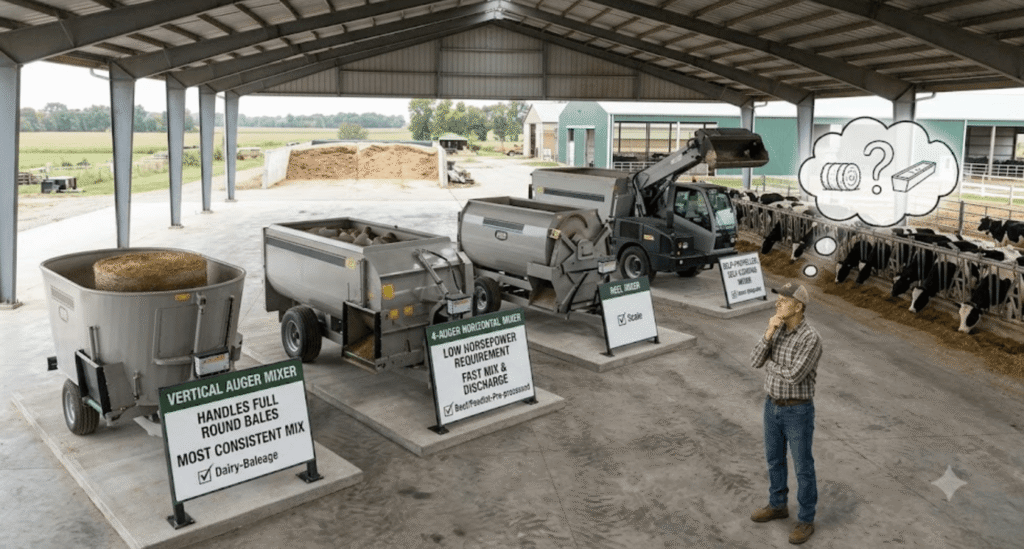
Initially, the farmer planned to purchase a 20 m³ tmr mixer because he believed larger equipment would save time. However, after reviewing his daily feeding requirements, we found a different solution.
Step 1: Calculate Daily Feed Requirement
The first step was determining the actual amount of Total Mixed Ration (TMR) needed each day.
| Item | Value |
|---|---|
| Lactating cows | 480 head |
| Average TMR intake | 45 kg/cow/day |
| Total feed required | 21,600 kg/day |
| Feed density | 320 kg/m³ |
| Total volume needed | 67.5 m³/day |
The farm fed cows twice per day, meaning each feeding required approximately: 67.5 ÷ 2 = 33.75 m³
Step 2: Compare Different Mixer Sizes
Instead of immediately selecting the largest machine, we compared several options.
| Mixer Capacity | Batches per Feeding | Daily Batches | Estimated Mixing Time |
|---|---|---|---|
| 12 m³ | 3 | 6 | 150 minutes |
| 16 m³ | 3 | 6 | 138 minutes |
| 20 m³ | 2 | 4 | 96 minutes |
| 24 m³ | 2 | 4 | 94 minutes |
Although the 24 m³ model was slightly faster, the difference was only 2 minutes per day, while the purchase price was considerably higher.
Step 3: Consider Future Expansion
The farmer planned to increase the herd to approximately 650 cows within three years.
Projected feed demand: 650 × 45 kg = 29,250 kg/day
At the same feed density: 29,250 ÷ 320 = 91.4 m³/day
A 20 m³ tmr mixer could still complete feeding in five batches per day, which remained practical without requiring another equipment upgrade.
Final Recommendation
After reviewing production goals, feeding frequency, labor availability, and future expansion, the farmer selected the 20 m³ tmr mixer instead of the larger 24 m³ model.
The decision reduced the initial equipment investment while leaving enough capacity for future herd growth.
Six Months Later
The farmer shared several operating results after six months.
| Performance Indicator | Before | After | Improvement |
|---|---|---|---|
| Mixing time/day | 170 min | 96 min | -43.5% |
| Feeding labor | 4 workers | 2 workers | -50% |
| Diesel consumption | 42 L/day | 30 L/day | -28.6% |
| Feed refusal | 8.2% | 4.9% | -40.2% |
| Daily milk yield | 31.6 L/cow | 32.9 L/cow | +1.3 L |
Besides reducing labor costs, the farm also noticed more consistent feed quality because every batch was mixed evenly. Cows spent less time sorting ingredients, and feed intake became more uniform throughout the herd.
TMR Mixers Explained: Types, Applications, and Vertical vs Horizontal Mixer Comparison
A Total Mixed Ration (TMR) mixer is a machine designed to combine forage, silage, grains, protein meals, minerals, vitamins, and feed additives into one uniform ration. Every bite contains the same nutritional balance, helping dairy and beef cattle receive consistent nutrition throughout the feeding period. Understanding vertical vs horizontal mixer differences is one of the most important steps when selecting the right equipment for a livestock farm.
Today, TMR mixers are widely used in dairy farms, beef cattle operations, sheep farms, and large-scale feed centers around the world. Modern mixers can improve feed consistency, reduce feed sorting, decrease labor requirements, and minimize feed waste.
Main Types of TMR Mixers
Globally, TMR mixers are generally divided into four major categories.
| Type | Mixing System | Typical Capacity | Best Application |
|---|---|---|---|
| Vertical TMR Mixer | One or more vertical augers | 3–46 m³ | Long-fiber forage, dairy farms |
| Horizontal TMR Mixer | Horizontal paddles or augers | 2–30 m³ | Fast mixing, feedlots |
| Reel Mixer | Rotating reel with paddles | 8–30 m³ | Medium fiber rations |
| Paddle Mixer | Paddle shaft system | 1–20 m³ | Fine ingredients and concentrate feeds |
Among these four designs, vertical and horizontal mixers account for the vast majority of TMR equipment used worldwide.
Vertical TMR Mixers
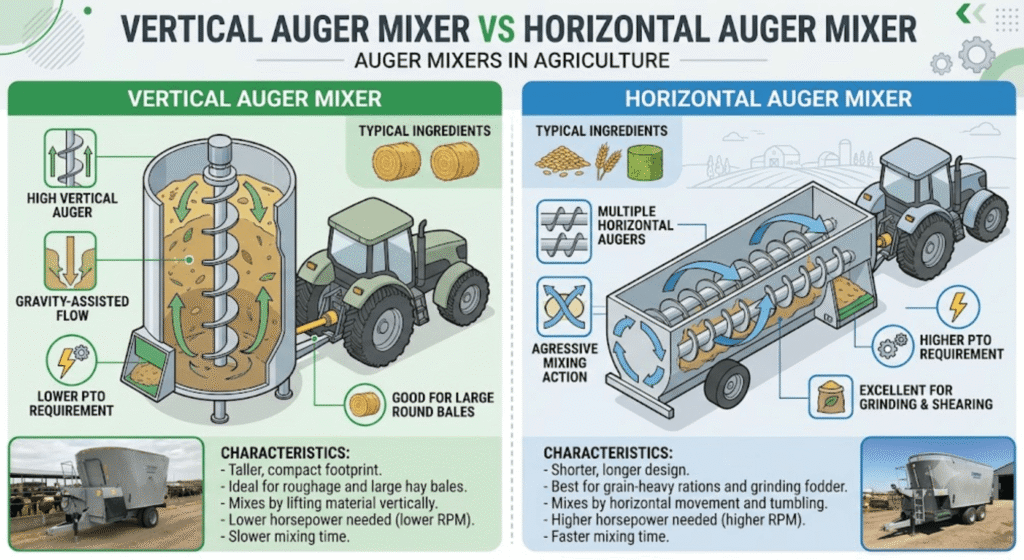
Vertical mixers use one, two, or three upright augers to lift and circulate feed continuously.
Advantages include:
- Excellent processing of round or square hay bales
- Better handling of long-fiber forage
- Lower ingredient separation
- Suitable for dairy farms feeding high-forage diets
Typical specifications:
| Specification | Typical Value |
|---|---|
| Capacity | 3–46 m³ |
| Mixing Time | 12–18 minutes |
| Fiber Length | Up to 300 mm |
| Herd Size | 50–3,000 cows |
Horizontal TMR Mixers
Horizontal mixers use augers, paddles, or ribbons that rotate horizontally to blend feed rapidly.
Advantages include:
- Faster mixing speed
- Lower machine height
- Suitable for chopped forage
- Popular in beef feedlots and commercial feed centers
Typical specifications:
| Specification | Typical Value |
|---|---|
| Capacity | 2–30 m³ |
| Mixing Time | 5–10 minutes |
| Fiber Length | Less than 100 mm |
| Herd Size | 30–1,500 cattle |
Vertical vs Horizontal Comparison
| Feature | Vertical Mixer | Horizontal Mixer |
|---|---|---|
| Long hay processing | Excellent | Limited |
| Mixing speed | Medium | Fast |
| Feed uniformity | Excellent | Very Good |
| Machine height | Taller | Lower |
| Maintenance | Lower | Moderate |
| Power requirement | Moderate | Higher for equal capacity |
| Best for | Dairy farms | Beef feedlots |
Which Type Is Most Popular?
Regional farming practices influence mixer selection.
| Region | Most Common Type |
|---|---|
| North America | Vertical Mixer |
| Europe | Vertical Mixer |
| Australia | Vertical Mixer |
| South America | Vertical Mixer |
| Large Beef Feedlots | Horizontal Mixer |
Industry estimates indicate that vertical TMR mixers account for approximately 65–75% of new dairy farm installations worldwide, primarily because they process long-fiber forage more effectively and produce highly uniform rations.
Choosing the Right Mixer
The best mixer depends on several factors:
| Selection Factor | Recommendation |
|---|---|
| Long hay or round bales | Vertical |
| Chopped forage | Horizontal |
| Dairy herd | Vertical |
| Beef feedlot | Horizontal |
| Large fiber content | Vertical |
| Fast batch turnover | Horizontal |
TMR mixers have become essential equipment for modern livestock farming because they improve feeding consistency, reduce labor, and support better animal performance. While several mixer designs are available worldwide, vertical and horizontal models remain the dominant choices. Selecting the right machine should be based on forage type, herd size, feeding frequency, and long-term production goals rather than purchase price alone.
Global TMR Mixer Manufacturers: Distribution, Price, Quality Comparison, and Key Buying Considerations
Modern TMR mixers are manufactured across Europe, North America, China, and Türkiye, serving dairy and beef farms of different sizes. In recent years, demand for the self propelled TMR mixer has increased because it combines loading, weighing, mixing, and feeding into one machine, reducing labor and improving feeding efficiency. However, manufacturers differ significantly in technology, quality, and price, making supplier selection just as important as choosing the right mixer capacity.
Major TMR Mixer Manufacturing Regions
| Region | Main Advantages | Typical Farm Size | Market Position |
|---|---|---|---|
| Europe | Advanced engineering, high durability | 200–5,000 cows | Premium |
| North America | Large-capacity equipment | 500–10,000 cows | Premium |
| China | Competitive pricing, rapid production | 50–3,000 cows | Value for money |
| Türkiye | Cost-effective, simple maintenance | 100–2,000 cows | Mid-range |
Representative Manufacturers
| Country/Region | Typical Products | Quality Level | Price Level |
|---|---|---|---|
| Italy | Vertical & self-propelled mixers | Excellent | $$$$ |
| Germany | Precision feeding systems | Excellent | $$$$ |
| Netherlands | Smart feeding equipment | Excellent | $$$$ |
| United States | Large horizontal mixers | Excellent | $$$$ |
| China | Vertical & horizontal mixers | Good–Very Good | $$ |
| Türkiye | Vertical mixers | Good | $$ |
Typical Price Range
Prices vary depending on capacity, materials, weighing systems, and automation.
| Mixer Type | Capacity | Typical Price (USD) |
|---|---|---|
| Trailed Vertical | 8–12 m³ | 12,000–22,000 |
| Trailed Vertical | 16–24 m³ | 22,000–40,000 |
| Horizontal Mixer | 12–20 m³ | 25,000–45,000 |
| Stationary Mixer | 20–40 m³ | 30,000–80,000 |
| Self-Propelled Mixer | 14–32 m³ | 120,000–300,000 |
Quality Comparison
| Evaluation Item | Premium Brands | Mid-range Brands | Budget Brands |
|---|---|---|---|
| Steel quality | Excellent | Good | Fair–Good |
| Mixing uniformity | Excellent | Very Good | Good |
| Hydraulic system | Excellent | Good | Moderate |
| Weighing accuracy | ±0.5% | ±1.0% | ±1.5% |
| Spare parts availability | Excellent | Good | Varies |
| Service life | 12–20 years | 8–15 years | 5–10 years |
Key Points to Confirm Before Purchasing
| Item to Confirm | Why It Matters |
|---|---|
| Actual mixer capacity | Matches daily feed requirements |
| Mixer type | Vertical or horizontal based on forage |
| Steel thickness and wear liner | Determines durability |
| Weighing system accuracy | Ensures consistent rations |
| Gearbox and hydraulic brands | Affects long-term reliability |
| Local spare parts inventory | Reduces downtime |
| Warranty period | Protects investment |
| Technical support | Faster troubleshooting |
| Tractor horsepower (if trailed) | Prevents overload |
| Future herd expansion | Avoids premature replacement |
Common Buying Traps
| Trap | Better Practice |
|---|---|
| Choosing the lowest price | Compare total ownership cost |
| Oversizing the mixer | Size according to daily feed volume |
| Ignoring after-sales service | Verify local dealer support |
| Focusing only on capacity | Evaluate mixing quality and reliability |
| Not requesting a demonstration | Test with your own feed ingredients |
A high-quality TMR mixer is not always the most expensive one. European and North American manufacturers generally lead in technology, automation, and long-term durability, while Chinese manufacturers often provide excellent value with competitive pricing and increasingly reliable quality. Before making a purchase, buyers should compare not only the initial equipment cost but also mixing performance, weighing accuracy, spare parts availability, maintenance requirements, and after-sales support. Selecting a manufacturer that offers dependable service and a machine matched to the farm’s feeding system will usually deliver a better return on investment than simply choosing the lowest-priced option.
TMR Mixer Calculation Formulas with Real Farm Examples: Cost, Capacity, and ROI Analysis
TMR mixer maintenance calculation is essential when evaluating the long-term cost of feeding equipment. Many dairy farms focus only on the purchase price but ignore fuel consumption, labor, depreciation, and repair expenses. A complete calculation helps farmers understand the actual operating cost and investment return of a TMR mixer.
When calculating dairy equipment cost, farmers should include all expenses during the equipment lifetime, not only the initial investment. The following formulas provide practical calculation methods with real examples.
1. TMR Mixer Capacity Calculation Formula
The correct mixer size depends on daily feed demand, feeding frequency, and feed density.
Formula:
Daily Feed Requirement (kg/day) = Number of Cows × Daily TMR Intake (kg/cow/day)
Mixer Capacity (m³) = Feed Weight per Batch (kg) ÷ Feed Density (kg/m³) ÷ Loading Rate
Example:
A dairy farm has:
| Item | Data |
|---|---|
| Lactating cows | 600 cows |
| Daily TMR intake | 45 kg/cow/day |
| Feeding frequency | 2 times/day |
| Feed density | 320 kg/m³ |
| Recommended loading rate | 85% |
Calculation:
Daily feed requirement: 600 × 45 = 27,000 kg/day
Feed per feeding: 27,000 ÷ 2 = 13,500 kg
Basic mixer volume: 13,500 ÷ 320 = 42.2 m³
Considering 85% loading: 42.2 ÷ 0.85 = 49.6 m³
Recommended mixer: 50 m³ TMR mixer
2. Daily Operating Cost Calculation Formula
The daily operating cost includes fuel and labor.
Formula:
Daily Cost = Fuel Cost + Labor Cost
Example:
| Item | Calculation | Daily Cost |
|---|---|---|
| Diesel consumption | 30 L/day × $1.20/L | $36 |
| Operator labor | 2 hours × $15/hour | $30 |
| Total daily cost | $66/day |
Annual operating cost: $66 × 300 working days = $19,800/year
3. Annual TMR Mixer Ownership Cost Formula
Total annual ownership cost includes:
- Depreciation
- Maintenance
- Insurance
- Interest cost
Formula:
Annual Ownership Cost = Purchase Price ÷ Service Life + Maintenance Cost
Example:
| Item | Data |
|---|---|
| Mixer purchase price | $80,000 |
| Service life | 10 years |
| Maintenance rate | 5% |
Depreciation: $80,000 ÷ 10 = $8,000/year
Maintenance: $80,000 × 5% = $4,000/year
Total ownership cost: $8,000 + $4,000 = $12,000/year
4. TMR Mixer Maintenance Cost Formula
Maintenance cost changes according to working intensity.
Formula:
Annual Maintenance Cost = Equipment Price × Maintenance Rate
| Machine Usage | Recommended Maintenance Rate |
|---|---|
| Light use | 2–3%/year |
| Normal dairy operation | 4–6%/year |
| Heavy commercial use | 7–10%/year |
Example:
Mixer price: $100,000
Normal maintenance rate: 5%
Annual maintenance: 100,000 × 5% = $5,000/year
5. Cost per Cow Calculation Formula
This shows how much the mixer costs for each animal.
Formula:
Cost per Cow per Year = Annual Equipment Cost ÷ Number of Cows
Example:
| Item | Value |
|---|---|
| Annual equipment cost | $35,000 |
| Herd size | 700 cows |
Calculation: $35,000 ÷ 700 = $50/cow/year
Daily cost: $50 ÷ 365 = $0.14/cow/day
6. ROI Calculation Formula
ROI helps farmers estimate how quickly the investment can be recovered.
Formula:
ROI Period (Years) = Equipment Investment ÷ Annual Savings
Example:
| Item | Before TMR Mixer | After TMR Mixer |
|---|---|---|
| Labor cost/year | $45,000 | $20,000 |
| Feed waste/year | $30,000 | $18,000 |
| Total annual saving | $37,000 |
Mixer investment: $100,000
ROI: $100,000 ÷ $37,000= 2.7 years
7. Lifetime Cost Comparison Example
| Item | Standard Mixer | Premium Mixer |
|---|---|---|
| Purchase price | $60,000 | $100,000 |
| Service life | 7 years | 12 years |
| Annual maintenance | $4,000 | $5,000 |
| Lifetime maintenance | $28,000 | $60,000 |
| Total lifetime cost | $88,000 | $160,000 |
The premium machine costs more initially but may provide better reliability, higher resale value, and lower downtime.
Essential TMR Mixer Calculation Checklist
| Calculation | Formula |
|---|---|
| Feed requirement | Cow number × Feed intake |
| Mixer size | Batch weight ÷ Feed density ÷ Loading rate |
| Fuel cost | Daily liters × Fuel price |
| Maintenance | Equipment price × Maintenance rate |
| Cost per cow | Annual cost ÷ Cow number |
| ROI | Investment ÷ Annual savings |
A correct TMR mixer calculation allows dairy farmers to select equipment based on real production needs. The best choice is not always the largest or cheapest machine, but the one that provides the lowest total cost per kilogram of feed and the highest return throughout its working life.
Top 5 Common Traps When Buying and Operating a TMR Mixer
Choosing a TMR mixer is a long-term investment for dairy farms. Many farmers focus only on the purchase price but ignore capacity matching, operating costs, and after-sales support. The following are the top 5 common traps that can cause unnecessary expenses and lower feeding efficiency.
Trap 1: Buying a Mixer That Is Too Large
Many farmers believe a larger mixer always means better performance. However, an oversized machine often works below its designed efficiency.
| Item | Example Data |
|---|---|
| Farm size | 300 cows |
| Daily TMR requirement | 13,500 kg/day |
| Required mixer volume | 25 m³ |
| Purchased mixer | 45 m³ |
| Average loading rate | 55% |
Problems:
- Higher purchase cost: +$20,000–$40,000
- Higher fuel consumption: +5–10 L/day
- Longer mixing time for small batches
- More difficult operation
Recommended:
Keep normal loading efficiency at 80–90% of rated capacity.
Trap 2: Choosing Only by Lowest Price
A low-price mixer may reduce initial investment but increase lifetime costs.
| Comparison | Budget Mixer | Premium Mixer |
|---|---|---|
| Purchase price | $50,000 | $85,000 |
| Service life | 6 years | 12 years |
| Annual maintenance | $6,000 | $3,500 |
| Downtime/year | 10 days | 2 days |
| Lifetime cost | $86,000 | $127,000 |
The cheapest machine is not always the lowest-cost solution.
Confirm:
- Steel thickness
- Gearbox quality
- Hydraulic system
- Wear liner material
- Spare parts availability
Trap 3: Ignoring Feed Characteristics
Different farms use different feed materials. Selecting the wrong mixer type can reduce mixing quality.
| Feed Type | Recommended Mixer | Wrong Choice Result |
|---|---|---|
| Long hay (300 mm+) | Vertical mixer | Poor cutting performance |
| Corn silage | Vertical/Horizontal | Usually acceptable |
| Chopped forage (<100 mm) | Horizontal mixer | Longer mixing time with vertical |
| High straw ration | Vertical mixer | Fiber not processed properly |
Before buying, confirm:
- Maximum forage length
- Bale type
- Moisture level
- Feed density
Trap 4: Ignoring Tractor and Power Requirements
A mixer must match available tractor power. Insufficient horsepower causes slow operation and higher wear.
| Mixer Capacity | Required Tractor Power |
|---|---|
| 8–10 m³ | 60–80 HP |
| 12–16 m³ | 80–110 HP |
| 18–24 m³ | 110–150 HP |
| 30–40 m³ | 180–250 HP |
Example:
A 24 m³ mixer requiring 130 HP connected to a 90 HP tractor may cause:
| Problem | Impact |
|---|---|
| Mixing speed reduction | 20–40% slower |
| Fuel consumption increase | +15–25% |
| PTO overload risk | High |
Trap 5: Forgetting After-Sales Service
Many farmers check specifications but ignore service capability.
| Item to Confirm | Recommended Standard |
|---|---|
| Warranty period | ≥12 months |
| Spare parts availability | Within 7 days |
| Technical response time | Within 24–48 hours |
| Knife replacement interval | 500–1,000 working hours |
| Gearbox inspection | Every 1,000 hours |
A mixer failure during feeding season can directly affect cow performance.
Example:
| Situation | Loss |
|---|---|
| Mixer downtime | 5 days |
| Farm size | 500 cows |
| Feed cost/cow/day | $8 |
| Extra labor and emergency feeding | $2,000–$5,000 |
Final Checklist Before Purchasing
| Question | Confirm |
|---|---|
| Is capacity matched to current herd size? | ✓ |
| Is 20–30% future expansion included? | ✓ |
| Is loading efficiency above 80%? | ✓ |
| Does it match forage type? | ✓ |
| Is tractor horsepower sufficient? | ✓ |
| Are spare parts available locally? | ✓ |
| Has the machine been tested on a real farm? | ✓ |
The biggest mistake when buying a TMR mixer is focusing only on the purchase price. A correct decision should consider capacity, feed materials, power requirements, maintenance cost, and service support. The right mixer is the one that provides the lowest cost per ton of mixed feed throughout its entire working life.