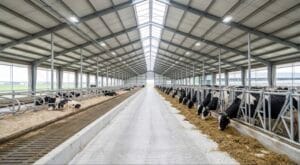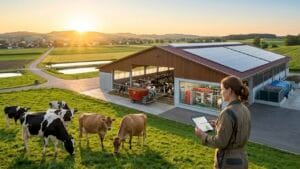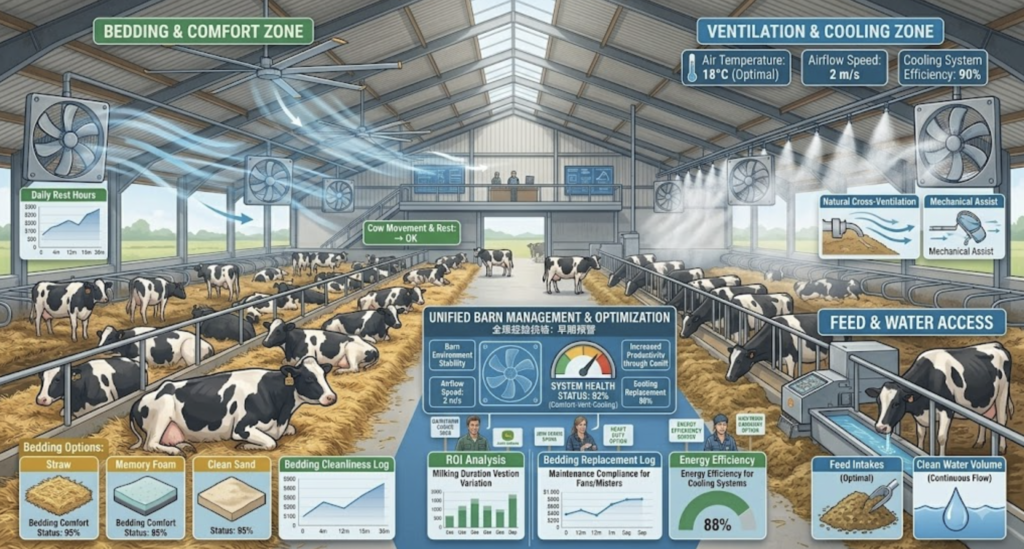
Cow comfort starts with three fundamentals: a clean and comfortable resting area, fresh moving air, and effective cooling during hot weather. In a dairy barn, these systems are connected. Wet bedding can discourage lying, weak ventilation can increase moisture, and heat stress can cause cows to spend more time standing instead of resting.
For beginners, the easiest way to evaluate a barn is to focus on three pillars: bedding and stalls, ventilation and airflow, and heat-abatement equipment. Then watch cow behavior and use monitoring data to identify which area needs attention first.
University of Minnesota Extension identifies appropriate resting space, heat abatement, ventilation, stocking density, cow flow, and access to feed and water as important parts of dairy cow comfort. (University of Minnesota Extension)
University of Minnesota Extension – Why Cow Comfort Matters
The practical process is simple:
Rest → Fresh air → Cooling → Observe → Measure → Improve
Quick Answer: The 3 Pillars of Cow Comfort
| Pillar | Main Goal | What to Watch |
|---|---|---|
| Bedding & stalls | Provide a clean, dry resting area | Stall use, cleanliness, moisture |
| Ventilation | Remove heat and moisture | Air quality, humidity, airflow |
| Cooling | Help cows lose excess heat | Panting, standing, bunching |
| Monitoring | Detect changes early | Activity, rumination, lying behavior |
| Maintenance | Keep systems performing | Fans, sprinklers, bedding, controls |
The key point is that cow comfort is not one piece of equipment. A farm can install good fans but still have problems if stalls remain wet, cows are overcrowded, or cooling does not reach the animals.
1. What Does Good Cow Comfort Look Like?
Good cow comfort means cows can rest on a clean, usable surface, move safely, access feed and water, breathe fresh air, and release excess body heat during hot conditions.
Instead of judging the barn only by how modern it looks, observe how cows actually use it.
Key Barn Comfort Indicators
| What to Observe | Desired Condition | Warning Sign |
|---|---|---|
| Resting area | Cows readily use stalls | Excessive standing |
| Bedding | Clean and dry | Wet or contaminated |
| Air | Fresh and moving | Humid/stale areas |
| Heat response | Normal breathing | Panting/bunching |
| Feed access | Normal access | Heavy competition |
| Water | Clean and accessible | Crowding |
| Flooring | Confident movement | Slipping/hesitation |
| Cow cleanliness | Relatively clean animals | Dirty flanks/udders |
These signs do not diagnose a problem by themselves. They tell you where to start looking.
For example, cows standing for long periods may be responding to heat, uncomfortable stalls, wet bedding, overcrowding, hoof problems, or management routines. Do not immediately assume that one piece of dairy barn equipment needs replacing.
Let the Cows Show You Where to Look
A short walk through the barn can reveal a surprising amount of information.
Look for cows that:
- avoid a particular row of stalls;
- crowd around specific fans;
- stand when most of the group should be resting;
- bunch tightly together;
- pant during warm periods;
- hesitate on slippery flooring;
- become unusually dirty.
Heat deserves particular attention. University of Minnesota Extension reports that heat stress increases respiration rate, body temperature, sweating, and standing time. Its current guidance uses a Temperature-Humidity Index (THI) below 68 as the no-heat-stress category, while 68–71 represents mild heat stress. (University of Minnesota Extension)
| THI | UMN Heat-Stress Category | Respiration Rate |
|---|---|---|
| <68 | No heat stress | 40–60 breaths/min |
| 68–71 | Mild | 60–75 breaths/min |
| 72–79 | Mild to moderate | 75–85 breaths/min |
| 80–90 | Moderate to severe | 85–100 breaths/min |
| 90–99 | Severe | 100–104 breaths/min |
University of Minnesota Extension – Heat Stress in Dairy Cattle
For beginners, this table provides a useful reference, but THI should not be used alone. Cow response, airflow, solar exposure, milk production level, and local barn conditions also matter.
2. Pillar One: How Should Dairy Bedding and Stalls Be Managed?
The first physical foundation of cow comfort is the resting area.
A cow is more likely to use a stall when it is clean, dry, appropriately sized, and easy to enter and leave. University of Minnesota Extension notes that appropriate stall design, size, and bedding management can improve bed use and lying time. (University of Minnesota Extension)
Which Bedding Material Is Best?
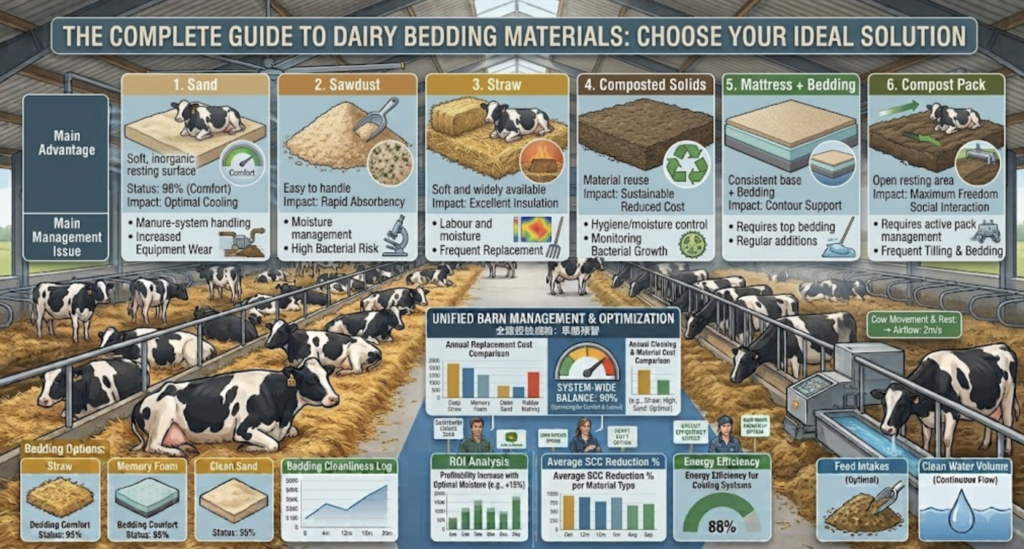
There is no single bedding material that is best for every dairy.
The choice needs to fit the cows and the farm’s labor, manure handling, climate, availability, and cost.
| Bedding Type | Main Advantage | Main Management Issue |
|---|---|---|
| Sand | Soft inorganic resting surface | Manure-system handling |
| Sawdust | Easy to handle | Moisture management |
| Straw | Soft and widely available in some regions | Labor and moisture |
| Composted solids | Material reuse | Hygiene/moisture control |
| Mattress + bedding | Consistent base | Requires top bedding |
| Compost pack | Open resting area | Requires active pack management |
The mistake beginners sometimes make is selecting bedding only by purchase price.
Consider the entire system:
Bedding → Stall → Collection → Separation → Storage
For example, sand may work very well as a resting material but requires a manure-handling setup capable of dealing with sand.
That is why bedding choice should be part of the overall dairy barn design, not a separate purchasing decision.
Why Bedding Moisture Matters
Wet bedding can make the resting area less attractive and more difficult to manage.
If bedding repeatedly stays wet, simply adding more material may hide the underlying problem. Check:
- drainage;
- bedding depth;
- water leaks;
- manure contamination;
- stocking density;
- airflow.
Compost-bedded packs require particularly active moisture management. University of Minnesota Extension recommends keeping compost bedding below approximately 65% moisture, providing at least 100 ft² per Holstein-sized cow and 85 ft² per Jersey, and aerating the pack at least twice daily to a depth of roughly 10 inches or more. (University of Minnesota Extension)
| Compost-Pack Reference | UMN Guidance |
|---|---|
| Holstein-sized resting area | ≥100 ft²/cow |
| Jersey resting area | ≥85 ft²/cow |
| Bedding moisture | <65% |
| Aeration | 2× daily |
| Aeration depth | ≥10 in |
University of Minnesota Extension – Compost-Bedded Pack Barns
These values apply specifically to compost-bedded pack management and should not be treated as universal requirements for every bedding system.
That distinction is important when comparing barn designs.
3. Pillar Two: How Much Ventilation and Airflow Do Dairy Cows Need?
A good ventilation system has two related jobs:
Air exchange removes heat and moisture from the barn; airspeed over the cow helps increase heat loss.
They are not exactly the same thing.
A barn can exchange air but still have weak air movement around cows. Likewise, a circulation fan can produce strong local airspeed without providing the total fresh-air exchange the building needs.
Natural vs. Mechanical Ventilation
| System | How Air Moves | Main Advantage | Main Limitation |
|---|---|---|---|
| Natural | Wind + thermal effects | Low mechanical energy use | Weather-dependent |
| Tunnel | Fans move air lengthwise | Controlled airflow | Requires suitable barn design |
| Cross ventilation | Fans move air across barn width | Useful for enclosed facilities | More mechanical complexity |
| Hybrid | Natural + mechanical | Flexible operation | Requires coordinated controls |
The correct choice depends on climate, barn dimensions, cow density, openings, prevailing wind, and the existing building.
During hot weather, University of Minnesota Extension recommends maximizing air exchange and gives approximately 60–90 air exchanges per hour as a usual hot-weather range. (University of Minnesota Extension)
That does not mean every barn should simply be designed to one universal number. Mechanical ventilation requires engineering based on actual building dimensions, fan performance, inlets, static pressure, and climate.
How Much Airspeed Is Needed at Cow Level?
For dry-cow heat abatement, UW–Madison Extension recommends air velocities of at least 2.5 mph, with 4–6 mph preferred over feed and resting areas. (Dairy Extension Wisconsin)
Another UW–Madison dairy-facility reference recommends no less than approximately 200 ft/min (2.3 mph) and ideally around 400 ft/min (4.6 mph) reaching the cow zone in resting areas. (Dairy Extension Wisconsin)
The practical lesson is more important than memorizing one number:
Measure airflow where cows stand and lie.
Do not judge the ventilation system only by looking at whether the fan blades are turning.
A handheld anemometer can help identify dead zones, particularly:
- between fan coverage areas;
- at the feed bunk;
- over stalls;
- inside holding areas;
- around structural obstructions.
Maintain Fans Before Hot Weather
Fan performance can deteriorate gradually.
University of Minnesota Extension reports that poorly maintained fans may move only 40–60% of normal fan capacity and recommends checking slipping belts and dirty or corroded louvers. (University of Minnesota Extension)
| Component | What to Check |
|---|---|
| Fan blades | Dirt accumulation |
| Shutters/louvers | Full opening |
| Belts | Tension and wear |
| Pulleys | Alignment |
| Motors | Heat and noise |
| Guards | Obstruction |
| Air inlets | Blockage |
| Curtains | Correct position |
| Controls/sensors | Correct operation |
Even correctly sized dairy barn equipment cannot perform as intended if it is dirty, damaged, or poorly adjusted.
Inspecting fans before summer is much easier than repairing them during a heat event.
4. Pillar Three: How Should a Dairy Barn Cooling System Control Heat Stress?
Ventilation supplies and moves air. A cooling system adds heat-abatement methods that help cows lose body heat when environmental conditions become challenging.
High-producing cows deserve particular attention because they generate substantial metabolic heat. University of Minnesota Extension notes that high-producing cows may begin experiencing heat stress at air temperatures as low as 65°F (18.3°C), even in well-ventilated barns. (University of Minnesota Extension)
Fans, Soakers, Sprinklers and Other Cooling Methods
| Cooling Method | Main Function | Typical Application |
|---|---|---|
| Fans | Increase airspeed | Stalls, feed bunk, holding pen |
| Soakers | Wet cow skin | Feed line/holding area |
| Sprinklers | Apply larger water droplets | Heat-abatement zones |
| Fog/mist | Cool incoming air through evaporation | Suitable engineered systems |
| Shade | Reduce solar heat load | Outdoor areas |
| Automated controls | Activate cooling by environmental conditions | Modern barns |
Water-based cooling must be designed carefully.
Too little water may provide inadequate wetting, while excessive water can enter manure systems, wet bedding, or create other management problems.
For low-pressure sprinklers, University of Minnesota Extension recommends cycling sprinklers on and off rather than operating them continuously; evaporation during the off cycle contributes to cooling. (University of Minnesota Extension)
Are Fans Alone Enough?
Not always.
A 2025 Penn State Extension dry-cow heat-abatement analysis reports that fans alone were insufficient in the Northeast research it discusses and recommends combining fans with sprinklers for the dry-cow conditions covered by that guidance. (Penn State Extension)
The example system Penn State analyzed for a dry-cow facility used:
| Example System Item | Value |
|---|---|
| Panel fans | 11 × 50 in |
| Approx. power/fan | 1 kW |
| Sprinkler pipe | 164 ft |
| Nozzles | 24 |
| Flow/nozzle | 0.75 gal/min |
| Sprinkler cycle | 1 min ON / 15 min |
| Estimated installation cost | $19,000 |
These numbers describe Penn State’s specific example system, not a universal design or cost estimate for dairy barns. (Penn State Extension)
Penn State Extension – Dry Cow Heat Stress Abatement
This distinction matters because fan quantity, water flow, electricity use, and installation cost vary considerably by barn size, climate, equipment, and local construction costs.
Which Barn Areas Need Cooling First?
Cooling should follow cow traffic.
| Area | Relative Heat Risk | Cooling Priority |
|---|---|---|
| Holding pen | Very high | Highest |
| Feed bunk | High | High |
| Freestalls/resting area | High | High |
| Dry-cow housing | High | High |
| Return alley | Medium | Situation-dependent |
| Outdoor areas | Climate-dependent | Site-dependent |
Holding areas deserve special attention because cows may be packed closely together.
University of Minnesota Extension notes that cows can spend up to about one hour in a holding area, where crowding reduces airflow around individual animals. (University of Minnesota Extension)
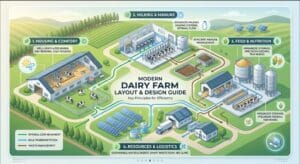
A good dairy barn design therefore considers the cow’s complete route:
Resting area → feed/water → holding area → milking → return
Cooling one section well while creating a hot bottleneck elsewhere reduces the benefit.
How Do You Know Cooling Is Not Working?
Watch the cows.
Important warning signs include:
- faster respiration;
- panting;
- drooling;
- bunching;
- increased standing;
- lower feeding activity;
- crowding around water.
University of Minnesota Extension lists normal adult dairy-cow respiration at approximately 40–60 breaths/min and states that if more than 10% of cows exceed 100 breaths/min, the situation should be considered an emergency requiring immediate action. (University of Minnesota Extension)
That gives managers something more useful than simply asking, “Does the barn feel hot to me?”
5. How Do You Measure and Improve Cow Comfort?
The final step is connecting bedding, ventilation, cooling, and cow behavior.
Do not start by asking:
“What equipment should we buy?”
Start with:
“What are the cows showing us?”
Troubleshoot the Barn From Cow Behavior
| What You See | Possible Cause | First Check |
|---|---|---|
| Excessive standing | Stall or heat problem | Bedding + temperature |
| Bunching | Heat, flies or airflow | Environment |
| Wet bedding | Moisture/drainage | Bedding + ventilation |
| One stall row avoided | Stall/airflow problem | Stall + fan coverage |
| Panting | Heat load | Cooling equipment |
| Dirty cows | Bedding/manure issue | Stall + cleaning |
| Rumination changes | Multiple possible causes | Cow + environment |
| Hot holding area | Crowding/weak cooling | Fans + water |
This table is a troubleshooting guide, not a diagnosis.
For example, reduced rumination can have nutritional, health, environmental, or management causes. Use the observation to decide what should be investigated next.
How Can a Cow Monitoring System Help?
A cow monitoring system can add another layer of information by tracking activity, rumination, lying, standing, feeding, location, or body-related measurements depending on the technology.
The useful signal is often change from normal, rather than one number that supposedly fits every cow.
For example:
Normal rumination → sustained decline → investigate cow, feed and environment
Normal lying pattern → sudden change → inspect stalls, heat load and management
This is where digital technology becomes useful for cow comfort management: it can identify a change earlier, while people determine what caused it.
Daily Cow Comfort Checklist
| Check | Look For |
|---|---|
| Stalls | Dry bedding + normal use |
| Cows | Standing, panting, bunching |
| Fans | Running + unobstructed |
| Cooling | Water coverage + controls |
| Water | Cleanliness + access |
| Flooring | Slipping or hesitation |
| Monitoring | Unusual behavior changes |
This routine does not need to take hours.
A short, consistent barn walk is more valuable than an elaborate checklist that employees stop using after a week.
30-Day Barn Improvement Plan
| Period | Action |
|---|---|
| Days 1–3 | Observe lying, standing and bunching |
| Days 4–7 | Evaluate bedding condition |
| Week 2 | Measure airflow at cow level |
| Week 2 | Inspect fans and controls |
| Week 3 | Check cooling coverage |
| Week 3 | Review holding-area conditions |
| Week 4 | Compare behavior after corrections |
| Day 30 | Prioritize the next improvement |
Do not try to rebuild the entire barn at once.
Find the weakest point → correct it → measure the response → move to the next problem.
That approach is usually easier to manage and makes it clearer whether an improvement actually worked.
Frequently Asked Questions
What are the three most important parts of cow comfort?
For barn environmental management, three major pillars are a comfortable resting area, effective ventilation, and heat abatement. Feed and water access, flooring, stocking density, cow health, lighting, and cow flow also contribute to overall comfort. (University of Minnesota Extension)
Which bedding is best for dairy cows?
There is no universal best choice. Bedding should provide a clean, dry, comfortable resting surface while fitting the farm’s labor, manure-handling system, climate, and management capabilities.
How much airspeed do dairy cows need?
For dry-cow heat abatement, UW–Madison Extension recommends at least 2.5 mph, with 4–6 mph preferred over feed and resting areas under the conditions described in its guidance. (Dairy Extension Wisconsin)
Are fans enough to cool dairy cows?
Not always. In hot conditions, airflow may need to be combined with soakers or sprinklers. Penn State’s 2025 dry-cow guidance recommends both fans and sprinklers for the Northeast conditions it discusses. (Penn State Extension)
How can you tell if cows are becoming heat stressed?
Increasing respiration is one of the quickest practical indicators. UMN lists approximately 40–60 breaths/min as normal for adult dairy cattle, with respiration increasing as heat stress becomes more severe. (University of Minnesota Extension)
Management and Engineering Note
The numerical values in this guide come from cited extension guidance or are clearly labeled management examples. They should not be treated as universal engineering specifications.
Final dairy barn design, stall dimensions, fan quantity, air distribution, sprinkler flow, electrical requirements, drainage, bedding system, and equipment placement should reflect the actual herd, building, climate, local regulations, and equipment-manufacturer specifications.
Conclusion
Strong cow comfort comes from a barn where cows can rest comfortably, breathe fresh moving air, and release excess heat during hot weather.
Bedding, the ventilation system, and the cooling system should therefore be managed as one environment rather than as three unrelated equipment projects.
Start by watching the cows.
Excessive standing, bunching, wet bedding, panting, avoided stalls, or unusual changes detected by a cow monitoring system can point to areas that deserve closer inspection.
The practical process is:
Observe → Measure → Find the weakest point → Correct it → Measure again
Good dairy barn design and correctly selected dairy barn equipment make that process easier, but daily management determines whether the barn continues to perform as intended.
The goal is not simply a modern-looking facility. It is a barn cows consistently choose to rest, eat, drink, and move through comfortably.
Recommended Resources
- Dairy Farm Machine – Dairy Farm Equipment
- University of Minnesota Extension – Why Cow Comfort Matters
- University of Minnesota Extension – Heat Stress in Dairy Cattle
- University of Minnesota Extension – Compost-Bedded Pack Barns
- UW–Madison Dairy Extension – Dry Cow Heat Stress Management
- UW–Madison Dairy Extension – Heat Stress Abatement in Dairy Facilities
- Penn State Extension – Dry Cow Heat Stress Abatement
- International Dairy Federation (IDF)
- FAO – Dairy Production and Products
- National Dairy FARM Program
- Journal of Dairy Science
- Progressive Dairy
- Dairy Herd Management