
Define the Drinking-Water Equipment Brief
Begin dairy water trough selection with the group and installation site. Compare storage capacity, refill conditions, drinking access and cleaning arrangements separately, then ask each supplier to price the same scope. A larger tank does not answer every question in that comparison.
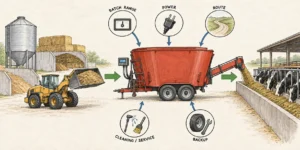
Start a brief with the group identity, animal numbers and class, location, existing water supply and proposed installation. Name the person who will agree the requirements and the person who will operate and clean the equipment. The dairy farm equipment guide places the water system alongside the farm’s other equipment and utility interfaces.
SDSU Extension identifies animal size, milk production, feed intake and moisture, weather and water availability among the factors affecting a lactating cow’s drinking. Give the farm advisor that context before setting a demand allowance; a herd count alone leaves important inputs unresolved.
Use the brief to distinguish a replacement at an existing point from a new installation. For a replacement, record the problem the purchase must resolve: access, refill, cleaning or another identified limitation. For a new location, arrange the supply and layout assessment before treating a catalogue model as a fit.
Record Site Inputs Before Comparing Troughs
Walk the proposed location with the feeder, installer and purchasing lead. Mark the drinking approach, passing route, cleaning position and intended drainage route on the same sketch. This makes a supplier’s proposed footprint easier to assess than a list of external dimensions alone.
Nebraska Extension lists poor placement, slippery or muddy surfaces and overcrowding among access problems. Ritchie also advises considering drainage and access for cleaning and maintenance when locating its waterers.
| Proposed brief field | Evidence to request |
|---|---|
| Group and use pattern | Group identity, animal class, feeding and milking movements; agreed demand and access criteria. |
| Proposed location | Site sketch showing approaches, passing space, standing surface, drainage and staff access. |
| Supply at the drinking point | Measured location, date, flow and pressure conditions, observer and other water uses operating. |
| Environment and utilities | Seasonal conditions, installation constraints and the qualified person assessing any protection or electrical provision. |
Review busy periods explicitly. SDSU Extension associates drinking with feeding and milking. Ask the supply assessor which concurrent uses should be represented when evaluating the proposed point, rather than assuming a quiet-time reading answers the peak-use question.
Nebraska Extension describes measuring supply at the drinking device and using meters on lines serving waterers. In the brief, keep the measurement location visible: a source or pump figure is different evidence from a reading at the intended trough.
Compare Trough and Installation Interfaces
Put each quoted model on a separate comparison row. Record the exact version, valve or connection option and document date. Keep nominal storage, rated refill and the proposed installation assessment in separate columns so one cannot silently stand in for another.
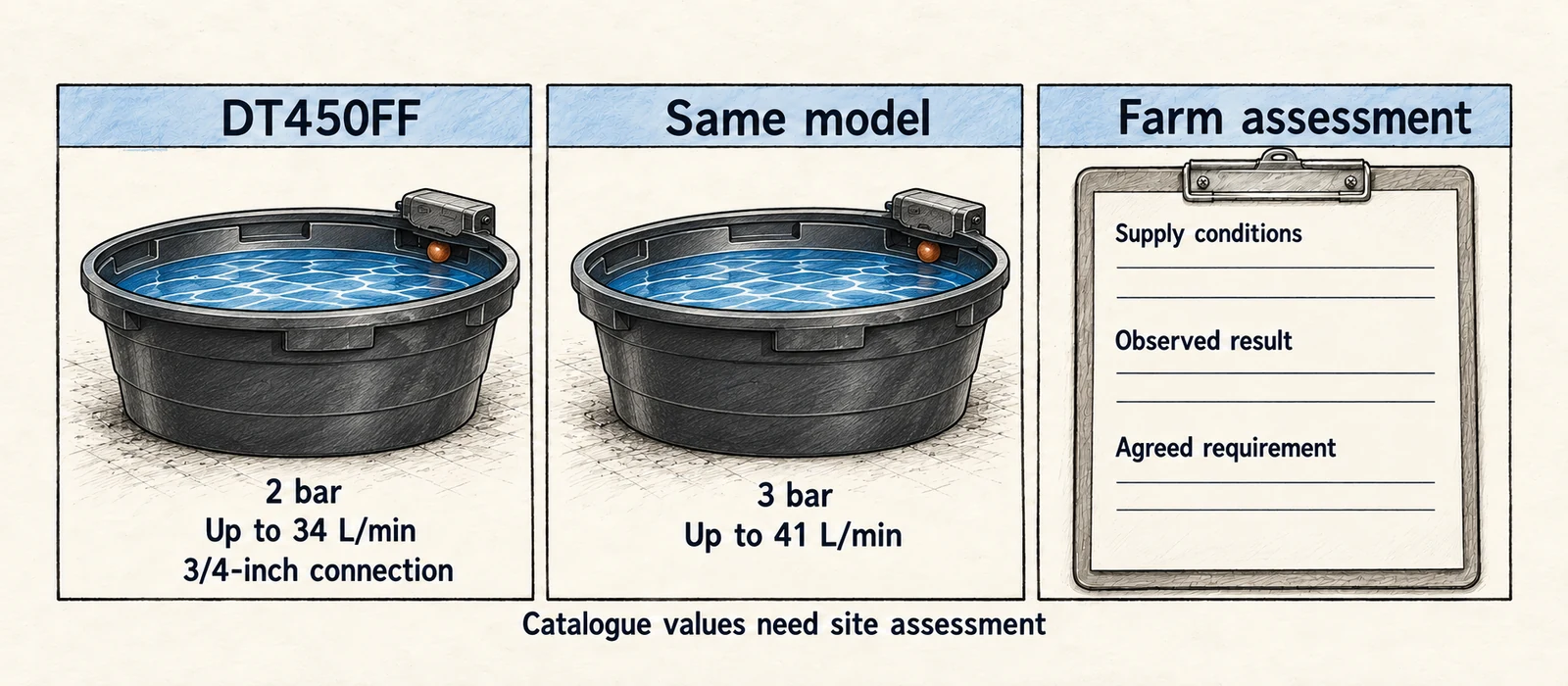
For example, JFC Agri lists its DT450FF valve at up to 34 L/min at 2 bar with a ¾-inch connection, and up to 41 L/min at 3 bar. These are catalogue values for that model at stated pressures. Neither figure establishes what an installed unit will deliver at the farm.
| DT450FF catalogue condition | Listed valve flow | Use in the comparison |
|---|---|---|
| 2 bar; ¾-inch connection | Up to 34 L/min | Retain the pressure and connection beside the rate. |
| 3 bar | Up to 41 L/min | Keep this as a different pressure condition for the same model. |
| Proposed farm installation | To be established | Ask for the applicable supply assessment and agreed observation conditions. |
Keep the comparison conditional
If a quotation gives a refill rate without its pressure condition, request the missing basis before comparing performance. Keep the catalogue figure and the farm assessment in separate fields.
The Ritchie OmniMaster manual calls for supply-line design to account for distance-related pressure loss. Its low-flow guidance also considers pressure loss while the valve is open. Ask the installer to resolve supply suitability, not merely confirm that a connection is present.
Compare the physical handover too: connection location, mounting arrangement, drain outlet, service access and the space needed for the chosen cleaning mechanism. Ask the supplier to identify those features on the proposed site sketch, with any installation work shown in the quotation.
For winter use, obtain the exact configuration’s protection requirements. The Ritchie OmniMaster manual addresses the supply line, base sealing and heater checks; a frost-resistant tank material alone does not establish winter readiness of the installed system.
For its equipment, Ritchie requires qualified electrical installation under applicable codes and restricts access-panel removal to service or similarly qualified personnel. Assign that work to the installation scope.
Review Access, Inspection and Cleaning Responsibilities
Choose a cleaning arrangement that staff can use in the proposed position. Ask to see the emptying mechanism, drain access and valve-service approach, then check the space those actions need against the site sketch.
Two documented features suggest different questions. JFC Agri describes its floor-standing TOT1 as a tip-over trough for emptying and cleaning. For that arrangement, ask where the trough moves and where discharged water will go. Its JFC Agri DT450FF page identifies a drain fitting and accessible valve compartment; ask whether the installed position preserves access to both.
Request a demonstration or applicable instructions for the quoted configuration. Have the intended operator identify the access they will need, any obstruction and the person responsible for resolving it. Put the cleaning task, inspection responsibility and access requirements in the handover documents.
SDSU Extension encourages easy-to-clean troughs and discusses chemical and bacterial water-quality assessment. Keep a separate field for the farm’s water-quality results and the advisor reviewing them. A convenient emptying mechanism does not answer whether the supplied water is suitable.
Write Comparable Supplier and Acceptance Records
Send the same brief and site sketch to each supplier. Ask for an itemized response against the requirements, identifying who supplies, installs and checks each interface. Record a missing answer as an open question rather than treating it as included in the price.
| Proposed comparison item | Supplier response required | Decision before ordering |
|---|---|---|
| Exact equipment and options | Model, valve/connection version, applicable documents and rated conditions. | Resolve whether the quoted configuration matches the brief. |
| Supply and installation | Assessment owner; connection, mounting, drainage and any protection or electrical work. | Identify included work, exclusions and the person accepting each interface. |
| Use and cleaning | Required access, instructions, demonstration and operator handover. | Resolve access conflicts shown on the site sketch. |
| Service and costs | Parts support, contact route, warranty scope, labor, shipping and installation materials. | Compare the same scope rather than headline equipment prices. |
| Acceptance evidence | Agreed conditions, authorized observer, records and unresolved-item process. | Agree what evidence is needed before accepting the installation. |
Exclusions can be specific. The Ritchie OmniMaster manual identifies recommended anchor bolts as not included; its limited warranty excludes labor and shipping. Ask each supplier to confirm its own scope.
Write the acceptance questions before delivery. The OmniMaster instructions include connection-leak checks and confirmation of valve function and water level. Use the applicable installer’s completion record alongside the farm’s agreed observations.
- Identify the delivered model and options against the quotation and applicable instructions.
- Record the qualified installer’s completion documents for the assigned interfaces.
- Record supply observations under the conditions agreed with the assessor, including which other uses were operating.
- Review animal approach and passing routes, plus operator access for the specified cleaning arrangement.
- Record each outstanding issue, its owner and the evidence needed to resolve it before acceptance.
Keep different results identifiable. An installer’s connection check, a supply measurement and an operator’s cleaning-access review answer different questions. Have the responsible people compare each result with the agreed requirement and retain any restriction with the handover.
Choose against the resolved brief
Select the model whose documented configuration, installation scope and agreed acceptance evidence meet the farm’s requirements. If a supply, access or scope question remains open, resolve it before treating the lower price as the better fit.
References
- AIG Machinery (aigmachinery.com) — Dairy industry solutions provider supplying the linked whole-farm equipment context for coordinating drinking-water procurement with other farm systems and utility interfaces.
- South Dakota State University Extension (SDSU Extension) — Provides dairy guidance on variable drinking needs, feeding and milking access, cleaning provisions and water-quality assessment used to frame the procurement brief.
- University of Nebraska–Lincoln Extension (Nebraska Extension) — Provides the dairy access-problem and drinking-device measurement context used to distinguish a proposed site survey from upstream supply figures.
- JFC Agri (JFC Agri) — Supplies the model-specific DT450FF pressure and refill examples and the TOT1 tipping arrangement used to examine catalogue conditions, drainage and cleaning access.
- Ritchie Industries, Inc. (Ritchie) — Supplies installation guidance and the OmniMaster manual used for supply-interface questions, qualified work, configuration-specific checks and quotation exclusions.