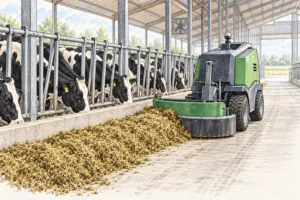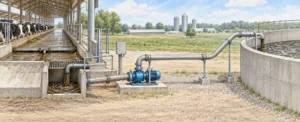
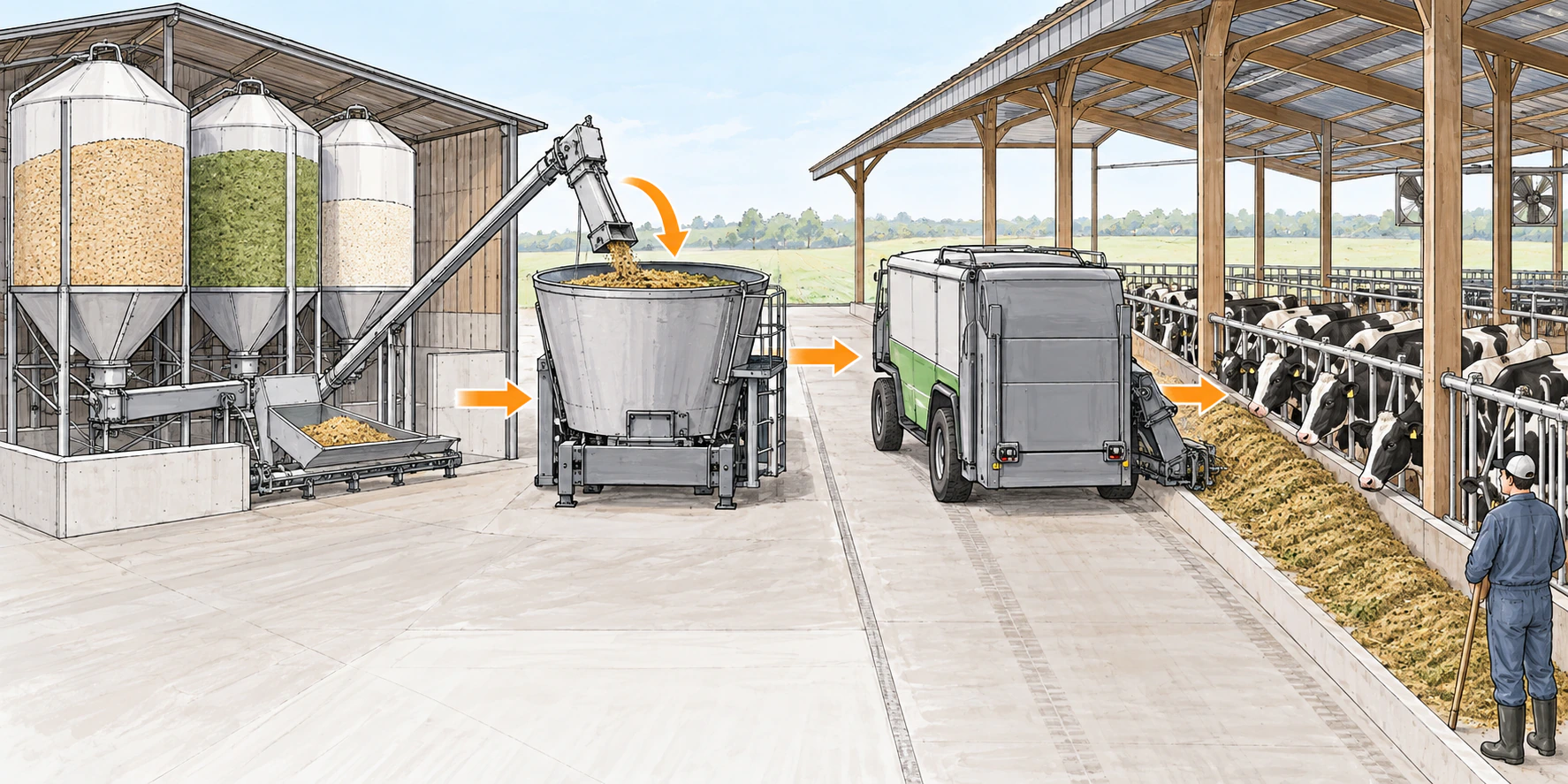
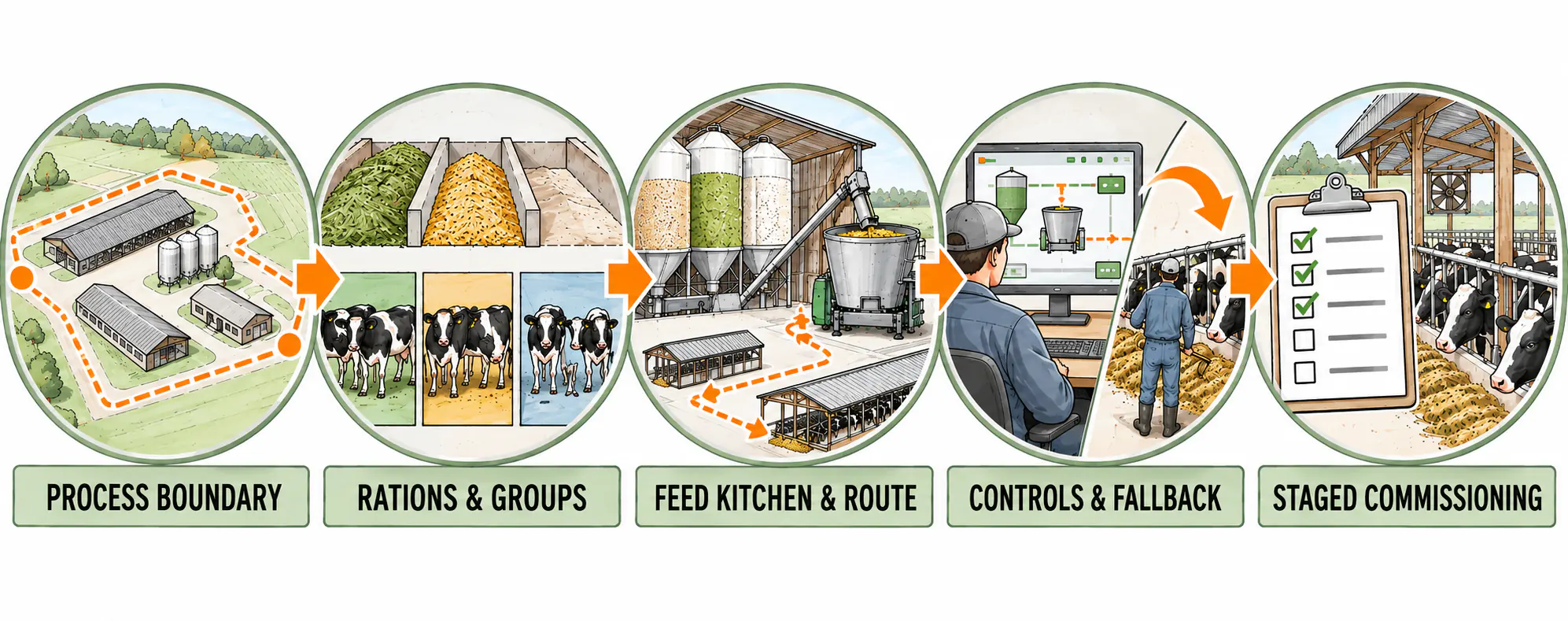
An automatic feeding system should be selected as a complete workflow, not as a standalone robot. The farm must define where automation starts, where it ends, which rations and groups it serves, how ingredients reach the mixer, how prepared feed reaches each bunk, and how feeding continues after a fault.
That process-first definition keeps unlike proposals from appearing equivalent. One project may automate only weighing, mixing, and delivery from a manually replenished feed kitchen. Another may add ingredient retrieval, multiple storage interfaces, feed pushing, and data exchange. Neither scope is automatically better; the correct scope is the one that performs the farm’s defined job and can be operated, cleaned, maintained, and recovered.
Define the Automatic Feeding System Boundary
Begin with the existing feeding process. Map each ration from ingredient receipt to refusal handling, and identify the equipment, person, control point, and recurring problem at every step. Then write two sentences: “The project starts at ___ and ends at ___,” and “When the system is unavailable, feeding continues by ___.”
A complete process map may include:
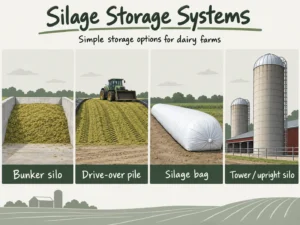
- ingredient receiving and preserved storage;
- transfer to temporary stores or dosing points;
- weighing and recipe control;
- processing and mixing;
- transport to the correct feeding group;
- distribution along the bunk;
- pushing feed back within reach;
- refusal handling and operating records.
Do not assume every quoted automatic feeding system includes every step. The peer-reviewed AFS review available through PMC describes several automation levels and delivery architectures, from stationary preparation feeding a delivery unit to more integrated preparation-and-distribution arrangements. It also identifies ingredient access, cleaning, maintenance, preservation, route, slope, and building fit as planning issues.
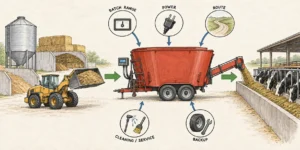
Keep related functions distinct when assigning responsibility. A TMR mixer prepares the ration. Feed distribution equipment transports and places prepared feed. Feed pushing equipment repositions feed already at the bunk. A project may combine them, but the quotation, controls, drawings, and acceptance plan should name each included interface.
Turn Rations and Groups into System Requirements
Automation cannot correct an undefined feeding program. Build a schedule for every ration and group before choosing architecture. Use the farm’s current nutrition program and measured records; do not fill blank inputs with brochure assumptions.
| Requirement | Farm record | Supplier evidence required |
|---|---|---|
| Feeding groups | Group names, animal count range, location | Every destination and identification method |
| Rations | Recipe owner, ingredient list, smallest controlled addition | Supported ingredients, dosing method, weighing resolution |
| Batches | Smallest and largest normal batch, peak sequence | Usable batch range and complete busiest-period test |
| Delivery | Time windows, number of deliveries, target distribution | Route time and delivered-weight record under site conditions |
| Feed condition | Moisture variation, fiber length, density, stickiness | Representative-feed handling and discharge test |
| Changes | Group moves, substitutions, ration revisions | Authorization, version history, and interrupted-batch rules |
University of Minnesota Extension identifies dry matter, group count, daily intake, loading order, mixing time, feed availability, refusals, particle size, and scale calibration as daily TMR controls. Those inputs still matter after automation. Recipe software cannot detect every forage change, correct an unsuitable loading sequence, or replace nutrition oversight unless the purchased scope contains a validated method for that exact task.
Ask how the system records requested, weighed, mixed, discharged, and delivered quantities. Clarify how manual additions and substitutions are entered, how an over- or under-weight ingredient is handled, and whether an interrupted batch can be identified before discharge. Selecting an automatic feeding system without these answers moves uncertainty into daily operation.
More frequent, smaller deliveries may help manage freshness in some conditions. University of Wisconsin–Madison Division of Extension pairs that practice with stored-feed stability, spoilage monitoring, suitable feed-out, and delivery timing during heat. Frequency should therefore come from the farm’s ration, climate, storage, bunk, and labor plan—not from the maximum number of trips a machine can advertise.
Match the Feed Kitchen and Delivery Route to the Site
The feed kitchen is part of the system, not unused space around the mixer. Record how ingredients are replenished, protected, identified, accessed for inspection, and safely removed after a blockage. Provide room for cleaning and maintenance around stores, conveyors, dosing devices, scales, processing equipment, and the mixer. Define who owns dust control, drainage, lighting, guarding, electrical work, and building alterations.
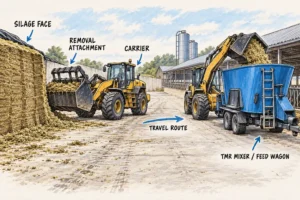
Survey the entire delivery route under normal farm activity. Capture the narrowest passage, lowest clearance, tightest turn, floor surface, slope, drains, door and gate logic, outdoor exposure, cross traffic, animal access, charging or power point, and any route blocked during scraping, bedding, or maintenance. For suspended equipment, require structural review for the actual loads and support arrangement. For mobile units, require the navigation and stopping method to be demonstrated at the limiting locations.
Use a dimensioned interface register:
| Interface | System supplier | Farm or other contractor | Acceptance evidence |
|---|---|---|---|
| Main storage to temporary store | Ingredient moves without contamination or uncontrolled loss | ||
| Store to dosing/weighing | Correct source, recorded weight, fault response | ||
| Weighing to mixer | Recipe sequence and batch identity preserved | ||
| Mixer to delivery unit | Complete discharge, residual check, safe access | ||
| Delivery unit to each group | Correct ration, route, side, placement, and record | ||
| Doors, gates, charger, network | Coordinated control and defined failure state |
If an interface has no named owner, it is a commissioning risk. The wider dairy farm equipment plan should also account for shared routes, utilities, cleaning systems, and future barn changes rather than treating feeding automation as an isolated installation.
Specify Controls, Safety, Data, and Failure Recovery
The control specification should explain decisions, not just list screens. Define who may create or approve recipes, change schedules, release a stopped batch, bypass an unavailable component, acknowledge alarms, and access the system remotely. Request a data dictionary showing units and meanings for requested weight, actual weight, batch identity, destination, delivery status, alarm, intervention, and configuration change.
For each critical failure, write the automatic response and the farm response before purchase:
| Failure | Safe system state | Operator decision | Temporary feeding method |
|---|---|---|---|
| Ingredient unavailable or wrong identity | Stop or hold the affected recipe | Verify stock and approved substitution | Documented manual or alternate recipe process |
| Scale or dosing fault | Prevent unverified ingredient addition | Isolate, inspect, and follow approved recovery | Calibrated backup weighing method if defined |
| Mixer or discharge fault | Preserve batch identity and prevent unsafe access | Decide safe emptying or repair route | Separate prepared-feed source or backup mixer |
| Delivery route blocked | Stop before conflict and retain destination | Clear through approved procedure or reschedule | Compatible manual delivery route |
| Power, network, or control loss | Move to documented fail-safe condition | Determine which functions remain available | Offline instructions, connection points, and trained staff |
The automatic feeding system must not make internet access the only path to safe operation or recovery unless the farm has explicitly accepted that dependency and provided another feeding method. Confirm emergency stops, isolation points, guards, obstacle response, restart rules, manual movement, cleaning access, configuration backup, spare parts, and technician escalation using the exact system documentation and site risk assessment.
Data should answer operational questions: Was the planned batch completed? Which ingredients and actual weights were recorded? Which group received it? Was delivery interrupted? Who changed a recipe or schedule? Can the farm export the history in a documented format? A dashboard without retrievable evidence is weak support for troubleshooting or supplier acceptance.
Compare Proposals and Commission the Complete Workflow
Normalize every automatic feeding system proposal to the same functional boundary. Separate equipment price from ingredient stores, conveyors, scales, processing, mixer, delivery units, navigation infrastructure, charger, electrical work, controls, software, licenses, safety devices, building work, installation, commissioning, training, manuals, backups, spares, and service. Record exclusions and farm-supplied work beside each item.
Do not award performance credit for an unsupported milk, feed, labor, energy, or payback claim. A 2025 observational study of 16 upper-Midwest commercial dairies, available through PMC, associated automated feeding robots with lower daily variation in feed-bunk dry matter and fiber concentrations. It found no difference in bulk-tank milk fat or protein, and the authors identified sample size and uncontrolled management factors as limitations. That is useful evidence for investigating ration consistency, not proof of a universal production return.
Commission the selected automatic feeding system in stages:
- Approve drawings, functional descriptions, I/O lists, recipe and user-role plans, manuals, and test methods.
- Verify mechanical, electrical, control, guarding, cleaning, and maintenance completion.
- Test each ingredient source, dosing point, scale, interlock, alarm, and batch record without hiding deviations.
- Run the smallest and largest planned recipes with representative ingredients and documented conditions.
- Deliver to every group through every route, including normal doors, crossings, slopes, charging, and concurrent farm work.
- Demonstrate agreed faults, interrupted-batch recovery, safe isolation, manual or degraded feeding, data export, and configuration restore.
- Record training, documents, spares, open defects, corrective action, owner, and retest result before acceptance.
After startup, review actual batch deviations, missed or delayed deliveries, alarms, manual additions, cleaning time, service response, feed condition, refusals, and whether the backup remains usable. An automatic feeding system is ready only when its complete boundary works under the farm’s defined conditions and staff can recognize, contain, and recover from failure.